home/ plants/ royal-catchfly

// SPECIES PROFILE · PERENNIAL · NATIVE · RARE · HUMMINGBIRD-POLLINATED

Royal Catchfly

Silene regia

Royal Catchfly is the reddest flower in the tallgrass prairie — a stunning perennial with upright stems 2–4 ft tall and clusters of five-petaled, star-like flowers of an almost impossibly intense scarlet, a color so saturated it seems to vibrate against the green and gold of the summer prairie. The calyx is sticky, trapping small insects and giving the plant its common name (catchfly), though the stickiness is thought to deter ants and other crawling nectar thieves rather than to capture prey. Silene regia is primarily pollinated by ruby-throated hummingbirds, whose long bills and hovering flight match the flower's tubular-throated calyx and horizontal orientation perfectly. Once widespread across the tallgrass prairie from Ohio to Kansas and south to Arkansas, it is now rare and declining due to habitat loss, fire suppression, and prairie fragmentation. In NE Oklahoma, it survives in dry, rocky prairie remnants in the Osage Hills and Cross Timbers — a living fragment of the prairie that was, and a plant whose garden cultivation is an act of conservation.

// QUICK FACTS
Family
Caryophyllaceae (pink / carnation family)
Life cycle
Herbaceous perennial
Native range
Central and eastern US tallgrass prairie region — Ohio to Kansas, south to Arkansas and Oklahoma
USDA hardiness
Zones 4–8 (Tulsa = 7a/7b)
Mature size
2–4 ft tall, 1–1.5 ft wide; upright, clump-forming
Bloom
June – August (NE OK); peak in July
Flower color
Brilliant scarlet-red; one of the few true red-flowered prairie natives
Sun
Full sun to very light shade
Soil
Dry to medium, well-drained; thrives in rocky, limestone-derived prairie soils
Water
Dry to medium; drought-tolerant; do not overwater
Wildlife
Primarily hummingbird-pollinated · occasional butterfly nectar
Conservation
NatureServe G3 (Vulnerable); rare and declining across range; tracked by OK Natural Heritage Inventory
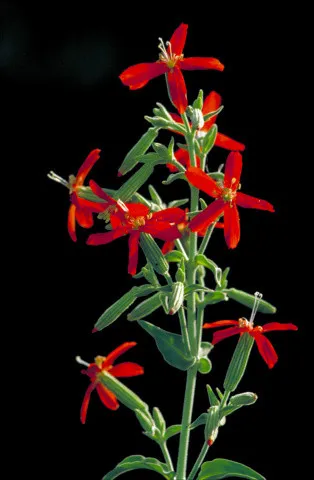
Royal Catchfly (Silene regia) with clusters of brilliant scarlet five-petaled flowers
Silene regia in peak summer bloom — the most intense scarlet of any prairie native, pollinated by ruby-throated hummingbirds. Photo: Rooted Revival.

Identification

[ field key — stem · leaf · flower · sticky calyx · distinguishing features ]

Habit & Stem

An upright, clump-forming perennial 2–4 ft tall with one to several stiff, erect stems arising from a woody rootstock. Stems are round, finely hairy, and typically unbranched below the inflorescence, with swollen nodes that are characteristic of the Caryophyllaceae. The plant has a sparse, open architecture — it is not a dense or bushy plant, but rather a few vertical stems with flowers clustered at the top, rising above the surrounding prairie grasses. The root system is a stout taproot with fibrous lateral roots, making the plant drought-tolerant but difficult to transplant once established.

Leaves

Leaves are opposite, lanceolate to narrowly ovate, 2–5 in long and 1/2–1.5 in wide, with entire (smooth) margins and an acute tip. The leaf surface is grayish-green to medium green and covered in fine, soft hairs (pubescent) on both surfaces, giving the foliage a slightly velvety texture. Basal leaves are larger and broader; stem leaves become progressively smaller and narrower up the stem. Leaves are sessile or clasping at the base, without a distinct petiole. The foliage has no noticeable scent when crushed.

Flowers: Structure & Color

The inflorescence is a loose, open terminal cyme of 3–15+ flowers on short pedicels. Each flower is a remarkable 1–1.5 in across, with five deeply notched (bifid) petals that spread flat to form a star-like shape. The petals are an intense, pure scarlet-red — not orange-red, not pink-red, but a saturated crimson that is rare among native prairie plants and indeed among all North American wildflowers. The center of the flower has a small, pale eye where the reproductive parts are clustered. Beneath the petals, the calyx is tubular, 5-toothed, and covered in sticky, glandular hairs that trap small insects (hence the name "catchfly"). The flowers are largely unscented to humans — hummingbirds are visual foragers, not scent-based foragers.

Hummingbird Pollination Syndrome

The flower of Silene regia exhibits classic ornithophilous (bird-pollinated) traits: bright red color (the hummingbird's preferred visual target), a tubular calyx that holds nectar at its base, flowers held horizontally or slightly nodding on stiff pedicels that support the weight of a hovering bird, abundant dilute nectar, and a flowering period that coincides with the peak of the ruby-throated hummingbird's breeding season in the central US. The stamens and pistil extend beyond the petals, depositing pollen on the hummingbird's forehead as it probes for nectar. This is one of the few Oklahoma prairie plants specifically adapted for hummingbird pollination — a specialized ecological relationship that makes the plant's decline particularly concerning for hummingbird conservation along the central flyway.

Sticky Calyx & "Catchfly" Function

The sticky, glandular hairs on the calyx and upper stem are a defining feature of the genus Silene and the source of the common name "catchfly." The stickiness is thought to function as a defensive adaptation: it traps ants and other small crawling insects that would steal nectar without effecting pollination (nectar robbery). By preventing ants from accessing the nectar, the plant reserves the reward for its legitimate pollinators — hummingbirds and, secondarily, large butterflies. The trapped insects on the calyx are not digested or absorbed; the plant is not carnivorous. The stickiness may also deter aphids and other small herbivorous insects.

Seasonal Cycle in NE Oklahoma

Emerges from the ground in April, producing a basal rosette of leaves and then sending up flowering stems in May. Grows steadily through May and June. Flower buds appear in mid-June, and the first flowers open in late June to early July. Peak bloom is in July, with flowering continuing through August and sometimes into early September if conditions are favorable. After flowering, the plant produces dry capsules full of small, dark seeds. Foliage is killed by frost in late October or November. The plant is long-lived — individual crowns can persist for a decade or more in suitable habitat.

Habitat & Range in NE Oklahoma

Silene regia is a tallgrass prairie endemic, historically ranging from Ohio and Indiana west through Illinois, Missouri, and Iowa to eastern Kansas and Nebraska, and south to Arkansas and Oklahoma. It has been extirpated from much of its historic range, particularly in the eastern (Ohio, Indiana, Illinois) and northern portions, due to conversion of prairie to agriculture and fire suppression. In Oklahoma, it occurs in dry, rocky, limestone-derived prairie remnants in the far northeastern part of the state, primarily in the Osage Hills and adjacent tallgrass prairie fragments that escaped the plow.

In NE Oklahoma, Royal Catchfly is associated with dry-mesic to dry tallgrass prairie on shallow, well-drained soils over limestone. It is often found growing with big bluestem, little bluestem, indiangrass, switchgrass, purple prairie clover, leadplant, and butterfly milkweed. It also occurs in open post-oak woodlands of the Cross Timbers where the canopy is thin and prairie grasses persist beneath the trees. The species is likely present in the Tallgrass Prairie Preserve in Osage County and in prairie remnants throughout the Osage Hills. It is not a common plant anywhere in Oklahoma — encountering it in the wild is a genuine botanical event.

Ecology & Wildlife Value

[ hummingbird pollination · fire ecology · conservation status · prairie specialist ]

Ruby-Throated Hummingbird Pollination

The primary pollinator of Silene regia is the ruby-throated hummingbird (Archilochus colubris), the only hummingbird species that breeds in eastern North America and the species commonly seen in NE Oklahoma from April through September. The flowers are adapted specifically for hummingbird pollination: the scarlet color is invisible to most insects but highly visible to birds; the tubular calyx holds nectar where only a long bill or tongue can reach it; the flower orientation and pedicel strength support a hovering bird; and the bloom period (June–August) coincides precisely with the period when hummingbirds are nesting and feeding young in Oklahoma. Large butterflies, particularly swallowtails, occasionally visit for nectar, but they are secondary pollinators at best.

Fire Ecology & Decline

Like most tallgrass prairie species, Royal Catchfly is fire-adapted and fire-dependent. Periodic burning removes woody encroachment, releases nutrients, exposes mineral soil for seedling establishment, and reduces competition from cool-season exotic grasses. Fire suppression is the primary cause of the species' decline across its range: without fire, the open prairie habitat Royal Catchfly requires is invaded by eastern redcedar (Juniperus virginiana), post oak, and other woody species that shade out the understory. In managed prairie restorations and preserves, prescribed fire every 2–4 years benefits this species significantly, and populations often respond with increased flowering and seedling recruitment after a burn.

Conservation Status

Silene regia is ranked G3 (Vulnerable) globally by NatureServe, meaning it is at moderate risk of extinction due to a restricted range, relatively few populations, and ongoing declines. It is state-listed or tracked in nearly every state where it occurs. In Oklahoma, it is tracked by the Oklahoma Natural Heritage Inventory and is considered rare and of conservation concern. The primary threats are habitat loss (conversion of prairie to agriculture and development), fire suppression (woody encroachment), and habitat fragmentation (small, isolated populations are vulnerable to genetic drift and local extinction). Garden cultivation of nursery-propagated stock (never wild-collected plants) is one valuable way to support the species' long-term survival by creating additional populations in the landscape.

Insect Associations

Beyond hummingbirds, Silene regia hosts a small but specific insect fauna. The seed capsules are fed upon by larvae of certain caryophyllaceous-specialist moths, including species in the genera Perizoma and Hadena, whose relationships with Silene and related genera are the subject of active ecological research. The sticky calyx, while deterring nectar-robbing ants, also incidentally traps small flies and gnats, which may provide a minor nutrient subsidy to the plant as their bodies decompose on the stem — a phenomenon known as indirect nutrient acquisition observed in several Silene species.

Growing Royal Catchfly is an act of conservation. Every Royal Catchfly in a home garden is one more plant in a world that has fewer of them every year. Source plants only from reputable native plant nurseries that propagate from cultivated stock — never buy wild-collected plants or seeds, and never dig plants from wild populations. If you have a dry, sunny, well-drained site and are willing to provide the occasional prescribed burn (or simulated burn through mowing and raking), you can be part of this plant's recovery.

Horticulture & Care

[ site · soil · drought tolerance · propagation · conservation gardening ]

Site Selection & Soil

Royal Catchfly requires full sun and excellent drainage. The ideal site is a dry, rocky, or sandy slope with limestone-derived soil, mimicking the prairie remnants where it naturally occurs. It will not tolerate heavy, wet clay or soils that stay saturated after rain — root rot is the most common cause of death in garden settings. If you have heavy clay, plant it in a raised bed, rock garden, or berm amended with coarse sand and limestone gravel to improve drainage. A south- or west-facing slope is ideal.

Fire Substitute Maintenance

In the absence of prescribed fire, simulate its effects by cutting back dead stems to ground level in late winter (February) and removing the cut material to expose the soil surface. This emulates the effects of a burn: removal of thatch, exposure of mineral soil for seedling germination, and warming of the crown in early spring. Do not leave heavy mulch or leaf litter on the planting area — it smothers the crown and encourages rot.

Propagation

Royal Catchfly is difficult to propagate and this is one reason it is still relatively rare in cultivation. Seeds require cold-moist stratification for 60–90 days and should be surface-sown (they need light to germinate). Sow in fall or stratified seed in spring. Germination is often low and sporadic, and seedlings are slow to reach flowering size (2–3 years from seed). The plant does not divide easily due to its taproot and resents transplanting once established. For the home gardener, purchasing nursery-grown plants is the most reliable path to establishment.

Companion Plants for Dry Prairie Gardens

In a dry prairie or rock garden, plant Royal Catchfly with butterfly milkweed, purple prairie clover, little bluestem, prairie dropseed, pale purple coneflower, rattlesnake master, leadplant, Indian blanket, and lance-leaf coreopsis. This replicates the species composition of a dry tallgrass prairie remnant and provides a succession of blooms from spring through fall. The scarlet of Royal Catchfly in July is complemented by the orange of butterfly milkweed (blooming somewhat earlier) and the yellow of coreopsis and black-eyed Susan.

Never wild-collect. Royal Catchfly is rare and declining. Purchasing wild-collected plants threatens remaining wild populations. Only buy from nurseries that clearly label their stock as "nursery-propagated" or "cultivated." Ethical native plant nurseries will be transparent about their propagation methods.

Cultivation as Conservation

Growing Silene regia in your garden is more than horticulture — it is a direct contribution to the conservation of a declining species. Every garden-grown Royal Catchfly increases the total global population of this plant, provides nectar for migrating hummingbirds, and produces seeds that can be shared with other gardeners and restoration projects. The network of native plant gardens across NE Oklahoma forms a dispersed ex-situ conservation population that buffers the species against catastrophic loss of any single wild population — a concept known as conservation gardening or participatory conservation. When you plant a Royal Catchfly, you are not just decorating your yard. You are taking a small but real action against the extinction of a piece of the tallgrass prairie.

Photo Reference

Close-up of Silene regia flower showing five deeply notched scarlet petals
// Flower — five deeply notched scarlet petals, star-like form
Wikimedia Commons
Wikimedia Commons
Sticky glandular calyx of Silene regia with trapped small insects
// Sticky calyx — glandular hairs trap small insects
Wikimedia Commons
Wikimedia Commons
Silene regia plant in full bloom showing upright stems and flower clusters
// Habit — 2–4 ft, upright, sparse architecture, flowers in terminal clusters
Wikimedia Commons
Wikimedia Commons
Ruby-throated hummingbird nectaring at Silene regia flowers
// Archilochus colubris (ruby-throated hummingbird) — the primary pollinator
Wikimedia Commons
Wikimedia Commons
Dry seed capsules of Silene regia after flowering
// Seed capsules — dry capsules with small dark seeds
Wikimedia Commons
Wikimedia Commons

Sources & Further Reading

  • USDA NRCS PLANTS Database — Silene regia: plants.usda.gov/plant-profile/SIRE2
  • Lady Bird Johnson Wildflower Center — Native Plant Database: wildflower.org — SIRE2
  • NatureServe Explorer — Silene regia conservation status (G3): explorer.natureserve.org
  • Oklahoma Natural Heritage Inventory — Rare and Endangered Species tracking list: biosurvey.ou.edu
  • Missouri Botanical Garden — Silene regia Plant Finder: missouribotanicalgarden.org
  • Fenster, C.B. et al. (2015). The reproductive ecology and conservation of Silene regia. Natural Areas Journal 35(2):278–286.
  • Gleason, H.A. & Cronquist, A. (1991). Manual of Vascular Plants, 2nd ed. New York Botanical Garden.
  • Wikipedia — Silene regia: en.wikipedia.org/wiki/Silene_regia (CC BY-SA 4.0; portions of the description and ecology sections summarize Wikipedia content).
  • Packard, S. & Mutel, C.F. (1997). The Tallgrass Restoration Handbook. Island Press — fire ecology and prairie restoration context.

Hero photo: Rooted Revival. Strip photos courtesy of Wikimedia Commons contributors under their respective licenses (linked under each image).