home/ plants/ narrow-leaved-coneflower

// SPECIES PROFILE · PERENNIAL · NATIVE · MEDICINAL ICON · DROUGHT-PROOF

Narrow-Leaved Coneflower

Echinacea angustifolia

Narrow-Leaved Coneflower is the prairie Echinacea that matters most — the species whose root was the primary medicinal Echinacea used by the Indigenous peoples of the Great Plains, including the Cheyenne, Lakota, Kiowa, Comanche, and Pawnee, and the one most utilized in early commercial Echinacea preparations. It is a slender, drought-proof perennial 1–2.5 ft tall with narrow, hairy, linear leaves and pale pink-to-lavender drooping ray petals around a spiny, cone-shaped disk. Echinacea angustifolia is a plant of the dry, rocky, calcareous prairies of the Great Plains, reaching the western edge of the Cross Timbers in Oklahoma. It is more drought-tolerant than Echinacea purpurea and better adapted to the thin, alkaline, limestone-derived soils found on glades and prairie remnants in the western portion of NE Oklahoma. The root's characteristic numbing sensation (from alkylamides) is used by herbalists to verify identity and potency.

// QUICK FACTS
Family
Asteraceae (sunflower / daisy family)
Life cycle
Long-lived herbaceous perennial
Native range
Great Plains: from Texas north to Saskatchewan, east to Iowa and Minnesota; western Oklahoma extending into the Cross Timbers
USDA hardiness
Zones 3–8 (Tulsa = 7a/7b)
Mature size
1–2.5 ft tall, 0.75–1.5 ft wide
Bloom
June – August (NE OK)
Flower color
Pale pink to lavender, drooping (reflexed) ray petals; spiny brown-orange disk
Sun
Full sun
Soil
Dry, well-drained; sandy, rocky, or calcareous; tolerates limestone clay
Water
Low; extremely drought-tolerant
Wildlife value
Native bee forage · butterfly nectar · goldfinch seed · medicinal plant
Conservation
G4 — apparently secure globally; populations reduced by overharvesting of wild roots; do not collect from the wild
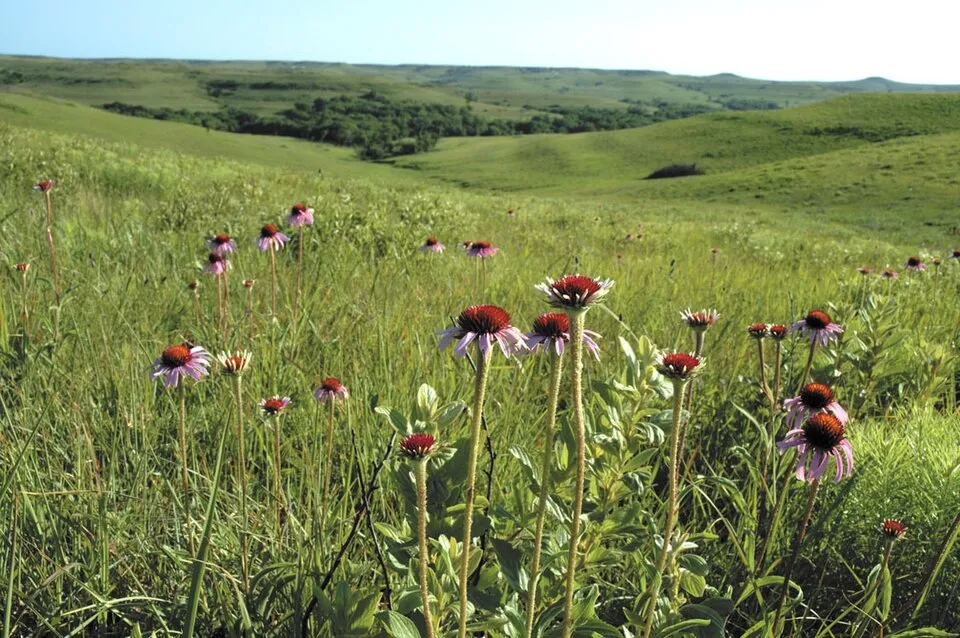
Narrow-Leaved Coneflower (Echinacea angustifolia) with pale pink drooping rays and spiny central cone
Echinacea angustifolia — the drooping pale pink ray petals and narrow, hairy leaves distinguish it from E. purpurea. Photo: Rooted Revival.

Identification

[ field key — habit · leaf · flower · fruit · distinguishing from E. purpurea and E. pallida ]

Habit & Stem

Slender, upright perennial from a thick, deep-branching taproot. Stems are erect, rough-hairy (hispid), and unbranched, typically producing a single flower head per stem. The plant is smaller and less robust than E. purpurea, with a more open, airy silhouette. Multiple stems arise from a woody crown atop the taproot. The plant dies back to the ground each winter and re-emerges in late spring, typically several weeks later than E. purpurea. The taproot can extend 4–6 ft deep in its native prairie habitat, accounting for the plant's legendary drought tolerance.

Leaves

Narrow, linear to narrowly lance-shaped, 2–8 in long and ¼–¾ in wide, with entire margins and three prominent parallel veins. Both surfaces are covered with stiff, spreading hairs (hispid). The leaves are concentrated near the base of the plant and along the lower stem. This narrow, linear leaf form is the key field character distinguishing E. angustifolia ("narrow-leaf") from E. purpurea (which has broadly ovate, coarsely toothed leaves) and from E. pallida (which also has narrower leaves but with longer, more reflexed ray petals).

Flowers

Composite flower heads 2–4 in across, with 12–20 pale pink to lavender ray florets that are shorter and less reflexed (less drooping) than those of E. pallida. The rays surround a prominent, spiny, dome-shaped to conical central disk that is orange-brown to dark brown at maturity. The genus name Echinacea derives from the Greek echinos (hedgehog or sea urchin), referring to the spiny disk. Flowers are fragrant, with a sweet, honey-like scent, and are highly attractive to a wide range of pollinators. The cone elongates as the season progresses, with individual florets opening in concentric rings from the bottom of the cone upward.

Root & Distinguishing Features

The root is thick, woody, dark brown to black on the outside and white to pale yellow inside, with a characteristic tingling, numbing sensation on the tongue (caused by alkylamides, the compounds responsible for much of the plant's immunostimulatory activity). This tongue-tingle test is used by herbalists to verify the identity and potency of Echinacea root. E. angustifolia roots are more potent in alkylamides than E. purpurea roots, which is why this species was historically preferred for medicinal use. The root odor is faintly aromatic. The species epithet angustifolia means "narrow-leaved."

Habitat & Range in NE Oklahoma

Echinacea angustifolia is a classic plant of the mixed-grass and tallgrass prairies of the Great Plains, with a range extending from Texas north into Saskatchewan and east to the tallgrass prairie of Iowa and Minnesota. In Oklahoma, it is most abundant in the western tallgrass and mixed-grass prairies, reaching the western margins of the Cross Timbers in the central and north-central portions of the state. In NE Oklahoma, it is less common than E. purpurea and is generally restricted to dry, rocky, calcareous (limestone-derived) prairie remnants and glade-like openings on the western periphery of the region.

Look for it on limestone glades, rocky prairie hillsides, and thin-soiled calcareous outcrops in Osage County and along the western borders of Rogers and Tulsa counties. It is frequently associated with little bluestem, sideoats grama, big bluestem, and a community of drought-tolerant forbs. The species has been significantly reduced by overharvesting of wild roots for the medicinal herb trade, and wild populations should never be dug. Cultivated sources are widely available from native plant nurseries, and home cultivation is the responsible way to grow this species.

Ecology & Wildlife Value

[ pollinators · lepidoptera · birds · medicinal trade pressure ]

Pollinators

The fragrant, nectar-rich flowers attract a broad diversity of native bees. Bumblebees (Bombus spp.), long-horned bees (Melissodes), leafcutter bees (Megachile), sweat bees (Lasioglossum, Agapostemon), and mining bees (Andrena) are common visitors. Honeybees forage heavily when hives are nearby. Syrphid flies and small solitary wasps also visit. The spiny central disk provides a stable landing platform for larger bee species, and the long bloom period (6–8 weeks) provides a sustained nectar and pollen resource through the summer.

Lepidoptera

Echinacea species are larval hosts for the silvery checkerspot (Chlosyne nycteis) and several moths. Adult butterflies nectaring on the flowers include painted ladies, red admirals, eastern-tailed blues, and various skippers and sulphurs. The large, stable flower heads make Echinacea one of the most accessible nectar sources for butterflies in the prairie garden.

Birds

American goldfinches feed heavily on the achenes from late summer through fall, perching on the spiny cones and extracting seeds with their specialized bills. Field sparrows and other granivorous songbirds also consume the seeds. The stiff, persistent stems and cones provide winter interest and cover for overwintering beneficial insects including native bee larvae that nest in hollow stems.

Conservation Note

E. angustifolia populations have been significantly reduced across much of its range by commercial wild-harvesting of roots for the herbal supplement industry. Although cultivated sources now supply most of the market, wild populations on accessible prairie remnants continue to be at risk from illegal digging. Never harvest wild Echinacea roots; always purchase from cultivated, nursery-propagated sources. The plant is easily cultivated from seed and grows well in garden settings, removing any justification for wild collection.

Horticulture & Care

[ site selection · establishment · care · companion planting ]

Site selection & establishment

Narrow-Leaved Coneflower is the Echinacea for the driest, leanest, most limestone-influenced soils on your property. It demands full sun and sharp drainage — it will not tolerate heavy, wet winter clay. Plant on a slope, in a rock garden, or in a raised bed with sandy, gravelly, or calcareous soil. It prefers slightly alkaline conditions (pH 6.8–8.0) typical of limestone-derived soils, and will struggle in acidic, organic-rich garden loam.

Care & maintenance

Once established, E. angustifolia is extremely low-maintenance. It needs no supplemental water, no fertilizer, and no staking. The deep taproot makes it nearly immune to drought once established. Cut dead stems to the ground in late winter. Do not harvest roots — cultivated plants should be left to grow and bloom, not dug for medicine. There are no significant pests or diseases. The plant is long-lived (15–25+ years on intact prairie remnants). Avoid overhead watering, which can encourage foliar diseases in humid summers.

Companion planting

For a dry, limestone-influenced prairie garden, pair with little bluestem, sideoats grama, butterfly milkweed, pale purple coneflower, Missouri coneflower, rough blazing star, aromatic aster, and wild bergamot. For a medicinal herb garden, combine with purple coneflower (E. purpurea) and yarrow for a comprehensive native medicinal planting. The pale pink flowers of E. angustifolia provide a softer color palette than the bold purple of E. purpurea, blending more subtly into a naturalistic prairie design.

Edible & Cultural Uses

Echinacea angustifolia is one of the most significant medicinal plants in the Indigenous pharmacopoeia of the Great Plains. The Cheyenne, Lakota, Kiowa, Comanche, Pawnee, Omaha, and many other Plains peoples used the root extensively as a remedy for infections, wounds, snakebites, sore throats, toothaches, and as a general tonic. The Lakota used it for tonsillitis and as a painkiller for toothaches; the Cheyenne applied chewed root to snake and spider bites; the Kiowa used a root decoction for coughs and sore throats; and the Comanche used it as a general preventative medicine. The characteristic tingling/numbing sensation of the root (caused by alkylamides) was considered a sign of potency.

The species was introduced to European-American medicine by H.C.F. Meyer, a German immigrant who learned of its use from Plains Indigenous peoples and marketed "Meyer's Blood Purifier" in the 1870s. It became one of the most widely used herbal medicines in the United States by the late 19th century, known as "Black Sampson" or "Kansas Snakeroot," and was included in the US National Formulary until 1950. Modern research has confirmed the presence of immunostimulatory alkylamides, polysaccharides, and caffeic acid derivatives that support many of the traditional uses, particularly for upper respiratory infections and immune system modulation.

Cultivation note: If you want to grow Echinacea for home medicine, E. purpurea is the better choice — it is faster-growing, produces more root biomass, and is more easily cultivated and harvested without damaging wild populations. Reserve E. angustifolia for its ecological and horticultural value, and leave wild populations strictly alone. Never purchase wild-harvested Echinacea root; always verify that products are made from cultivated sources.

Photo Reference

Close-up of Echinacea angustifolia pale pink flower head
// Flower — pale pink drooping rays, spiny orange-brown central disk
Wikimedia Commons
Wikimedia Commons
Narrow, linear, hairy leaves of Echinacea angustifolia
// Leaves — narrow, linear, with three parallel veins and stiff hairs
Wikimedia Commons
Wikimedia Commons
Echinacea angustifolia plant in dry prairie
// Plant habit — slender, 1–2.5 ft tall on dry calcareous prairie
Wikimedia Commons
Wikimedia Commons
Medicinal taproot of Echinacea angustifolia
// Root — the thick, medicinal taproot; DO NOT harvest wild roots
Wikimedia Commons
Wikimedia Commons
Echinacea angustifolia in mixed-grass prairie with little bluestem
// Habitat — mixed-grass prairie on calcareous soil, Great Plains
Wikimedia Commons
Wikimedia Commons

Sources & Further Reading

  • USDA NRCS PLANTS Database — Echinacea angustifolia: plants.usda.gov/plant-profile/ECAN2
  • Lady Bird Johnson Wildflower Center — Native Plant Database: wildflower.org — ECAN2
  • Kindscher, K. (1992). Medicinal Wild Plants of the Prairie. University Press of Kansas.
  • Moerman, D.E. (1998). Native American Ethnobotany. Timber Press.
  • Bauer, R. & Wagner, H. (1991). "Echinacea species as potential immunostimulatory drugs." Economic and Medicinal Plant Research 5:253–321.
  • Flora of North America — Echinacea angustifolia taxonomy and distribution.
  • Wikipedia — Echinacea angustifolia: en.wikipedia.org/wiki/Echinacea_angustifolia (CC BY-SA 4.0).

Hero photo: Rooted Revival. Strip photos courtesy of Wikimedia Commons contributors under their respective licenses (linked under each image).