// SPECIES PROFILE · PERENNIAL · NATIVE · PRAIRIE SPECIALIST
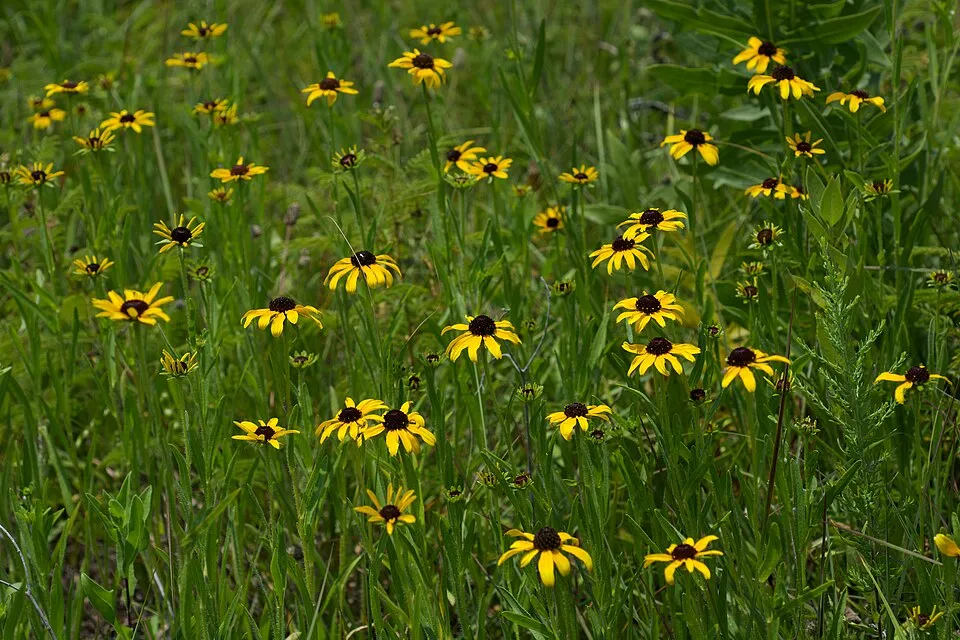
Missouri Coneflower is the refined, drought-loving cousin of the familiar black-eyed Susan — smaller, finer-textured, and perfectly adapted to the dry, rocky, limestone-and-sandstone soils of NE Oklahoma's Cross Timbers and Ozark-influenced ridges. It forms a tidy, clump-forming perennial 1–2 ft tall with narrow, hairy leaves and an endless succession of bright yellow ray flowers surrounding a dark brown central cone from early summer through fall. Where Rudbeckia hirta is a vigorous biennial that spreads by seed, R. missouriensis is a long-lived, clumping perennial that stays put, slowly expanding its crown over years rather than taking over the garden. It blooms prolifically on lean, fast-draining soils where richer-soil plants would sulk, making it an outstanding choice for the un-irrigated, un-amended, full-sun parts of the landscape.

[ field key — habit · leaf · flower · fruit ]
Clump-forming perennial from a fibrous-rooted crown. Stems are erect, stiff, and unbranched, covered with stiff, spreading hairs that give them a rough texture. Multiple stems arise from each crown, forming a dense, upright clump 1–2 ft tall. Unlike the biennial R. hirta, which often sprawls or produces a single large plant that dies after seeding, R. missouriensis is a true perennial that persists and slowly expands from the crown for many years. The rough-hairy texture of stems and leaves is the origin of the common name "coneflower" for Rudbeckia species (not to be confused with Echinacea, the purple coneflowers).
Leaves are narrow, linear to narrowly lance-shaped, 2–6 in long and about ¼–½ in wide, with entire margins (rarely with a few small teeth). Both surfaces are densely covered with stiff, appressed hairs, giving the leaves a gray-green, rough texture. The narrow leaf shape is a reliable character distinguishing R. missouriensis from the broader-leaved R. hirta. Basal leaves are larger and more persistent; stem leaves are smaller and progressively reduced upward. The foliage is more densely hairy than R. hirta, contributing to this species' superior drought tolerance.
Composite flower heads 2–3 in across, held singly on long peduncles. Each head has 8–12 bright yellow ray florets surrounding a prominent, dome-shaped to cylindrical dark brown central disk. The rays are slightly reflexed (bent backward) in full sun, giving the flower a cheerful, open-faced appearance. The bloom period is exceptionally long: from June through October in NE Oklahoma, with new heads continuously produced as older ones mature. Deadheading extends bloom but is not necessary; the seed heads are attractive and feed birds through fall and winter.
Fruits are small, four-angled achenes (cypselae), each topped with a tiny crown of scales rather than a tuft of bristles — a difference from Echinacea that can be observed with a hand lens. The dark brown, cone-shaped receptacle persists on the plant after the ray florets fall, eventually shattering to release the seeds. American goldfinches are especially fond of the seeds and will perch on the dried cones through fall and winter, extracting the achenes with their specialized finch bills. The seeds require no pretreatment for germination and can be direct-sown or started indoors in spring.
Rudbeckia missouriensis has a relatively restricted native range centered on the Ozark and Ouachita highlands of Missouri, Arkansas, and eastern Oklahoma, extending into adjacent Texas and Louisiana. In NE Oklahoma, it is a plant of dry, rocky, open sites: limestone glades, sandstone barrens, dry prairie remnants, rocky openings in post-oak and blackjack-oak woodlands, and the sun-drenched margins of Cross Timbers savannahs. It is consistently found on thinner, poorer soils than R. hirta — this is the rudbeckia for the dry rock garden, the limestone outcrop, and the unwatered slope.
In the Tulsa region, Missouri Coneflower occurs on the limestone glades along the Arkansas River bluffs, in the sandstone barrens of the Cross Timbers, and in dry prairie remnants on well-drained slopes. It is frequently associated with little bluestem, sideoats grama, prairie dropseed, aromatic aster, and stiff goldenrod. It is notably abundant on roadsides and in dry pastures on the limestone soils of Osage County, where it blooms alongside narrow-leaved coneflower through the summer months.
[ pollinators · lepidoptera · birds · ecological role ]
The open, daisy-form flowers are accessible to a wide range of small-to-medium native bees. Sweat bees (Lasioglossum, Agapostemon), mining bees (Andrena), small carpenter bees (Ceratina), leafcutter bees (Megachile), and honeybees are frequent visitors throughout the long bloom period. Syrphid flies, tachinid flies, and small solitary wasps also visit for nectar. The extremely long bloom season (June–October) makes this plant a critical steady-state nectar and pollen source through the entire growing season, sustaining bee populations through summer heat and into fall.
Rudbeckia species are larval hosts for the silvery checkerspot (Chlosyne nycteis) and the gorgone checkerspot (C. gorgone), both of which occur in NE Oklahoma prairies and woodland openings. The bordered patch (Chlosyne lacinia) also uses Rudbeckia as a larval host. Adult butterflies of many species visit the flowers for nectar, including painted ladies, eastern-tailed blues, pearl crescents, and various skippers.
American goldfinches are the iconic seed predator — they feed heavily on the ripening achenes from August through October and will cling acrobatically to the dried cones through winter, timing their late-season breeding to coincide with the peak seed production of summer composites. Field sparrows, chipping sparrows, house finches, and other granivorous songbirds also consume the seeds. The stiff, persistent stems provide perching sites for insectivorous birds hunting in the prairie and shelter for overwintering beneficial insects in hollow stem cavities.
As a long-blooming, drought-tolerant perennial, R. missouriensis plays a key role in sustaining pollinator populations through the summer and fall when many other forbs have finished blooming. Its fibrous root system provides modest erosion control on dry slopes, and its persistent seed heads support winter bird populations. In the tallgrass prairie ecosystem, this species occupies a unique niche: a low-growing, long-blooming composite that provides continuous floral resources without competing aggressively with the matrix of warm-season grasses.
[ site selection · establishment · care · companion planting ]
Missouri Coneflower needs full sun and well-drained soil — it tolerates the heavy red clay common around Tulsa only if planted on a slope or mound where winter drainage is adequate. It performs best in lean, rocky, or sandy soils without amendment. Rich soil produces floppy, weakened plants with reduced bloom. This is an excellent plant for a dry prairie garden, rock garden, limestone glade planting, or the un-irrigated hell strip between the sidewalk and the street. It also thrives in large containers with a gritty, fast-draining potting mix.
Once established, Missouri Coneflower needs essentially no care. No supplemental water (once established), no fertilizer, no staking. It is extremely drought-tolerant and long-lived — individual clumps persist for a decade or more on suitable sites. Cut dead stems to the ground in late winter or leave standing for birds. No significant pests or diseases in NE Oklahoma. Do not over-mulch or over-water — crown rot in wet winter soil is the most common cause of failure, and heavy organic mulches hold excess moisture against the crown. A light gravel or crushed limestone top-dressing is ideal.
Mass-plant for a spectacular long-bloom groundcover in dry, sunny areas. Pair with little bluestem, sideoats grama, aromatic aster, stiff goldenrod, narrow-leaved coneflower, and pale purple coneflower. The low stature makes it ideal for the front of a dry prairie bed or the edge of a limestone outcrop planting. For a stunning mass effect, plant a large drift of R. missouriensis alone where its continuous yellow bloom forms a seamless carpet from June through October — one of the most reliable and longest-lasting floral displays available from any native perennial in NE Oklahoma.
Rudbeckia missouriensis has no significant record of edible or medicinal use in the ethnobotanical record. The genus Rudbeckia is named for Olof Rudbeck the Younger (1660–1740), a Swedish botanist and professor at Uppsala University who taught Carl Linnaeus. The specific epithet missouriensis refers to the state of Missouri, where the species was first collected and described. The plant's primary value is ecological and horticultural: a tough, long-lived, long-blooming native perennial for the dry, lean-soil parts of the landscape that supports pollinators and birds through the entire growing season.
Though the common name includes "coneflower," do not confuse Rudbeckia missouriensis with the medicinal Echinacea species (purple coneflowers). While both genera belong to the Asteraceae and share a cone-shaped central disk, they are chemically and medicinally distinct. Rudbeckia has no documented immunostimulatory properties comparable to Echinacea.
Hero photo: Rooted Revival. Strip photos courtesy of Wikimedia Commons contributors under their respective licenses (linked under each image).