home/ plants/ prairie-coreopsis

// SPECIES PROFILE · PERENNIAL · NATIVE · PRAIRIE SPECIALIST

Prairie Coreopsis

Coreopsis palmata

Prairie Coreopsis is the native golden daisy that blooms for nearly four months straight — from late May into September in the Tulsa region — outlasting almost every other wildflower in the tallgrass prairie. It is a clump-forming perennial 1.5–3 ft tall with stiff, upright stems bearing pairs of narrow, palmately three-lobed leaves that are unlike those of any other common Coreopsis. The golden-yellow flowers, 2–3 in across, are held singly on wiry peduncles and appear in a steady succession from early summer well into early fall. Coreopsis palmata is a prairie specialist through and through — it spreads aggressively by rhizomes in sunny, open sites, forming dense colonies that compete favorably with warm-season grasses. It handles the heavy red clay of NE Oklahoma better than most native perennials, making it an outstanding choice for large prairie restorations, roadside plantings, and the tough, unirrigated parts of the landscape where pretty much everything else gives up.

// QUICK FACTS
Family
Asteraceae (sunflower / daisy family)
Life cycle
Herbaceous perennial; spreads by rhizomes
Native range
Central US; Great Plains and tallgrass prairie from Minnesota to Texas, east to Indiana and Arkansas; all of Oklahoma
USDA hardiness
Zones 3–8 (Tulsa = 7a/7b)
Mature size
1.5–3 ft tall, spreading indefinitely by rhizomes
Bloom
Late May – September (NE OK); one of the longest bloom seasons of any prairie perennial
Flower color
Golden-yellow rays around a darker yellow disk
Sun
Full sun; blooms decline sharply in shade
Soil
Adaptable; dry to mesic, clay to loam, well-drained; tolerates heavy clay
Water
Low to medium; drought-tolerant once established
Wildlife value
Native bee forage · butterfly nectar · bird seed · lepidoptera host
Conservation
G5 — secure globally; common in tallgrass prairies, open woods, and roadsides throughout NE Oklahoma
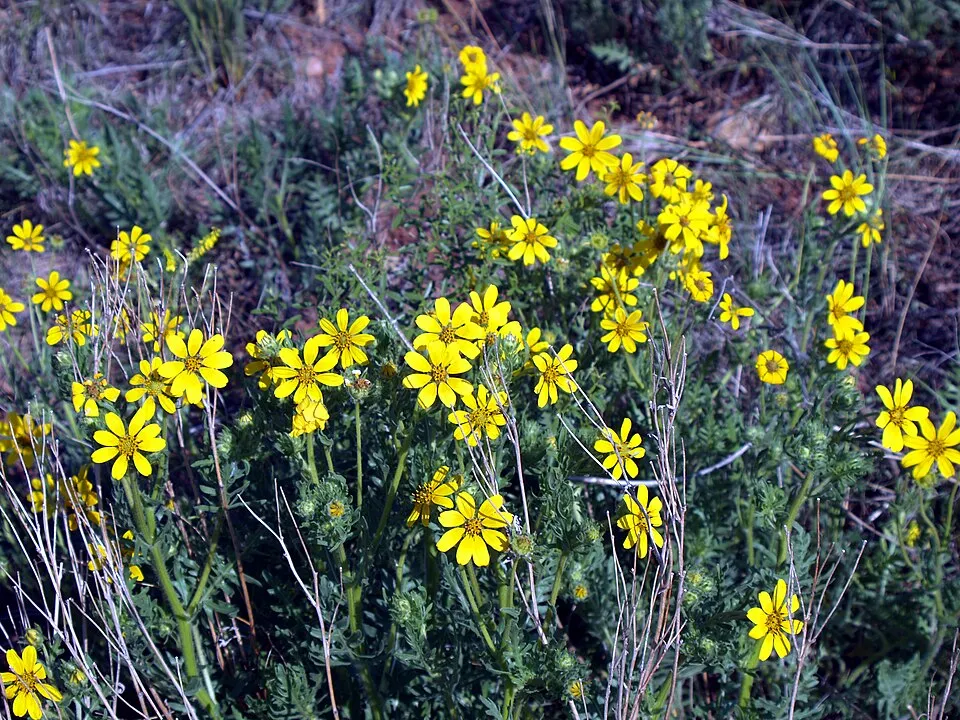
Prairie Coreopsis (Coreopsis palmata) with bright golden-yellow daisy flowers and three-lobed leaves
Coreopsis palmata in bloom — the three-lobed leaves are the reliable field mark; no other common Coreopsis has them. Photo: Rooted Revival.

Identification

[ field key — habit · leaf · flower · fruit · special features ]

Habit & Stem

Erect, clump-forming perennial with stiff, wiry, unbranched stems that emerge from a spreading rhizome system. Stems are smooth (glabrous), green to reddish, and rigidly upright — they do not flop even in rich soil. The dense, spreading rhizome network allows the plant to form large, near-monocultural colonies in favorable conditions, with stems spaced 6–12 in apart across a continuous underground root system. In a garden setting, this can be aggressive; in a large prairie restoration, it is a feature. The plant dies back completely in winter, with new shoots emerging from the rhizomes in mid-spring.

Leaves

The leaves are the best field identification character: they are opposite, sessile (stalkless), and deeply palmately divided into three narrow, linear to lance-shaped lobes, each 1–4 in long and about ¼ in wide. The leaf arrangement gives the stem a distinctive appearance of having pairs of three-fingered hands projecting outward at each node. This is fundamentally different from the finely dissected, thread-like leaves of plains coreopsis (C. tinctoria) and the simple, lance-shaped leaves of lance-leaf coreopsis (C. lanceolata). The species epithet palmata means "palm-like" or "hand-shaped," referring directly to the leaf form.

Flowers

Golden-yellow composite flower heads 2–3 in across, held singly on long, wiry peduncles at the stem tips. Each head consists of 8 yellow ray florets (the "petals"), each with a broadly notched or toothed tip, surrounding a central disk of numerous darker yellow disk florets. The rays are somewhat widely spaced, giving the flower an open, star-like appearance. Bloom is prolonged and prolific — individual flowers last 5–7 days, and new buds are continuously produced from late May through September in NE Oklahoma, making this one of the longest-blooming native perennials available for the prairie garden. Deadheading is unnecessary but prolongs bloom and tidies appearance.

Fruit & Special Features

Fruits are small, flat, dark achenes (the "tickseeds" that give the genus its common name), each about ¼ in long with two small teeth or awns at the tip. The seeds are consumed by goldfinches, sparrows, and other granivorous songbirds in fall and winter. The genus name Coreopsis derives from the Greek koris (bug) + opsis (appearance), referring to the seed's resemblance to a tick — hence the common name "tickseed." C. palmata is one of the more aggressively rhizomatous members of the genus, and this spreading habit is both its greatest asset (for large-scale prairie restoration) and its main caution (for small garden beds).

Habitat & Range in NE Oklahoma

Coreopsis palmata is a plant of the tallgrass prairie and prairie-forest transition zone, with a native range centered on the central United States from Minnesota and Wisconsin south through Iowa, Missouri, and eastern Kansas into Oklahoma and Arkansas. In NE Oklahoma, it is a characteristic component of tallgrass prairie remnants, open post-oak savannahs, dry roadside ditches, railroad rights-of-way, and the grassy openings within Cross Timbers woodlands. It is notably common along the grassy strips of rural highways in Osage and Rogers counties, where its bright yellow flowers and distinctive leaves are readily spotted from June onward.

Prairie Coreopsis is more tolerant of heavy clay soils than most other Coreopsis species — it handles the red clay common throughout the Tulsa metropolitan area far better than C. lanceolata or C. tinctoria, which prefer sandier, better-drained ground. This clay tolerance, combined with its rhizomatous spread and long bloom, makes it the best Coreopsis choice for the typical NE Oklahoma suburban lot with unamended native clay soil. In natural settings, it grows in association with big bluestem, little bluestem, indiangrass, and a diverse community of mid-height prairie forbs.

Ecology & Wildlife Value

[ pollinators · lepidoptera · birds · ecological role ]

Pollinators

The open, daisy-form flowers of C. palmata are accessible to a wide range of pollinators. Small to medium-sized native bees are the primary visitors: sweat bees (Lasioglossum, Agapostemon), mining bees (Andrena), small carpenter bees (Ceratina), and cuckoo bees (Nomada) are common. Honeybees also forage heavily. Syrphid flies (hover flies), tachinid flies, and small solitary wasps visit for nectar. The exceptionally long bloom period (3–4 months) makes this plant a critical steady-state nectar and pollen source through the growing season, bridging gaps between the mass blooms of individual spring and fall species.

Lepidoptera Hosts

Coreopsis species are larval hosts for several checkerspot butterflies including the silvery checkerspot (Chlosyne nycteis) and the gorgone checkerspot (C. gorgone). Several geometer moths also feed on Coreopsis foliage. Adult butterflies of many species visit the flowers for nectar — you'll see eastern-tailed blues, pearl crescents, painted ladies, and various skippers nectaring on Prairie Coreopsis in a NE Oklahoma garden throughout the summer.

Birds

The achenes (seeds) are consumed by American goldfinches throughout the late summer and fall — goldfinches are late nesters in NE Oklahoma, timing their breeding to coincide with the peak seed production of summer composites including Coreopsis. House finches, field sparrows, chipping sparrows, and other granivorous songbirds also feed on the seeds. If you leave the dead stems standing through winter, the seed heads provide a natural bird feeder that requires zero effort beyond not mowing.

Ecological Role

The dense, rhizomatous colonies of C. palmata play a significant role in prairie soil stabilization — the network of underground stems binds soil particles and resists erosion on slopes and roadside embankments. The dense above-ground growth also suppresses weeds effectively once established, making it a living mulch in prairie restorations. In the tallgrass prairie community, Coreopsis palmata occupies a mid-height niche, its foliage capturing light beneath the taller grasses and forbs while its flowers rise just above the general prairie canopy.

Horticulture & Care

[ site selection · establishment · management · companion planting ]

Site selection & establishment

Prairie Coreopsis is not shy about spreading, and you should plant it accordingly. This is a large-scale prairie groundcover, not a well-behaved clump-forming perennial for the tidy border. Give it full sun and room to run — slopes, roadside strips, prairie restorations, the tough clay patch where the lawn keeps dying. It will spread aggressively by rhizomes into open, sunny ground and can overwhelm smaller, less competitive perennials if not contained. In a smaller garden, install a rhizome barrier or plant within a confined bed surrounded by mowed turf that limits spread.

Care & maintenance

Once established, Prairie Coreopsis is essentially zero-maintenance. It is drought-tolerant, disease-resistant, and requires no supplemental water or fertilizer. Do not fertilize — rich soil produces excessive, floppy growth and reduced bloom. To manage spread, mow or cut the perimeter of the colony annually. In prairie restorations, periodic prescribed fire (every 2–4 years) stimulates vigorous regrowth from rhizomes. In a garden, simply cut dead stems to the ground in late winter. The plant has no serious pests or diseases in NE Oklahoma. Powdery mildew may appear on foliage in late summer during humid weather — it is purely cosmetic and does not affect the plant's vigor or bloom.

Companion planting

Because of its spreading habit, Prairie Coreopsis should be paired with plants that can hold their own. In a tallgrass prairie garden, plant it with big bluestem, indiangrass, switchgrass, and other robust competitors including purple coneflower, wild bergamot, compass plant, and Maximilian sunflower. For a lower-growing prairie planting, pair with little bluestem, sideoats grama, purple prairie clover, and butterfly milkweed — the coreopsis will spread among these species but will not exclude them. Avoid interplanting with small, delicate perennials or annuals that will be quickly overrun.

Edible & Cultural Uses

There is no significant record of Coreopsis palmata being used as a food or medicine by Indigenous peoples or early settlers. The flowers can be used as a yellow dye (boiling the ray florets produces a yellow-to-gold pigment that has been used for textiles), though this is a minor use compared to plants like goldenrod or coreopsis species more specifically known for dye properties. The primary value of Prairie Coreopsis is ecological and horticultural — a tough, long-blooming prairie native that handles clay, drought, and neglect with grace.

The genus Coreopsis is the state wildflower of Florida (they claim all Coreopsis species collectively), but Oklahoma has a more specific claim: our state wildflower designation goes to Indian blanket (Gaillardia pulchella). Prairie Coreopsis is nonetheless one of the most visible and beloved wildflowers of the Oklahoma tallgrass region, and it is increasingly included in native seed mixes for roadside beautification and CRP plantings throughout the state.

Photo Reference

Close-up of Coreopsis palmata golden-yellow daisy flower with notched ray tips
// Flower — 8 notched golden rays around a darker yellow central disk
Wikimedia Commons
Wikimedia Commons
Coreopsis palmata showing distinctive palmately three-lobed leaves
// Leaves — opposite, sessile, palmately three-lobed — the diagnostic field character
Wikimedia Commons
Wikimedia Commons
Coreopsis palmata plant showing upright, stiff-stemmed form
// Plant habit — stiff, erect stems 1.5–3 ft tall, rigid and unbranched
Wikimedia Commons
Wikimedia Commons
Dense colony of Coreopsis palmata in a tallgrass prairie remnant
// Colony — dense rhizomatous stand in a prairie remnant, spreading aggressively
Wikimedia Commons
Wikimedia Commons
Coreopsis palmata achenes (tickseeds) with small awns at tip
// Achenes (tickseeds) — golden finch food through late summer and fall
Wikimedia Commons
Wikimedia Commons

Sources & Further Reading

  • USDA NRCS PLANTS Database — Coreopsis palmata: plants.usda.gov/plant-profile/COPA10
  • Lady Bird Johnson Wildflower Center — Native Plant Database: wildflower.org — COPA10
  • Oklahoma Biological Survey — Coreopsis species distribution in Oklahoma.
  • Weakley, A.S. (2022). Flora of the Southeastern United States. UNC Herbarium.
  • Packard, S. & Mutel, C.F., eds. (1997). The Tallgrass Restoration Handbook. Island Press.
  • Fowler, J. & Droege, S. — Pollen Specialist Bees of the Eastern United States (Asteraceae section).
  • Wikipedia — Coreopsis palmata: en.wikipedia.org/wiki/Coreopsis_palmata (CC BY-SA 4.0).

Hero photo: Rooted Revival. Strip photos courtesy of Wikimedia Commons contributors under their respective licenses (linked under each image).