// SPECIES PROFILE · TREE · NATIVE · NEARLY-LOST · ECOLOGICAL RESTORATION
The Ozark chinquapin is a small to medium tree 20–50 ft tall, formerly abundant throughout the Ozark Highlands of Oklahoma, Arkansas, and Missouri, where it was a cornerstone of the upland forest ecology and an important food source for wildlife and rural families. It produces smaller but sweeter nuts than the American chestnut, with a single nut per bur, and was considered by many old-timers to be the finest-tasting chestnut in North America. Then came Cryphonectria parasitica — the exotic chestnut blight fungus — which swept through in the mid-20th century and reduced the species to a handful of surviving sprouts and a few resistant individuals persisting in the Ozark foothills. Planting an Ozark chinquapin today is an act of ecological restoration — you are putting back a piece of a forest ecosystem that was ripped out in a single human lifetime.

[ field key — habit · bark · leaf · bur & nuts · distinguishing features ]
A small to medium deciduous tree 20–50 ft tall, often multi-stemmed or shrubbier in blight-affected populations where stems die back and resprout from the root collar. In pre-blight stands, the species grew as a straight-trunked canopy tree reaching 60–80 ft on deep, moist soils of sheltered Ozark coves. The bark on young stems is smooth and grayish-brown, somewhat reminiscent of young American beech; on older, pre-blight trunks, it developed broad, flat ridges with shallow fissures — not deeply furrowed like oaks or deeply ridged like mature American chestnut. The overall form tends to be more openly branched and irregular than the American chestnut's upright, columnar habit.
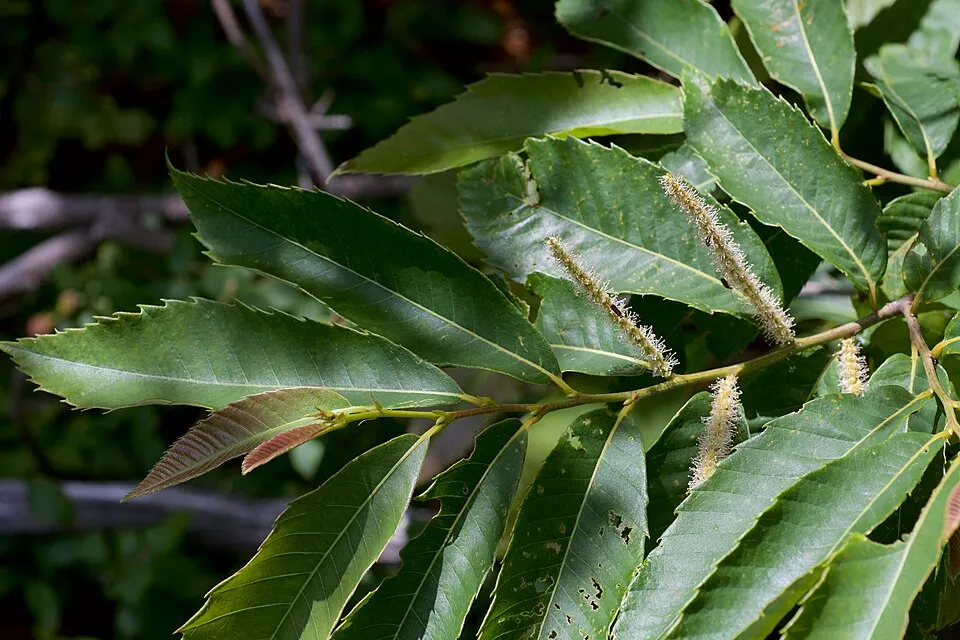
Leaves are simple, alternate, narrowly oblong to lance-oblong, 4–8 in long and 1.5–3 in wide, with coarsely and sharply serrated margins where each tooth terminates in a small bristle-tip. The upper surface is dark green and smooth (glabrous); the underside is paler and covered with a dense mat of soft, whitish to pale tan tomentum (woolly hairs) that gives the leaf underside a felted, silvery look. This dense, persistent pubescence on the leaf underside is the best field character separating the Ozark chinquapin from the closely related Allegheny chinquapin (Castanea pumila), whose leaf undersides are only sparsely hairy or nearly smooth.
Like all chestnuts, the Ozark chinquapin is monoecious — separate male and female flowers on the same tree. Bloom occurs in May–June, after the leaves have fully expanded (which helps distinguish it from the Chinese chestnut and its hybrids, which often bloom earlier). The male flowers are held in erect, creamy-white to pale yellow catkins 4–8 in long, which produce a strong, somewhat musky-sweet fragrance that can be detected from a considerable distance on warm, humid days. Female flowers are inconspicuous, borne at the base of some male catkins or on separate short spikes. The species is self-incompatible — at least two genetically distinct trees are needed for reliable nut production.
The fruit is a spherical to slightly pear-shaped, extremely spiny bur 1–1½ in across, containing a single nut (occasionally 2 — unlike the American chestnut, which usually has 2–3 nuts per bur, and the Allegheny chinquapin, which has 1–2). The nut is small, ½–¾ in, dark brown, and highly glossy, with a small, oval pale scar at the base. The flavor is exceptionally sweet and rich — widely regarded as the best-tasting North American chestnut, sweeter than the American chestnut and with a finer, less starchy texture. Burs are produced even on relatively young and small trees, a trait that allows the species to reproduce before the blight inevitably kills the stem back.
The Ozark chinquapin's historic range hugs the Ozark and Ouachita highlands: the Boston Mountains of Arkansas, the Missouri Ozarks, and the extreme eastern edge of Oklahoma — particularly within the Ozark Plateau and Ouachita foothills of Delaware, Adair, and Cherokee counties and south into Le Flore and McCurtain counties. In NE Oklahoma, surviving chinquapin sprouts persist primarily in the Ozark foothill region east of the Grand River system, where the terrain rises into the rugged, dissected plateau of the Boston Mountain front. The species is not naturally found in the Cross Timbers or Tallgrass Prairie ecoregions of the Tulsa and Osage County area — it is a creature of the ancient, deeply weathered Ozark landscape.
Its preferred habitat is dry to mesic upland hardwood forests on acidic, well-drained, sandy or rocky soils, particularly on south- and west-facing slopes, ridge tops, and the thin-soiled margins of sandstone and chert glades. It grew in association with blackjack oak, post oak, black hickory, Shumard oak, shortleaf pine, and in the moister coves, sugar maple and flowering dogwood. The remaining sprout populations in Oklahoma are found in these same habitat types, though they rarely reach nut-bearing size before the blight kills them back to ground level.
[ chestnut blight ecology · wildlife nut value · Lepidoptera hosts · restoration context ]
The single most important fact about Ozark chinquapin ecology is the chestnut blight (Cryphonectria parasitica, formerly Endothia parasitica), an ascomycete fungus accidentally introduced to North America on Japanese chestnut nursery stock in the late 19th century. The fungus enters through wounds in the bark, colonizes the cambium, and girdles the stem, killing everything above the infection point. It does not kill the root system, and many infected trees resprout repeatedly from the root collar, only to be killed back again and again. In the Ozarks, the blight arrived later than in the Appalachians (mid-20th century) but was equally devastating. The species survives today primarily as a repeatedly dieback-affected shrub, rarely reaching nut-bearing size except in isolated, blight-sheltered microsites or in the very small number of trees that exhibit natural resistance.
Before the blight, Ozark chinquapin was a critical fall mast species throughout its range. The nuts are consumed by white-tailed deer, black bears, wild turkeys, Eastern gray and fox squirrels, chipmunks, raccoons, blue jays, and woodpeckers. The single-nut-per-bur format means each bur produces a calorie-dense, easily cracked nut that small wildlife can handle efficiently — a deer or turkey can eat chinquapin nuts directly from the ground without the work of extracting them from a multi-nut bur. The nuts' high sugar content (sweeter than acorns or hickory nuts) makes them a preferred energy source during the critical pre-winter fattening period.
As a member of the Fagaceae, the Ozark chinquapin hosts a broad community of native insects. The foliage supports larvae of the red-spotted purple (Limenitis arthemis astyanax), the orange-tipped oakworm moth (Anisota senatoria), and numerous other Lepidoptera. The fragrant, insect-pollinated catkins (chestnuts are among the few wind-and-insect-pollinated Fagaceae) attract bees, beetles, and flies. In the pre-blight Ozark forest, chinquapin trees supported an insect community that no longer has its full host-tree base in many areas — restoring the tree restores that missing link in the food web.
The Ozark chinquapin is not yet extinct, and there is active work to breed blight-resistant individuals. The Ozark Chinquapin Foundation has been locating surviving, nut-bearing trees across the Ozarks, collecting their nuts, and crossing them to concentrate any natural resistance genes. Seedlings from these crosses are being distributed to restore the species to its historic range. Planting Ozark chinquapin is ecologically significant in a way that planting a more common native tree is not: every tree that survives to nut-bearing age contributes to the genetic diversity of the species and the possibility of a blight-resistant population. Even a tree that eventually succumbs to blight may produce nuts for 8–15 years before dying back, and its root system will continue to resprout, functioning as a perpetual shrub-level nutrient pump and wildlife food source.
[ sourcing trees · site selection · planting · blight management · companion planting ]
You cannot walk into a retail nursery and buy an Ozark chinquapin. Seedlings and seeds are distributed primarily through conservation channels: the Ozark Chinquapin Foundation (ozarkchinquapin.com), state forestry nurseries in Arkansas and Missouri, and occasionally through native plant sales at nature centers and arboreta in the Ozark region. When you source a tree, ask about the provenance of the seed — ideally, you want seedlings from surviving Oklahoma or nearby Arkansas parent trees, which are adapted to the local climate and photoperiod. Do not plant Chinese chestnut (Castanea mollissima) or its hybrids in or near native Ozark forest — these trees carry blight resistance but also carry the blight fungus itself, potentially infecting nearby surviving pure Ozark chinquapins.
Growing Ozark chinquapin from seed is the primary propagation method and the most important action an individual can take for the species' conservation. Nuts should be collected from known surviving trees that have demonstrated some level of blight tolerance — the Ozark Chinquapin Foundation coordinates the identification of these trees and the distribution of their nuts to growers. Fresh nuts must be kept moist and cold-stratified (stored in damp peat moss or sand at 34–40°F for 90–120 days) before spring planting. They lose viability quickly if allowed to dry out, so plant immediately after collection in fall or store properly for spring planting. Direct-seed nuts 1–2 in deep in a prepared, weed-free bed in early spring; protect from squirrels with wire mesh until germination, which occurs in 4–8 weeks.
Grafting of scion wood from known blight-resistant trees onto seedling rootstock is being explored by the Ozark Chinquapin Foundation as a method of preserving and multiplying resistant individuals, but this work is still in its early stages. For the home grower, growing from seed and accepting attrition is the current path. The Foundation recommends planting seedlings in small "families" of 3–5 trees, closely spaced (8–10 ft), so that cross-pollination occurs and genetic diversity is maintained in the local population. Some of these trees will succumb to blight; those that survive and produce nuts are the future of the species.
Ozark chinquapin can function as a mid-story nut tree in a multi-story food forest or as a component of an Ozark-style woodland restoration planting. Compatible companions include: post oak, blackjack oak, and chinkapin oak in the overstory; downy serviceberry and red buckeye in the understory; aromatic aster, leadplant, and purple prairie clover in the sunny herbaceous layer beneath (chinquapin casts light, dappled shade that native forbs tolerate well); and groundnut as a nitrogen-fixing vine. In a more intensively managed food forest, chinquapin pairs well with American hazelnut and American persimmon for a diverse native nut-and-fruit planting. Keep chinquapin at least 30–40 ft from black walnut and pecan, which prefer the richer, moister, higher-pH soils that chinquapin does not.
Before the blight, the Ozark chinquapin was not merely a wildlife food — it was an important seasonal food for rural people throughout the Ozarks. Families would gather chinquapin nuts by the bushel in September and October, and the nuts were prized for their sweetness and ease of preparation. The tree was woven into the culture and economy of Ozark farm life in ways that older residents still recall.
Hero photo: Rooted Revival. Strip photos courtesy of Wikimedia Commons contributors under their respective licenses (linked under each image).