home/ plants/ maryland-senna

// SPECIES PROFILE · PERENNIAL · NATIVE · NITROGEN-FIXING · SULPHUR HOST

Maryland Senna

Senna marilandica

Maryland Senna is the dry-land counterpart to its taller cousin, American Senna — a more compact, drought-hardy, shrub-like perennial native that brings the same ecological punch in a smaller, tougher package. Reaching 3–5 ft with essentially the same compound leaves and bright yellow, dark-centered flowers, Senna marilandica is the senna of the uplands: open woods, prairie edges, dry meadows, and the sandstone-derived soils of the Cross Timbers where S. hebecarpa would wilt. It is a primary larval host for sulphur butterflies (Phoebis, Colias species), a nitrogen-fixing legume that enriches thin, depleted soils, and a valuable late-mid-summer nectar source when many prairie plants are catching their breath between early and late bloom. If you have a dry, sunny spot where S. hebecarpa would complain, plant this one.

// QUICK FACTS
Family
Fabaceae (pea / legume family)
Life cycle
Herbaceous perennial
Native range
Eastern and central US — New York to Florida, west to Nebraska and Texas; all of eastern OK
USDA hardiness
Zones 4–9 (Tulsa = 7a/7b)
Mature size
3–5 ft tall, 2–3 ft wide; more compact and upright than S. hebecarpa
Bloom
July – August (NE OK); blooms slightly later than S. hebecarpa
Flower color
Yellow petals, dark brown-red anther center
Sun
Full sun to light shade; more sun-tolerant in dry conditions than S. hebecarpa
Soil
Dry to medium, well-drained; thrives in sandy, rocky, and thin soils
Water
Dry to medium; significantly more drought-tolerant than S. hebecarpa
Wildlife
Primary larval host for sulphur butterflies · bumblebee nectar · nitrogen-fixer
Conservation
Secure globally (G5); locally common in Cross Timbers and eastern OK prairies
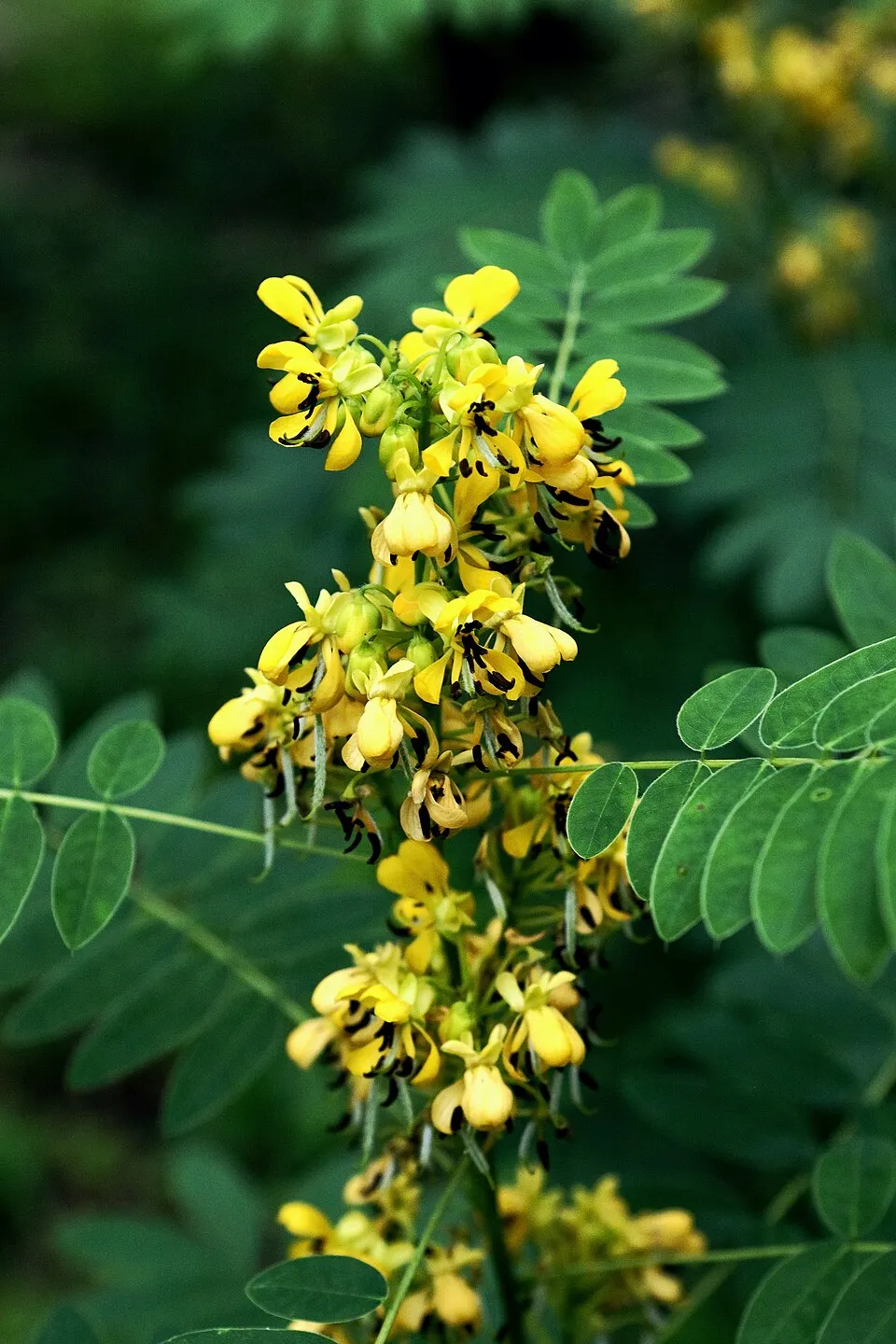
Maryland Senna (Senna marilandica) with axillary clusters of yellow flowers and compound foliage
Senna marilandica in mid-summer bloom — a more compact, drought-tolerant senna for upland sites and prairie edges. Photo: Rooted Revival.

Identification

[ field key — habit · leaf · flower · pod · distinguishing from S. hebecarpa ]

Habit & Stem

A shrub-like herbaceous perennial, typically 3–5 ft tall and shorter than Senna hebecarpa. Stems are erect to slightly arching, branched in the upper portion, and finely pubescent (hairy) on the upper stems and inflorescence branches — a key difference from the glabrous stems of S. hebecarpa. The plant has a dense, bushy form with multiple stems arising from the woody crown, giving it a more substantial presence than its height would suggest. Emerges slightly later than S. hebecarpa in spring (early to mid-May in the Tulsa area) and grows steadily through early summer.

Leaves

Even-pinnately compound, 4–8 in long, generally smaller than those of S. hebecarpa, with 6–12 pairs of oblong leaflets, each 3/4–1.5 in long. Leaflets are medium green, smooth to slightly hairy on the underside, with entire margins and a blunt or slightly notched tip with a tiny mucro. The petiolar gland between the lowest leaflet pair is nearly sessile, globular or dome-shaped — broader and less stalked than the club-shaped gland of S. hebecarpa — and is a reliable identification feature under a hand lens. Foliage is somewhat coarser in appearance than S. hebecarpa.

Inflorescence & Flowers

The flowers of S. marilandica differ in arrangement from its cousin: rather than terminal racemes, the flowers are borne in short axillary racemes or clusters in the upper leaf axils, making the inflorescence appear tucked among the foliage rather than displayed above it. Individual flowers are essentially identical to S. hebecarpa: five yellow petals, 3/4–1 in across, with prominent dark brown stamens forming a contrasting center eye. The petals are somewhat irregularly arranged and drop within a day or two. Bloom period is July through August, often starting a week or so later than S. hebecarpa when the two are grown side by side.

Fruit & Seeds

The fruit is a flat, papery-brown legume pod 3–4 in long and about 3/8 in wide, slightly shorter and narrower than those of S. hebecarpa. The pods are held at an angle from the stem and contain 8–14 flattened, rectangular seeds. Pods dry to a dark brown and often persist on the plant through winter, splitting along both sutures to release seeds. The seeds, like those of S. hebecarpa, have a hard seed coat and require scarification for reliable germination. The rattle of dry pods in winter wind is a diagnostic sound of a senna planting at rest.

Distinguishing from Senna hebecarpa

The two eastern US perennial sennas overlap in range and appearance but segregate by habitat and morphology. S. marilandica is generally shorter (3–5 ft vs. 4–6+ ft), has pubescent (hairy) upper stems vs. glabrous, bears flowers in axillary clusters rather than prominent terminal racemes, and has a short, globular petiolar gland vs. the stalked, club-shaped gland of S. hebecarpa. Ecologically, S. marilandica prefers drier, upland sites — open woods, prairie edges, and dry meadows of the Cross Timbers and Tallgrass Prairie — while S. hebecarpa is found in moister bottomlands, streambanks, and wet meadows. If you're standing in dry post-oak savannah, you're probably looking at S. marilandica; if your feet are wet, it's S. hebecarpa.

Seasonal Cycle in NE Oklahoma

Breaks dormancy in early to mid-May, one of the last prairie perennials to emerge. Grows rapidly through late May and June, reaching full height by early July. Flowers open in July and continue through August into early September in wet summers. Seed pods ripen from September through October, turning from green to brown. Foliage is killed by the first hard freeze (late October to early November), and stems die back to the crown but often remain standing as winter structure. The plant can take two to three full growing seasons to reach mature flowering size from a young transplant — patience is essential.

Habitat & Range in NE Oklahoma

Senna marilandica has a broad range across the eastern and central United States, from New York and southern Ontario south to Florida, and west through the Ohio Valley and lower Midwest to Nebraska, Kansas, Oklahoma, and Texas. It is common throughout eastern Oklahoma and extends into the central part of the state, where it inhabits open post-oak and blackjack-oak woodlands, prairie edges, dry meadows, roadsides, and the margins of Cross Timbers savannah. Unlike S. hebecarpa, it is not tied to moist sites and is equally at home on a dry, sandy ridge as in a bottomland opening.

In NE Oklahoma, look for it in the Tallgrass Prairie Preserve region (Osage County), the open woodlands of the Cross Timbers in Tulsa, Creek, and Pawnee counties, and dry prairie openings throughout the Arkansas River watershed. It is often found growing alongside little bluestem, indiangrass, and purple prairie clover on upland prairie remnants. In the sandstone-derived soils south and east of Tulsa, it occurs in sunny openings within the post-oak / blackjack-oak woodland matrix. Documented in Rogers, Mayes, Wagoner, Tulsa, Creek, Osage, and Pawnee counties.

Ecology & Wildlife Value

[ sulphur butterfly host · nitrogen fixation · buzz pollination · dry prairie ecology ]

Sulphur Butterfly Host Plant

Like S. hebecarpa, Senna marilandica is a primary larval host for sulphur butterflies. The cloudless sulphur (Phoebis sennae), sleepy orange (Abaeis nicippe), and little yellow (Pyrisitia lisa) all lay eggs on the foliage, and their caterpillars feed on the compound leaves. Because S. marilandica occupies different habitat (drier uplands) than S. hebecarpa (moist lowlands), the two species together extend the total senna host acreage across the landscape, increasing the number of sites where sulphurs can successfully reproduce — a strong argument for planting both species where site conditions differ on a single property.

Bumblebee Pollination

The flowers require buzz pollination (sonication) to release pollen from the poricidal anthers, and the primary pollinators are bumblebees (Bombus pensylvanicus, B. impatiens, B. griseocollis) and carpenter bees (Xylocopa virginica). Other large-bodied bees, including leafcutter bees (Megachile spp.) and Anthophora bees, may also visit. The flowers produce no nectar; they are a pure pollen reward. Blooming in the mid-summer gap between the early flush of spring prairie flowers and the late-summer explosion of composites, senna fills a critical nectar and pollen timing niche that supports bee colony growth when other resources may be limited.

Nitrogen Fixation & Soil Building

As a legume in the Fabaceae, S. marilandica forms symbiotic relationships with nitrogen-fixing rhizobia in root nodules, converting atmospheric nitrogen into plant-available ammonium. This is particularly valuable in the thin, acidic, sandy-loam soils of the Cross Timbers, where nitrogen is often limiting. A mature senna plant measurably enriches the soil in its immediate root zone. In a prairie restoration or perennial garden, S. marilandica serves as a living nitrogen source for neighboring grasses and forbs, reducing or eliminating the need for supplemental fertilizer.

Wildlife Associations

The seeds are eaten by Northern bobwhite quail and other granivorous birds. White-tailed deer browse the foliage moderately, though senna is not a preferred browse species. The plant's stout, persistent winter stems provide structural habitat for overwintering arthropods and solitary bee nesting cavities. As a component of upland prairie and savannah communities, S. marilandica contributes to the structural and functional diversity that supports a wide range of grassland-obligate species, including Henslow's sparrows, dickcissels, and eastern meadowlarks — all declining birds that require structurally complex native grasslands.

Horticulture & Care

[ site · establishment · drought tolerance · companion planting ]

Site Selection & Establishment

Senna marilandica is the senna for dry ground. Choose a site with full sun and well-drained soil — it will thrive on a south- or west-facing slope, in thin soil over sandstone or limestone, or in any dry, sunny corner where other natives struggle. It does not require irrigation once established and performs beautifully in the Tulsa area's characteristic summer dry spells. It tolerates light shade but will be leggier and flower less.

Drought Tolerance & Maintenance

This is a remarkably drought-tolerant native legume once established. Water weekly for the first two months after transplanting; after that, natural rainfall is sufficient in most years. In extreme drought (June–August with less than 1 inch of rain per month), a deep watering every two weeks will keep foliage healthy. Overwatering or planting in heavy clay that stays wet will cause root rot — if you have a wet site, plant Senna hebecarpa instead.

Companion Planting

In a dry prairie planting, pair with little bluestem, indiangrass, prairie dropseed, purple prairie clover, leadplant, and wild indigo for a nitrogen-fixing guild on thin soils. For color contrast, the yellow senna flowers work beautifully with the purple of pale purple coneflower and prairie blazing star, the orange-red of butterfly milkweed, and the white of rattlesnake master. In a Cross Timbers woodland edge, plant beneath post oak and blackjack oak with fragrant sumac and coralberry as understory shrubs.

Photo Reference

Senna marilandica axillary flower cluster with yellow petals and dark brown center
// Inflorescence — axillary cluster, yellow petals + brown anthers
Wikimedia Commons
Wikimedia Commons
Close-up of Senna marilandica leaf showing the short globular petiolar gland
// Petiolar gland — short, globular (not club-shaped) — key ID feature
Wikimedia Commons
Wikimedia Commons
Maturing seed pods of Senna marilandica turning brown
// Seed pods — flat papery legumes, 3–4 in, persistent in winter
Wikimedia Commons
Wikimedia Commons
Mature Senna marilandica plant showing full form in a dry prairie setting
// Habit — 3–5 ft, compact bushy form in a Cross Timbers dry meadow
Wikimedia Commons
Wikimedia Commons
Sleepy orange butterfly (Abaeis nicippe) on foliage
// Abaeis nicippe (sleepy orange) — a sulphur whose larvae feed on senna
Wikimedia Commons

Sources & Further Reading

  • USDA NRCS PLANTS Database — Senna marilandica: plants.usda.gov/plant-profile/SEMA11
  • Lady Bird Johnson Wildflower Center — Native Plant Database: wildflower.org — SEMA11
  • Missouri Botanical Garden — Senna marilandica Plant Finder: missouribotanicalgarden.org
  • Oklahoma Biological Survey — Senna marilandica county-level distribution: biosurvey.ou.edu
  • Gleason, H.A. & Cronquist, A. (1991). Manual of Vascular Plants of Northeastern United States and Adjacent Canada, 2nd ed. New York Botanical Garden — the standard reference for Senna (as Cassia) morphology and distribution.
  • Scott, J.A. (1986). The Butterflies of North America. Stanford University Press.
  • Wikipedia — Senna marilandica: en.wikipedia.org/wiki/Senna_marilandica (CC BY-SA 4.0; portions of the description and ecology sections summarize Wikipedia content).
  • Isely, D. (1975). Leguminosae of the United States: II. Subfamily Caesalpinioideae. Memoirs of the New York Botanical Garden 25(2).

Hero photo: Rooted Revival. Strip photos courtesy of Wikimedia Commons contributors under their respective licenses (linked under each image).