// SPECIES PROFILE · PERENNIAL · NATIVE · NITROGEN-FIXING · SULPHUR HOST
American Senna is a commanding, shrub-like perennial that rises 4–6 ft each summer and unfurls showy terminal clusters of bright yellow, brown-centered flowers above a mass of elegant compound leaves. It is one of the most visually striking native legumes of the eastern tallgrass region and, more importantly, the essential larval host for several species of sulphur butterflies (Colias, Phoebis) whose caterpillars depend on senna foliage. A nitrogen-fixing legume in the Fabaceae, it enriches the soil it grows in, making it a functional cornerstone of any NE Oklahoma pollinator planting, rain garden, or food-forest understory. In mid-summer, when its yellow racemes open against the compound blue-green leaves, the plant is often covered in clouds of yellow butterflies — a perfect, self-reinforcing ecological loop: the plant feeds the caterpillars, and the adult butterflies return to nectar on the flowers.

[ field key — habit · leaf · inflorescence · seed pod · comparison with S. marilandica ]
A tall, shrub-like herbaceous perennial that dies back to the ground each winter and regrows vigorously from a woody crown in late spring. Stems are erect, stout, mostly unbranched or sparingly branched near the top, 4–6 ft tall in NE Oklahoma (up to 8 ft in optimal moisture conditions), smooth and glabrous with a slightly glaucous (bluish-waxy) bloom on the upper portions. The plant has a commanding, vase-like or upright-arching silhouette when mature — it reads as a subshrub or small shrub in the landscape even though it is fully herbaceous above ground. Emerges late in spring (mid-April to early May in the Tulsa area), well after many other perennials are already in leaf.
Even-pinnately compound, 6–12 in long, with 5–10 pairs of oblong to elliptic leaflets, each 1–2 in long. The leaflets are medium to blue-green, smooth above and slightly paler below, with entire margins and a small, soft point (mucro) at the rounded tip. A distinctive club-shaped gland sits between the lowest pair of leaflets on the rachis — this is a key identification feature for Senna species. The leaves fold together slightly at night or during extreme heat (nyctinastic movement), a trait shared with many legumes. The compound leaves give the plant a fine, airy texture despite its substantial size.
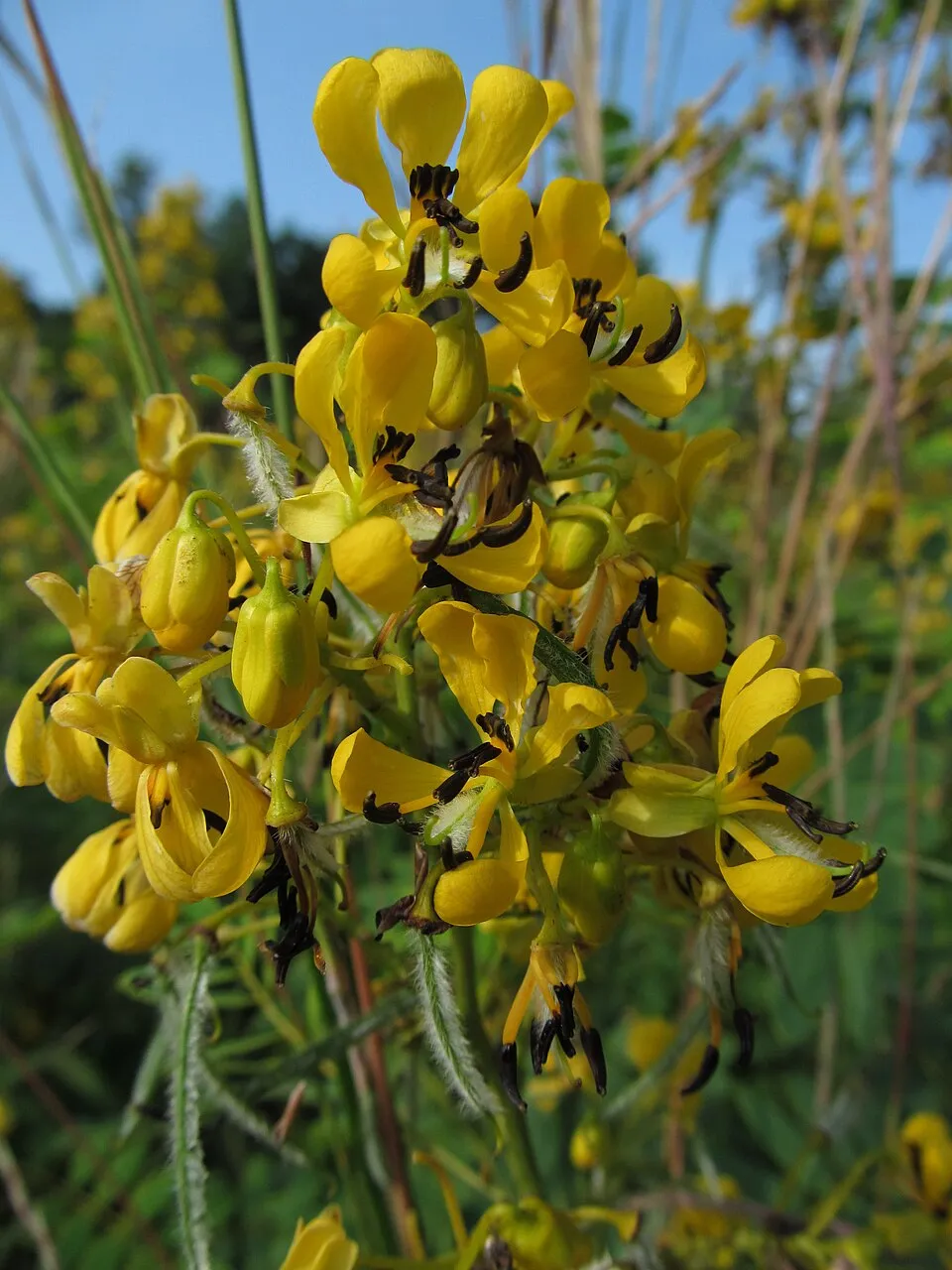
Flowers are borne in terminal and upper-axillary racemes 4–8 in long, each containing 10–30 individual flowers that open from the bottom of the raceme upward over several weeks. Individual flowers are 3/4–1 in across with five bright yellow, broadly obovate petals that are somewhat crumpled-looking in bud and flatten as they open. The flower center is dominated by a cluster of dark chocolate-brown stamens with long, curved anthers that give the flower its distinctive brown eye. The petals drop within a day or two of opening, and the raceme continues producing new flowers for weeks. Blooms in July through August in NE Oklahoma, occasionally extending into September with supplemental water.
The fruit is a flattened, papery legume pod 3–5 in long and about 1/2 in wide, held horizontally to ascending on the raceme. Immature pods are green; they dry to a dark brown or blackish-brown in fall and often persist on the plant well into winter, rattling in the wind. Each pod contains 6–12 flat, brown seeds arranged in one row. The dry pods split open along both sutures to release seeds in late fall and winter. The persistent seed pods are an ornamental feature in their own right, adding winter interest to the garden and making a satisfying dry rattle in the breeze — one reason this plant is valued beyond its ecological function.
Senna hebecarpa and S. marilandica are closely related and sometimes confused. S. hebecarpa is generally taller (4–6 ft vs. 3–5 ft), has flowers in terminal racemes (vs. primarily axillary clusters in S. marilandica), and has glabrous stems (vs. stems with fine hairs near the top in S. marilandica). The gland on the leaf rachis is short-stalked and club-shaped in S. hebecarpa versus nearly sessile and more globular in S. marilandica. Ecologically, S. hebecarpa prefers moister soils and is found in bottomlands and streambanks, while S. marilandica is more drought-tolerant and occupies upland sites and prairie edges.
Emerges from the ground in late April to early May, well after the last frost. Grows rapidly through May and June, reaching full height by late June. Flowering begins in early to mid-July and continues through August. Seed pods mature from late August through September, turning from green to brown. Foliage turns yellow in October with the first frosts, and the entire above-ground portion dies back to the crown by November. The stout, stiff stems often remain standing through winter unless knocked down by ice or heavy snow, and the dry pods persist and rattle.
Senna hebecarpa is native to the eastern half of the United States, from New England south to Georgia and west to Minnesota, Wisconsin, and eastern Oklahoma. In Oklahoma it reaches the western edge of its range, occurring in the eastern counties including the Arkansas River valley, the Neosho and Grand River watersheds, and scattered locations in the eastern Cross Timbers. In NE Oklahoma it is found in moist meadows, open bottomland woods, streambanks, roadside ditches, and occasionally in wetter openings within post-oak and blackjack-oak woodlands. It is not a widespread or abundant plant in the Tulsa region — you are more likely to encounter it in conservation plantings and native gardens than in the wild — but it is native and well adapted.
The species' preference for consistent moisture ties it to the eastern drainages of Oklahoma: the Illinois River watershed, Grand Lake tributaries, and the lower Verdigris River bottoms. It is absent from the drier upland prairies of Osage County and the sandstone glades of the western Cross Timbers, where its upland cousin Senna marilandica takes over. In the Arkansas River lowlands south of Tulsa, it occasionally appears in damp openings in the cottonwood-sycamore-willow riparian corridor. It has been documented in Wagoner, Cherokee, Mayes, Rogers, and Tulsa counties.
[ sulphur butterfly host · nitrogen fixation · bumblebee nectar · seed pod ecology ]
Senna hebecarpa is the primary larval host for several sulphur butterflies (Pieridae: Coliadinae). In NE Oklahoma, the most common species using senna are the cloudless sulphur (Phoebis sennae) — a large, brilliant yellow butterfly that migrates north in spring and whose caterpillars are green or yellow with a pale lateral stripe — and the sleepy orange (Abaeis nicippe), a smaller, rich orange species. The orange sulphur (Colias eurytheme) and clouded sulphur (Colias philodice) may also oviposit on senna, though they more commonly use clovers and other herbaceous legumes. Sulphur caterpillars feed on the compound leaves and are often found resting along the leaf rachis or on the midrib of individual leaflets, where they are well camouflaged.
The large, open flowers with exposed nectar are visited by a wide range of large-bodied bees. Bumblebees (Bombus impatiens, B. pensylvanicus, B. griseocollis) are the primary pollinators, grabbing the flower and vibrating their wing muscles to release pollen from the poricidal anthers (buzz pollination). Carpenter bees (Xylocopa virginica), leafcutter bees (Megachile), and long-horned bees (Melissodes) also visit. The flowers produce no nectar in typical nectaries; instead, the bees collect pollen from the dark stamens. Small bees and flies are less frequent visitors because the pollen is not easily accessible to insects that cannot buzz-pollinate effectively.
Like most members of the Fabaceae, Senna hebecarpa forms symbiotic relationships with nitrogen-fixing rhizobia bacteria in root nodules, converting atmospheric nitrogen (N₂) into plant-available ammonium. This makes it a soil-building species that improves fertility for neighboring plants. Over several years, a senna planting can measurably increase soil organic nitrogen in its root zone. This trait makes S. hebecarpa an excellent pioneer or nurse plant for establishing other native perennials on degraded soils, particularly in former pasture or construction-compacted sites where nitrogen is depleted. The abundant leaf litter it drops each fall also contributes to building organic matter in the soil profile.
The seeds of Senna hebecarpa are consumed by Northern bobwhite quail and other ground-feeding birds, particularly in winter when the pods split and drop seed onto the snow or leaf litter. Small mammals, including white-footed mice and chipmunks, also harvest senna seeds. The tall, stiff stems that remain standing through winter provide cover and perching structure for overwintering birds and insects. The hollow or pithy dried stems serve as nesting cavities for native solitary bees and overwintering sites for beneficial predatory insects — one more reason to leave the stems standing until spring cleanup in late March or April.
[ site selection · establishment · garden design · companion planting ]
American Senna wants full sun (6+ hours) for best flowering and habit, though it tolerates light shade — in dappled shade it will grow taller and lean toward the light, producing fewer flowers. The ideal site has consistent moisture: a low spot, a rain garden, the bottom of a slope, or a bed with supplemental irrigation. In the Tulsa area, a north- or east-facing bed that holds moisture after rain is ideal. The plant is tolerant of clay soils and seasonal wetness, but does not thrive in permanently waterlogged conditions.
Senna hebecarpa is a back-of-the-border plant with real architectural presence. Use it as a seasonal hedge or screen, as a specimen at the back of a perennial bed, or massed in groups of three to five for a bold mid-summer statement. The compound leaves provide a fine texture that contrasts beautifully with the broad leaves of companion perennials and the bold foliage of tropical-looking plants. The plant is deciduous above ground — mark its location so you don't dig into the dormant crown in early spring before it emerges. It pairs well with ornamental grasses that provide structure while the senna is dormant.
In a pollinator garden or prairie planting, pair American Senna with purple coneflower, wild bergamot, rattlesnake master, compass plant, and common milkweed for a tall, multi-layered pollinator powerhouse. The yellow flowers of senna work well with the purple of New England aster (blooming later) and prairie blazing star. For a moisture-loving planting, combine with Joe-Pye weed, buttonbush, swamp milkweed, and common boneset in a rain garden or moist swale. Underplant with buffalograss or sideoats grama as a living mulch. In food-forest guilds, use senna as a nitrogen-fixing support species near American persimmon or pecan.
Hero photo: Rooted Revival. Strip photos courtesy of Wikimedia Commons contributors under their respective licenses (linked under each image).