home/ plants/ foxglove-beardtongue

// SPECIES PROFILE · PERENNIAL · NATIVE · BUMBLEBEE SPECIALIST · ADAVANABLE

Foxglove Beardtongue

Penstemon digitalis

Foxglove Beardtongue is the workhorse penstemon of eastern North America — a clump-forming perennial 3–4 ft tall with a glossy, semi-evergreen basal rosette that holds its deep green through the Tulsa winter, and tall, elegant panicles of tubular white flowers (sometimes tinged pink) that open in late spring and early summer. The large, throaty flowers are pollinated almost exclusively by bumblebees — watch a queen or worker bumblebee approach a penstemon panicle, crawl entirely into a corolla tube, and emerge dusted with pollen. This is one of the most enduring and reliable native perennials in cultivation, tolerating heavy clay, partial shade, periodic drought, and the general neglect that kills fussier species. For the beginning native plant gardener in NE Oklahoma, this is one of the first plants to put in the ground — it will not disappoint.

// QUICK FACTS
Family
Plantaginaceae (plantain family; formerly Scrophulariaceae)
Life cycle
Herbaceous perennial; semi-evergreen basal rosette
Native range
Eastern and central North America — Maine to Texas, west to the Dakotas and Nebraska; all of eastern OK
USDA hardiness
Zones 3–8 (Tulsa = 7a/7b)
Mature size
3–4 ft tall (in flower), 1.5–2 ft wide; clump-forming
Bloom
May – June (NE OK); peak in late May
Flower color
White, often with a faint pink to lavender blush on the tube exterior
Sun
Full sun to part shade; flowers best with 6+ hrs sun
Soil
Moist, well-drained; tolerates clay, loam, sandy soil; pH 5.5–7.5
Water
Medium; surprisingly drought-tolerant once established
Wildlife
Bumblebee specialist · occasional hummingbird visits · host to checkerspot butterflies
Conservation
Secure globally (G5); common and widespread
Foxglove Beardtongue (Penstemon digitalis) with tall panicles of white tubular flowers
Penstemon digitalis in early summer bloom — panicles of tubular white flowers, pollinated by bumblebees that enter the corolla entirely. Photo: Rooted Revival.

Identification

[ field key — basal rosette · stem · leaf · flower · distinguishing from other Penstemon ]

Habit & Basal Rosette

The plant produces a striking basal rosette of leaves that remains green through most of the winter in NE Oklahoma — a valuable trait for winter garden interest. The rosette leaves are glossy, dark green, lanceolate to elliptic, 4–8 in long and 1–2.5 in wide, often with a bronzy or purplish tint to the midrib and petiole base. From this rosette arise one to several erect, unbranched flowering stems 3–4 ft tall, which are smooth (glabrous), round, and often reddish-purple at the base, fading to green above. The plant is clump-forming and does not spread aggressively by rhizomes.

Stem Leaves

Stem leaves are opposite, sessile and clasping (they wrap partially around the stem at the base), lanceolate, 2–6 in long, with entire to finely toothed margins. They become progressively smaller up the stem. The upper surface is glossy and deep green; the lower surface is slightly paler. The leaves have a smooth, almost leathery texture and are notably glabrous (hairless) on both surfaces — a key distinction from the hairy foliage of many other native penstemons. The clasping leaf bases are a useful field mark.

Inflorescence & Flowers

The inflorescence is a tall, narrow terminal panicle 8–18 in long, with flowers arranged in paired clusters (cymes) at intervals along the upper stem. The overall effect is a loose, airy candelabra of white blooms. Each individual flower is tubular to bell-shaped, 1–1.25 in long, with a five-lobed corolla that opens into two lips: the upper lip is two-lobed, the lower lip is three-lobed and slightly reflexed. The corolla is white, sometimes with a delicate pink or lavender flush on the outside of the tube. Inside the throat, fine purple guide lines (nectar guides) direct bumblebees to the nectaries at the base of the tube. A single prominent sterile stamen (staminode) protrudes from the throat, covered in golden-yellow hairs — the "bearded tongue" that gives the genus its common name.

Fruit & Seed

After pollination, each flower develops a dry, brown, ovoid capsule 1/3–1/2 in long that splits open to release numerous tiny, angular, dark brown seeds. The seed capsules are persistent on the stem through summer and fall, turning from green to tan to dark brown, and are an attractive textural feature if the stems are left standing. The dried capsules rattle faintly in the wind. Goldfinches and other small birds occasionally pick at the tiny seeds. For those wanting to control self-seeding, cut the stems back after flowering before the capsules mature.

Distinguishing from Other Oklahoma Penstemons

Penstemon digitalis is distinguished from other native penstemons by its large size (3–4 ft), white flowers, smooth (glabrous) foliage, and clasping stem leaves. Penstemon tubaeflorus (tube penstemon / white wand) is also white-flowered but much smaller (1–2 ft) with narrower leaves. Penstemon cobaea (cobaea penstemon) has large purple or white flowers and prefers drier, calcareous soils. Penstemon tenuis (Gulf Coast penstemon) has small lavender flowers and is found in moist lowlands in southeastern Oklahoma. The number of Penstemon species can be intimidating, but in practice, the large, glabrous, white-flowered penstemon growing in your Tulsa garden is almost certainly P. digitalis.

Seasonal Cycle in NE Oklahoma

The semi-evergreen basal rosette is present from fall through spring, providing winter green in the garden. In early spring (March–April), the rosette expands and new leaves emerge. Flowering stems bolt in April and reach full height by early May. Flower buds form in early to mid-May, and the first flowers open in mid to late May. Peak bloom is typically the last week of May through the first two weeks of June, making this one of the key transitional plants between the spring ephemerals and the summer prairie bloom. Seed capsules mature through July and August. Stems can be cut back after flowering or left standing for structure and seed. The basal rosette persists into the following winter.

Habitat & Range in NE Oklahoma

Penstemon digitalis is native to eastern and central North America, from Maine and Quebec south to Texas, and west to South Dakota, Nebraska, and eastern Kansas. In Oklahoma it occurs throughout the eastern half of the state, with scattered populations extending into the central counties. In NE Oklahoma it is found in moist prairies, open woods, woodland edges, roadsides, old fields, and prairie remnants. It is a plant of the transition zone — not full sun prairie, not deep shade forest, but the open, sunny edge where light and moisture are both available.

This species is common and locally abundant throughout the eastern Oklahoma landscape. It occurs along roadsides throughout the region (those tall white spikes you see along Highway 75 in late May are likely P. digitalis), in the open understory of the Cross Timbers, in moist openings of tallgrass prairie remnants, and in old fields and pastures where grazing pressure is light. It is one of the most frequently encountered native penstemons in the state and is well documented in Tulsa, Rogers, Osage, Wagoner, Creek, and Mayes counties.

Ecology & Wildlife Value

[ bumblebee pollination · Lepidoptera host · hummingbird visits · early summer niche ]

Bumblebee Pollination: The Main Event

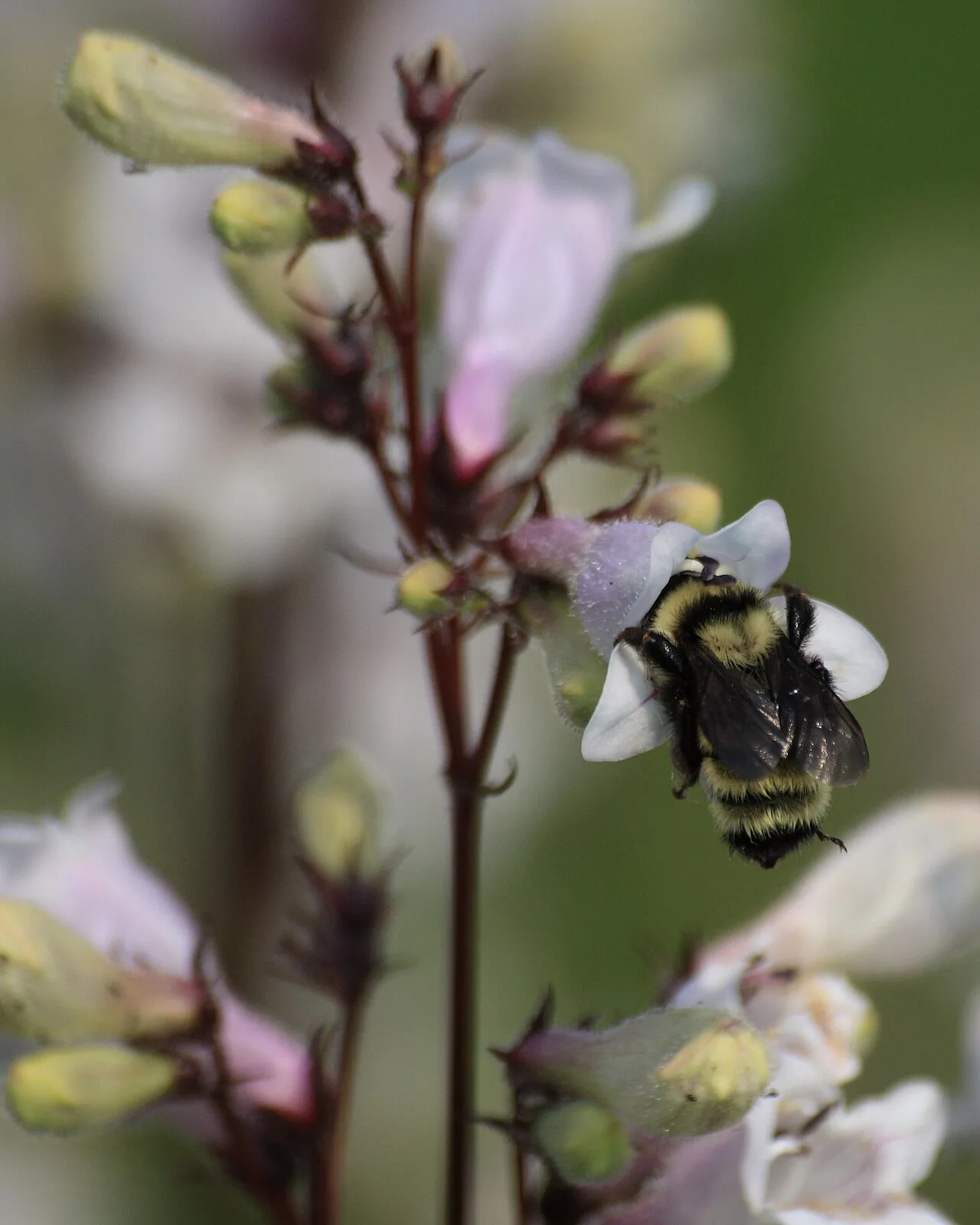
The large, tubular flowers of Penstemon digitalis are pollinated almost exclusively by bumblebees — queens in early spring and workers later in the season. The flowers are constructed so that only a heavy-bodied bee with sufficient strength can push past the staminode (the "bearded tongue") and into the corolla tube to reach the nectar. Watching a bumblebee work a penstemon panicle is one of the pleasures of a late May garden: the bee lands on the lower lip, pushes its head and thorax into the tube, disappears from view entirely for a moment, then backs out, dusted with white pollen on its back and head, and moves to the next flower. The primary visitors are Bombus impatiens (common eastern bumblebee), B. pensylvanicus (American bumblebee), and B. griseocollis (brown-belted bumblebee). Large carpenter bees (Xylocopa virginica) sometimes visit but often rob nectar by chewing a hole in the base of the corolla, bypassing the reproductive parts.

Hummingbird Visits

While penstemons of the American West are famously hummingbird-pollinated (indeed, the red-flowered species are classic hummingbird flowers), the white flowers of P. digitalis are less frequently visited by hummingbirds. However, ruby-throated hummingbirds in NE Oklahoma do occasionally visit the flowers, particularly early in the breeding season (late April–May) when fewer other nectar sources are available. The tubular shape and abundant nectar make the flowers physically accessible to hummingbirds even if the white color does not specifically advertise to them. A patch of P. digitalis in a garden that also contains red-flowered hummingbird plants (royal catchfly, crossvine, trumpet honeysuckle) will likely see occasional hummingbird use.

Lepidoptera & Other Insects

Penstemon species are larval host plants for several checkerspot butterflies, though less prominently than sunflowers, milkweeds, or asters. The flowers are visited by large butterflies with long proboscises that can reach the nectar: eastern tiger swallowtails, pipevine swallowtails, and occasionally monarchs. The foliage supports a small community of specialist herbivores, including the penstemon sawfly and the larvae of certain checkerspot moths in the genus Anania. The seed capsules are sometimes attacked by penstemon weevil larvae.

Ecological Niche: The May Gap

Foxglove Beardtongue occupies a critical phenological niche: it blooms in May and early June, after the spring ephemerals have faded but before the main flush of summer prairie flowers in July. This late spring pollination gap is a challenging period for newly emerged queen bumblebees, who need abundant nectar and pollen to establish their colonies. Penstemon flowers, with their large, accessible corollas and generous nectar production, are an essential early-season resource for bumblebee colony foundation. A garden with penstemon in bloom in late May is directly supporting the next generation of bumblebees that will pollinate your tomatoes, squash, and peppers in July.

Horticulture & Care

[ site · soil · cultivars · self-seeding · companion planting ]

Site Selection & Establishment

Penstemon digitalis is one of the most adaptable native perennials in cultivation. It thrives in full sun to part shade and tolerates a wider range of soil conditions than almost any other penstemon, including the heavy red clay of Tulsa. It prefers moist, well-drained soil but is surprisingly drought-tolerant once established — the glossy, semi-succulent basal leaves retain moisture during dry spells. It will grow and flower in as little as 4 hours of sun, though stems may be weaker and flowers fewer in deep shade.

Notable Cultivars

Maintenance

Companion Planting

Foxglove beardtongue bridges the spring-to-summer transition in the garden. Plant it with spring-blooming natives like golden Alexanders, wild columbine, and spiderwort for an early-season pollinator sequence. Pair with summer-blooming plants that will take over as the penstemon fades: purple coneflower, butterfly milkweed, wild bergamot, black-eyed Susan, and lance-leaf coreopsis. In a woodland edge garden, combine with Solomon's seal, Christmas fern, and coralberry beneath eastern redbud and downy serviceberry.

Design tip: The basal rosettes of P. digitalis make an excellent evergreen groundcover at the front of a border or along a path edge, where the glossy leaves provide structure through winter. In spring, the rosettes send up their flowering stems, which rise above shorter companion plants without shading them out. The cultivar 'Husker Red' is particularly effective as a foliage accent plant, its maroon leaves contrasting with the green foliage of neighboring perennials and grasses.

Photo Reference

Close-up of Penstemon digitalis flower showing white tubular corolla and bearded staminode
// Flower — tubular white corolla, purple nectar guides, golden-bearded staminode
Wikimedia Commons
Wikimedia Commons
Semi-evergreen basal rosette of Penstemon digitalis in winter
// Basal rosette — glossy, semi-evergreen, persists through winter
Wikimedia Commons
Wikimedia Commons
Bumblebee entering a Penstemon digitalis flower
// Bombus sp. entering a penstemon corolla — the plant's primary pollinator
Wikimedia Commons
Wikimedia Commons
Tall flowering panicle of Penstemon digitalis showing paired cymes
// Inflorescence — panicle of paired cymes, 8–18 in tall
Wikimedia Commons
Wikimedia Commons
Penstemon digitalis 'Husker Red' with maroon foliage and white flowers
// 'Husker Red' cultivar — maroon foliage, white flowers with pink blush
Wikimedia Commons
Wikimedia Commons

Sources & Further Reading

  • USDA NRCS PLANTS Database — Penstemon digitalis: plants.usda.gov/plant-profile/PEDI
  • Lady Bird Johnson Wildflower Center — Native Plant Database: wildflower.org — PEDI
  • Missouri Botanical Garden — Penstemon digitalis Plant Finder: missouribotanicalgarden.org
  • Oklahoma Biological Survey — Penstemon species in Oklahoma: biosurvey.ou.edu
  • Gleason, H.A. & Cronquist, A. (1991). Manual of Vascular Plants, 2nd ed. New York Botanical Garden.
  • Wolfe, A.D. et al. (2006). Phylogeny and biogeography of Penstemon. Systematic Botany 31(4):698–712.
  • Wikipedia — Penstemon digitalis: en.wikipedia.org/wiki/Penstemon_digitalis (CC BY-SA 4.0; portions of the description and ecology sections summarize Wikipedia content).

Hero photo: Rooted Revival. Strip photos courtesy of Wikimedia Commons contributors under their respective licenses (linked under each image).