home/ plants/ virginia-bluebells

// SPECIES PROFILE · PERENNIAL · NATIVE · SPRING EPHEMERAL

Virginia Bluebells

Mertensia virginica

If you have ever walked a woodland trail in late March and come around a bend to find the forest floor transformed into a sea of brilliant sky-blue, you have encountered Virginia Bluebells and you will never forget the sight. Mertensia virginica is one of the most spectacular spring wildflowers of eastern North America, and in the brief window between the end of winter and the closing of the canopy, it produces clusters of nodding, trumpet- shaped flowers that emerge as rich pink buds and open to a shade of blue that looks like it was sampled directly from an April sky. The foliage is smooth, blue-green, and substantial — large, ovate leaves that form a lush ground layer while the flowers hover above in loose, terminal clusters. In NE Oklahoma, M. virginica is at the southwestern edge of its continuous range, found in protected bottomlands and on north- facing slopes along the Grand (Neosho) and Illinois rivers and their tributaries, where the alluvial soils are deep, rich, and consistently moist. For the Tulsa gardener, Virginia Bluebells offers something rare among woodland natives: a bold, saturated color display in deep shade that rivals anything the perennial border can produce, and it does so at a time of year when little else is in flower.

// QUICK FACTS
Family
Boraginaceae (borage / forget-me-not family)
Life cycle
Spring ephemeral perennial; emerges March, blooms April, goes dormant by June–July
Native range
Eastern and central N. America — New York to Alabama, west to E. Kansas, E. Oklahoma, and Minnesota
USDA hardiness
Zones 3–8 (Tulsa = 7a/7b)
Mature size
12–24 in tall, 12–18 in wide; forms colonies via self-seeding and rhizome spread
Bloom
Late March – April (NE OK)
Flower
Pink buds open to sky-blue trumpet flowers, 1 in long; nodding clusters of 15–20 blooms per stem
Foliage
Smooth, blue-green, ovate leaves 2–6 in long; basal leaves larger than stem leaves
Sun
Part shade to full shade; requires spring sun before canopy leaf-out
Soil
Rich, moist, well-drained alluvial or woods soil; pH 6.0–7.5; tolerates clay if well-amended
Water
Medium to high during active growth (March–May); tolerates summer drought during dormancy
Pollination
Long-tongued bees (bumblebees, Anthophorinae); occasionally hummingbirds; butterflies visit but are poor pollinators
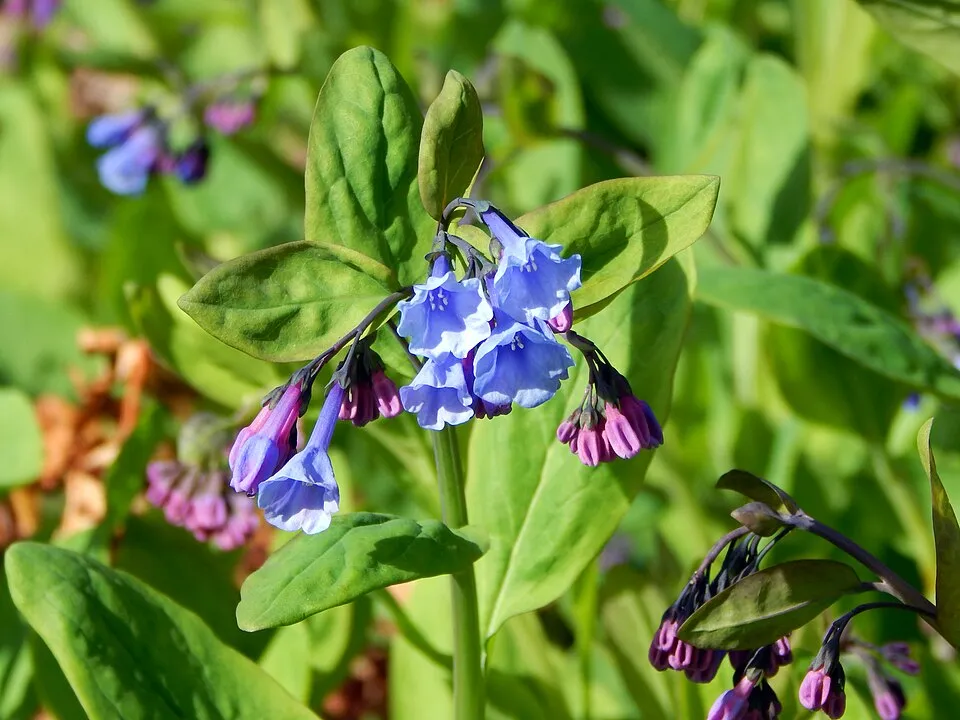
Virginia Bluebells (Mertensia virginica) in full bloom, showing clusters of sky-blue trumpet flowers with pink buds above blue-green foliage
Mertensia virginica — pink buds and sky-blue flowers create one of the most spectacular spring displays in the eastern deciduous forest. Photo: Rooted Revival.

Identification

[ field key · leaves · flowers · pink-to-blue transition · distinction from related species ]

Leaves & Foliage

Virginia Bluebells produces two distinct types of leaves: basal leaves that arise directly from the rootstock on long petioles and are large (3–8 in long), broadly ovate to elliptic, with smooth margins and parallel veins, and stem leaves that are alternate, smaller, sessile (attached directly to the stem), and more lanceolate. The foliage is smooth (glabrous), fleshy, and distinctly blue-green — the color is one of the best field marks for the plant, even before it blooms. The leaves are covered with a slight waxy bloom (glaucous) that gives them a soft, silvery-blue cast. The foliage emerges in March as a tight rosette that expands rapidly as the flower stalks elongate. After flowering, the leaves continue to photosynthesize for a few weeks, gradually yellowing, and by late June or July the entire plant has retreated underground.

Flowers & the Pink-to-Blue Transition

The inflorescence is a loose, terminal cluster (cyme) of 15–30 nodding flowers at the top of each flowering stem. The most striking feature is the color change: buds open as rich pink to magenta, and over the course of a day or two, the flowers transition to brilliant sky-blue. This color change is caused by a shift in the pH of the cell sap in the petals (anthocyanin pigments are pink in acidic conditions and blue in alkaline conditions), and it serves as a signal to pollinators: the pink buds have not yet opened and offer no nectar, while the blue flowers are fully open and ready for pollination. The result is a cluster that simultaneously displays pink buds and blue open flowers, a color combination that is both beautiful and ecologically functional. Each flower is trumpet-shaped (tubular), about 1 in long, with five shallow lobes at the opening. The inside of the tube is paler, often white to very pale blue, with a ring of small ridges (fornices) at the throat.

Underground Structure & Growth Cycle

The plant grows from a fleshy, branching taproot (not a bulb or corm) that penetrates deep into the soil and stores the carbohydrates needed for the rapid spring growth spurt. The root is thick, somewhat brittle, and pale, and it resents disturbance — a reminder that bluebells should be transplanted when dormant, not during the active growth season. Unlike many spring ephemerals that spread primarily by seed, Virginia Bluebells also spreads vegetatively via short lateral roots, allowing individual plants to form expanding clumps over several years. The plant's complete cycle — emergence, growth, flowering, seed set, and senescence — takes approximately 10–14 weeks, from the first shoots breaking the soil in March to the last yellowing leaves collapsing in June.

Distinction from Similar Species

The combination of large, smooth, blue-green leaves and pink-buds-to-blue-flowers in nodding clusters is unique in the Oklahoma spring flora, and no other common woodland species presents a similar profile. The most likely point of confusion in the garden is with garden comfrey (Symphytum officinale) or Russian comfrey, which are in the same family (Boraginaceae) and share the broad, rough-hairy leaves and tubular flowers. However, comfrey's flowers are typically purple, pink, or white (not clear sky-blue), and its foliage is roughly hairy (scabrous) rather than smooth, and the plant is not an ephemeral — comfrey persists above ground through the growing season. In the wild, Virginia Bluebells can be confused with wild comfrey (Cynoglossum virginianum), but that plant's flowers are smaller, paler blue, and the leaves are rough, not smooth.

Habitat & Range in NE Oklahoma

Mertensia virginica reaches the southwestern limit of its continuous range in northeastern Oklahoma, where it is associated with the deep, rich, moist alluvial soils of major river bottomlands and their tributary floodplains. The species is at the very edge of its climate tolerance in this region — it requires consistent spring moisture, cool soil temperatures, and the protection of high deciduous canopy, conditions that in Oklahoma are found primarily in:

In the immediate Tulsa area, Virginia Bluebells is not a common wild plant — the combination of hot summers, erratic spring precipitation, and widespread floodplain clearing has eliminated most natural habitat. However, the species is widely available in the nursery trade (unlike many ephemerals that are difficult to propagate) and is one of the easiest spring wildflowers to establish in a prepared woodland garden. It is more tolerant of garden conditions than most ephemerals and will thrive where the soil has been amended with organic matter and the site receives consistent spring moisture.

Ecology & Wildlife Value

[ bumblebee pollination · color-change signal · Lepidoptera · deer resistance · ant dispersal ]

Pollinators & the Pink-to-Blue Signal

The flowers of Virginia Bluebells are pollinated primarily by long- tongued bees, including queen bumblebees (Bombus impatiens, B. pensylvanicus, B. bimaculatus), Anthophorine bees (digger bees), and large carpenter bees (Xylocopa virginica). The narrow, tubular corolla requires a long tongue to reach the nectar at the base, which excludes short-tongued bees and most flies. The pink-to-blue color change functions as a long-distance pollinator signal: from a distance, the mixed pink-and-blue cluster is highly visible against the brown forest floor, and the preponderance of blue (fully open, nectar- available) flowers in a cluster tells incoming bees that the stop is worth making. Ruby-throated hummingbirds have been observed visiting the flowers during their northward migration in April, though they are not the primary pollinators. Butterflies (spring azures, mourning cloaks) visit occasionally but are ineffective at transferring pollen due to the flower's architecture.

Lepidoptera & Herbivory

The foliage of Mertensia virginica is consumed by the larvae of at least several moth species, though host-plant documentation for the genus is sparse relative to more intensively studied plants. The most significant ecological relationship with insects is the pollination mutualism with long-tongued bees. White-tailed deer browse on Virginia Bluebells is generally light to moderate — the foliage is not a preferred food, and in a mixed understory, the plants often escape heavy browsing. However, in areas with severe deer overpopulation, bluebells can be grazed to the ground, and a wire cage may be necessary to protect garden plantings during the active growth period.

Birds & Mammals

The primary interaction with vertebrates is through seed dispersal by ants (myrmecochory). The seeds bear small elaiosomes that attract Aphaenogaster and other ant species, which carry the seeds to their nests and facilitate short-distance dispersal. Birds do not appear to consume the seeds directly, and the plant's contribution to the bird food web is primarily indirect, through the support of pollinator populations that sustain insectivorous birds. Small mammals occasionally dig up and consume the fleshy roots during winter dormancy.

Colony Formation & Landscape Ecology

The combination of myrmecochory (ant seed dispersal) and short- distance vegetative spread via lateral roots means that Virginia Bluebells forms dense, expanding colonies in favorable sites. In a well-established colony, the plants can reach densities of 20–50 flowering stems per square yard, producing a display that is visible from a considerable distance through the still-bare April woods. The colonies expand slowly (typically less than a foot per year in radius), and the largest, most spectacular colonies in the wild are often decades old, occupying the same site year after year. The senescence of the foliage in June contributes a significant pulse of high-nitrogen leaf litter to the soil, which benefits summer-emerging species that occupy the same ground.

Horticulture & Care

[ shade garden · soil · planting · companion design · summer follow-on ]

Site selection & planting

Virginia Bluebells wants a site that receives full sun in March and April and dappled to full shade from May onward. The ideal location is beneath a high-canopy deciduous tree (oak, maple, sycamore) on the south side, where the low-angle early-spring sun reaches the ground but the full leaf canopy provides deep shade by summer. The soil should be rich, deep, and moisture- retentive but well-drained. Bluebells are more tolerant of heavy clay than many woodland ephemerals, but the soil must be loose enough for the fleshy taproot to penetrate. Amend with 3–4 in of compost, leaf mold, or well-rotted manure worked into the top 12 in.

Managing the dormant bed

The biggest challenge with Virginia Bluebells in the garden is not growing them — it is remembering where they are after they go dormant. By July, the planting bed is completely bare, with no above-ground trace of the plants, and it is easy to accidentally dig into the dormant roots or plant something over them. Strategies:

Companion planting

Virginia Bluebells pairs spectacularly with other spring ephemerals and with summer- emergent woodland plants. Companions for the spring display: bloodroot (Sanguinaria canadensis) for early white flowers alongside the emerging bluebell foliage, Dutchman's Breeches (Dicentra cucullaria) for finely cut foliage and white pantaloon flowers at a lower height, Toadshade (Trillium sessile) for maroon flowers and mottled leaves, and Cut-leaved Toothwort (Cardamine concatenata) for delicate white-to-pink flowers. For summer cover after the bluebells go dormant: ostrich fern (Matteuccia struthiopteris) for tall, lush fronds, true Solomon's seal (Polygonatum biflorum) for arching foliage, wild ginger (Asarum canadense) for a low, evergreen groundcover, and Christmas fern (Polystichum acrostichoides) for winter structure. Underplanted beneath eastern redbud or spicebush, a drift of Virginia Bluebells creates an April destination that rivals anything in the perennial border.

Edible & Cultural Uses

Virginia Bluebells are not widely documented as a food or medicine plant among Indigenous peoples of eastern North America, and the plant should be considered inedible. The genus Mertensia contains pyrrolizidine alkaloids in some species (common in the Boraginaceae, including comfrey and borage), and while M. virginica has not been specifically implicated in toxicity cases, the precautionary principle dictates that no part of the plant should be consumed. The plant's cultural value is primarily ornamental: it has been a beloved garden plant since the early days of American horticulture and was among the first native wildflowers brought into cultivation by colonial gardeners. Thomas Jefferson recorded Virginia Bluebells in his garden at Monticello (along with Twinleaf, which was named for him), and the plant remains one of the most popular and widely available native ephemerals in the nursery trade.

Photo Reference

Close-up of the pink-buds-to-blue-flowers of Mertensia virginica in an April cluster
// Flowers — the diagnostic pink buds transitioning to sky-blue open trumpets
Wikimedia Commons
Wikimedia Commons
A spectacular colony of Virginia Bluebells forming a sea of blue on the forest floor
// Colony — a mature stand in full April bloom, forming the classic "sea of blue"
Wikimedia Commons
Wikimedia Commons
The smooth, blue-green ovate leaves of Mertensia virginica emerging in March
// Foliage — the large, smooth, blue-green basal leaves before flowering
Wikimedia Commons
Wikimedia Commons
Pink buds of Mertensia virginica before opening to blue flowers
// Bud stage — the rich pink buds before the pH shift turns them blue
Wikimedia Commons
Wikimedia Commons

Sources & Further Reading

  • USDA NRCS PLANTS Database — Mertensia virginica: plants.usda.gov/plant-profile/MEVI3
  • Lady Bird Johnson Wildflower Center — Native Plant Database: wildflower.org — MEVI3
  • Flora of North America — Mertensia (Vol. 15): efloras.org
  • Weiss, M.R. (1995). Floral color change: A widespread functional convergence. American Journal of Botany 82(2):167–185 — on the pink-to-blue transition as pollinator signal.
  • Wikipedia — Mertensia virginica: en.wikipedia.org/wiki/Mertensia_virginica (CC BY-SA 4.0; portions of the description, ecology and uses sections summarize Wikipedia content).
  • Oklahoma Biological Survey — Atlas of Oklahoma Flora: biosurvey.ou.edu

Hero photo: Rooted Revival. Strip photos courtesy of Wikimedia Commons contributors under their respective licenses (linked under each image).