home/ plants/ copper-iris

// SPECIES PROFILE · PERENNIAL · NATIVE IRIS · HUMMINGBIRD POLLINATED

Copper Iris

Iris fulva

Copper Iris is the warm-toned wonder of the southern swamps — a slender, arching native iris that produces flowers in a shade range entirely unlike any other North American iris: terracotta, coppery-red, brick, and rusty orange, sometimes with faint yellow signals at the base of the falls. Standing 2–3 feet tall with blade-thin, sword-shaped leaves, it is found in the muddy, seasonally flooded bottoms of sloughs and slow rivers throughout the Mississippi drainage, reaching its northwestern range limit in NE Oklahoma's Arkansas and Grand (Neosho) River bottoms. The flowers, which open in late April through May, are among the earliest wetland blooms to attract ruby-throated hummingbirds returning from migration — a co-evolutionary relationship unique among North American iris species.

// QUICK FACTS
Family
Iridaceae (iris family)
Life cycle
Perennial, from thick creeping rhizomes
Native range
Lower Mississippi drainage; Illinois to Louisiana and Texas, NW limit in E Oklahoma
USDA hardiness
Zones 5–9 (Tulsa = 7a/7b, cold-hardy here)
Mature size
2–3 ft tall, clumps spreading 1–2 ft wide
Bloom
Late April – late May (NE OK)
Flower color
Terracotta, brick-red, copper, rusty orange; 3–4 in wide
Sun
Full sun to partial shade; best bloom in 5+ hrs sun
Soil
Hydric to mesic; heavy clay, silty loam; tolerates seasonal inundation
Water
Moist to wet; tolerates standing water in winter/spring, drier in summer
Wildlife
Ruby-throated hummingbird · native bees · larval host for iris borer (minor)
Conservation
Globally secure (G5); uncommon at NW edge of range in OK
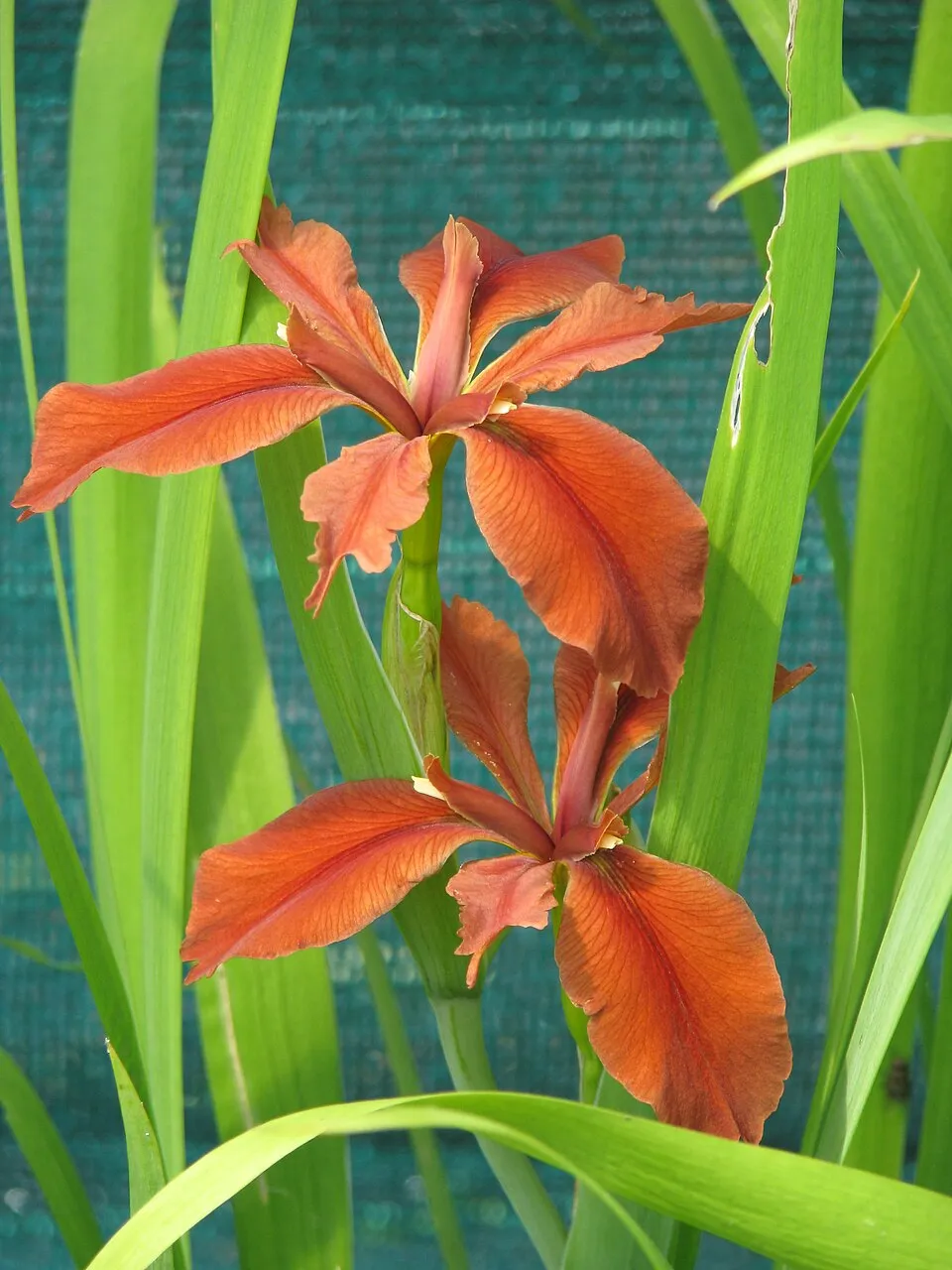
Copper Iris (Iris fulva) in bloom with distinctive terracotta-red falls and erect standards
Iris fulva at peak bloom — the unique coppery-red falls and smaller, erect standards distinguish it from all other native irises; the flower shape is adapted for hummingbird pollination. Photo: Rooted Revival.

Identification

[ field key — rhizome · leaf · flower · fruit · look-alikes ]

Habit & Rhizome

Herbaceous perennial rising from a thick, green, creeping rhizome that lies just below or at the soil surface. The rhizome bears distinct annual constrictions marking each year's growth increment and is notable for its bright green interior when cut — a trait shared with other irises in the Louisiana iris complex (Iris series Hexagonae). Plants form loose, open clumps with evident spaces between individual shoots, not tight tussocks. The rhizome can be divided easily with a sharp knife and transplanted in the same manner as garden bearded irises.

Leaves

Leaves are erect to gracefully arching, sword-shaped (ensiform), 1–3 ft long and about 1 in wide, bright green with a prominent midrib. They emerge from the rhizome in a fan-like arrangement (equitant) typical of irises. Unlike many garden irises, the foliage of I. fulva is relatively thin-textured and flexible, not stiff or glaucous. In its native habitat, leaves often show signs of mud splashing and temporary submergence during spring floods without ill effect. Foliage remains attractive through summer if soils are not allowed to desiccate completely.

Flowers

The flowers of Copper Iris are unique among North American irises: they lack the complex color patterns, beards, and crests typical of most garden irises. Each flower is 3–4 in across with three broad, drooping falls (sepals) and three smaller, erect standards (petals), all in the same terracotta-to-brick-red color range. The falls are flat and unmarked except for a small, raised yellow signal patch at the base. The flower tube (perianth tube) is relatively long and narrow — an adaptation for pollination by hummingbirds rather than bees. One to two flowers open per stem, each lasting several days. Blooms emerge from late April through May in the Tulsa region.

Fruit & Seed

After pollination, the ovary develops into a large, six-angled (hexagonal in cross-section), green capsule 1.5–3 in long, held erect on the stem well above the foliage. At maturity in late summer, the capsule splits into three sections to release large, corky-coated, discoid brown seeds that float — an adaptation for water dispersal across the floodplain. Seeds can be collected and sown fresh for propagation; they require cold-moist stratification (60–90 days) to break dormancy.

Habitat & Range in NE Oklahoma

Iris fulva is a species of the lower Mississippi River drainage, with its distribution centered on the Mississippi Alluvial Plain from southern Illinois through Missouri, Kentucky, Arkansas, Louisiana, and eastern Texas. It reaches the northwestern limit of its natural range in eastern Oklahoma, occurring sparingly but consistently in the bottomland forests and sloughs of the Arkansas River and Grand (Neosho) River systems. In the Tulsa region, wild populations have been documented in Wagoner, Muskogee, and McIntosh counties, particularly in the forested backwater areas of the Verdigris River bottoms and the muddy margins of oxbow lakes.

The signature habitat of Copper Iris is the seasonally flooded bottomland hardwood swamp — those low, clay-rich flats under overcup oak (Quercus lyrata), water hickory (Carya aquatica), and bald cypress where standing water persists from winter through early spring and recedes gradually through summer. It also occurs in marshy swales, sluggish stream margins, and wet pastures in the Arkansas River Valley. Gardeners in the Tulsa metropolitan area are at the far northern edge of this plant's climatic tolerance, but it is reliably hardy here with proper siting.

Ecology & Wildlife Value

[ hummingbird pollination · water-dispersed seed · floodplain ecology ]

Hummingbird Pollination

Iris fulva is pollinated primarily by ruby-throated hummingbirds (Archilochus colubris) — one of only a handful of North American irises to have evolved this pollination strategy. The flower's long, narrow perianth tube, reddish color (hummingbirds are strongly attracted to red and orange wavelengths), and early spring bloom timing (coinciding with hummingbird northward migration through Oklahoma) are all convergent traits of ornithophily. Research by Emms and others has confirmed that I. fulva flowers produce nectar at concentrations (20–25% sucrose equivalent) and volumes suitable for hummingbird visitation, and that fruit set is significantly reduced when hummingbirds are excluded.

Insect Visitors & Pests

While hummingbirds are the primary pollinators, large carpenter bees (Xylocopa virginica) and bumblebees occasionally visit Copper Iris flowers for pollen and may effect some incidental pollination. The iris borer (Macronoctua onusta) is a known pest of I. fulva throughout its range; larvae burrow into the rhizome, opening wounds for bacterial soft rot (Erwinia carotovora). In moist, well-maintained garden conditions, borers are rarely severe enough to kill plants but should be monitored.

Dispersal & Floodplain Ecology

The corky, buoyant seeds are adapted for hydrochory (water dispersal) across the floodplain — a key reproductive strategy in the species' native bottomland hardwood swamp habitat. Seeds float on floodwater for days to weeks, settling onto mud as water recedes, where they germinate the following spring. This dispersal mechanism explains the species' linear distribution along river corridors and its tendency to colonize new sites after major flood events. The thick underground rhizome serves as an energy reserve that allows plants to survive prolonged submergence during winter and spring floods and re-sprout rapidly when water recedes.

Role in Bottomland Communities

Copper Iris occupies a narrow ecological niche in the herbaceous understory of bottomland hardwood forests, growing alongside lizard's tail (Saururus cernuus), false nettle (Boehmeria cylindrica), and sedges. Its dense, fibrous root system helps stabilize mudbanks and slough edges during flood recession. The robust foliage provides cover for frogs, salamanders, and small wetland birds in the early growing season before the forest canopy closures.

Conservation context: While globally secure, Iris fulva is rare at the edges of its range. In Oklahoma, it is considered an S2 (imperiled) species due to limited populations and habitat loss from channelization, reservoir construction, and bottomland forest clearing. Garden cultivation using nursery-propagated stock (never wild-collected plants) helps preserve the genetic resources of this unique iris.

Horticulture & Care

[ siting · soil · water · division · companion planting ]

Site selection & planting

Copper Iris performs best in moist to wet, rich soil in full sun to partial shade. In the Tulsa region, provide morning sun with some afternoon protection from the intense July–August sun — dappled shade beneath a high-canopy tree like pecan or black tupelo is ideal. This is not a pond plant to submerge — it wants moist soil that does not dry out but does not require standing water through summer. Amend heavy clay with composted leaf mold; in sandy soils, incorporate generous organic matter to improve water retention.

Maintenance & propagation

Copper Iris is low-maintenance once established. Remove spent flower stalks after bloom to prevent energy diversion to seed (unless seed propagation is desired). Cut back dead foliage to the ground in late winter (February) before new growth emerges. Divide every 3–4 years in late summer or early fall, when plants are semi-dormant: lift the clump, cut the rhizome into sections each with at least one growth bud and healthy roots, and replant immediately. Discard any rhizome sections showing soft rot or borer damage.

Pests & diseases

Companion planting

Copper Iris belongs in the moist woodland garden or wet-meadow border. Excellent companions include: cardinal flower (Lobelia cardinalis) for a stunning red-on-red combination with hummingbird appeal doubled; great blue lobelia for cool contrast later in the season; marsh marigold (Caltha palustris) for early-spring yellow beneath the iris foliage; buttonbush as a taller backdrop shrub; and Christmas fern or maidenhair fern for evergreen ground-layer texture. All Louisiana iris species and hybrids (Iris series Hexagonae) are compatible garden partners.

Do not dig from the wild. All native iris populations in Oklahoma are limited. Purchase only nursery-propagated stock from reputable native plant nurseries. Wild collection threatens the few remaining Oklahoma populations and is illegal on public lands without authorization.

Cultural & Horticultural Significance

Iris fulva is one of the five species that make up the famed "Louisiana Iris" complex (Iris series Hexagonae), a group of closely related wetland irises native to the southeastern United States that freely hybridize with one another in cultivation, producing thousands of named cultivars in colors spanning the spectrum. The Copper Iris contributes the warm terracotta and red tones to the Louisiana iris gene pool. It and its hybrids are the official state wildflower of Louisiana (designated as the Louisiana iris collective).

Indigenous peoples of the lower Mississippi Valley, including the Choctaw, used iris rhizomes for medicinal preparations, particularly as a poultice for sores and skin conditions. The tough, fibrous leaves have historically been used for basketry and cordage by several Southeastern tribes. In Cherokee culture, irises found in bottomland settings were often associated with water and renewal.

Photo Reference

Close-up of Iris fulva flower showing terracotta falls and yellow signal patch
// Flower detail — terracotta falls with yellow signal patch
Wikimedia Commons
Wikimedia Commons
Clump of Iris fulva in a garden setting with multiple blooms
// Garden clump — mature planting with multiple flowering stems
Wikimedia Commons
Wikimedia Commons
Iris fulva in its native bottomland slough habitat
// Native habitat — bottomland slough with seasonal standing water
Wikimedia Commons
Wikimedia Commons
Mature hexagonal seed capsule of Iris fulva
// Seed capsule — six-angled fruit splitting to release floating seeds
Wikimedia Commons
Wikimedia Commons
Ruby-throated hummingbird visiting an Iris fulva flower
// Ruby-throated hummingbird — the primary pollinator of Copper Iris
Wikimedia Commons
Wikimedia Commons

Sources & Further Reading

  • USDA NRCS PLANTS Database — Iris fulva: plants.usda.gov/plant-profile/IRFU
  • Lady Bird Johnson Wildflower Center — Native Plant Database: wildflower.org — IRFU
  • Society for Louisiana Irises — Iris fulva species profile and cultivation guide: louisianas.org
  • Emms, S.K. & M.L. Arnold (2000). Site-to-site differences in pollinator visitation patterns in a Louisiana iris hybrid zone. Oikos 91:568–578.
  • Taylor, S.J. et al. (2012). Pollination ecology of Iris fulva (Iridaceae), a hummingbird-pollinated species. Journal of the Botanical Research Institute of Texas 6:281–289.
  • Oklahoma Natural Heritage Inventory — species ranking for Iris fulva (S2 imperiled in state).
  • Flora of North America, Vol. 26 — Iris treatment, including I. fulva description and distribution.
  • Wikipedia — Iris fulva: en.wikipedia.org/wiki/Iris_fulva (CC BY-SA 4.0; portions of the description summarize Wikipedia content).
  • Native American Ethnobotany Database (University of Michigan–Dearborn) — Iris traditional uses.

Hero photo: Rooted Revival. Strip photos courtesy of Wikimedia Commons contributors under their respective licenses (linked under each image).