// SPECIES PROFILE · BIENNIAL / SHORT-LIVED PERENNIAL · NATIVE · MEDICINAL
Common Evening Primrose is the tall, weedy-looking biennial you see along every gravel road, fallow field, and railroad cut in NE Oklahoma from June through September — but do not dismiss it as a roadside nuisance. This plant is one of the great evening-spectacle natives of North America: a spike of pale-yellow, four-petaled blooms that unfurl at dusk in real time, each flower lasting a single night before wilting by noon the following day. The flowers are pollinated by nocturnal sphinx moths (Hyles and Manduca species) that hover like hummingbirds in the gathering dark, and the seeds that follow are a staple winter food for goldfinches. The entire plant is edible — root, leaf, flower, and seed — and the seed oil is the commercial source of gamma-linolenic acid (GLA), used worldwide for skin conditions, hormonal balance, and inflammatory disorders. This is a plant that feeds moths at night, goldfinches in winter, and humans all year round.

[ field key — rosette · stem · leaf · flower · fruit · distinguishing features ]
Biennial, occasionally a short-lived perennial when conditions are mild. The first year produces a low, flat basal rosette of leaves 6–12 in across that sits close to the ground through winter; it looks like a coarse, weedy lettuce and is easy to overlook. In the second year, a stout, erect flowering stalk bolts from the rosette center, reaching 3–6 ft tall (and occasionally taller on rich soil). The stem is unbranched or lightly branched above, angular in cross-section, and covered in fine white hairs that give it a slightly gray-green appearance. After setting seed, the plant dies, but self-sown seedlings reliably replace it.
Alternate, simple, lanceolate to elliptic, 2–8 in long, with prominent white or pink midribs that are a helpful field mark. Margins are wavy to shallowly toothed, and the leaf surface is pubescent with short, soft hairs that feel velvety rather than rough. Basal leaves (rosette year) are larger and have distinct petioles; stem leaves are progressively smaller up the stalk and become sessile or nearly clasping the stem near the top. The leaves often take on reddish tints in autumn, especially on stressed or nutrient-poor soils.
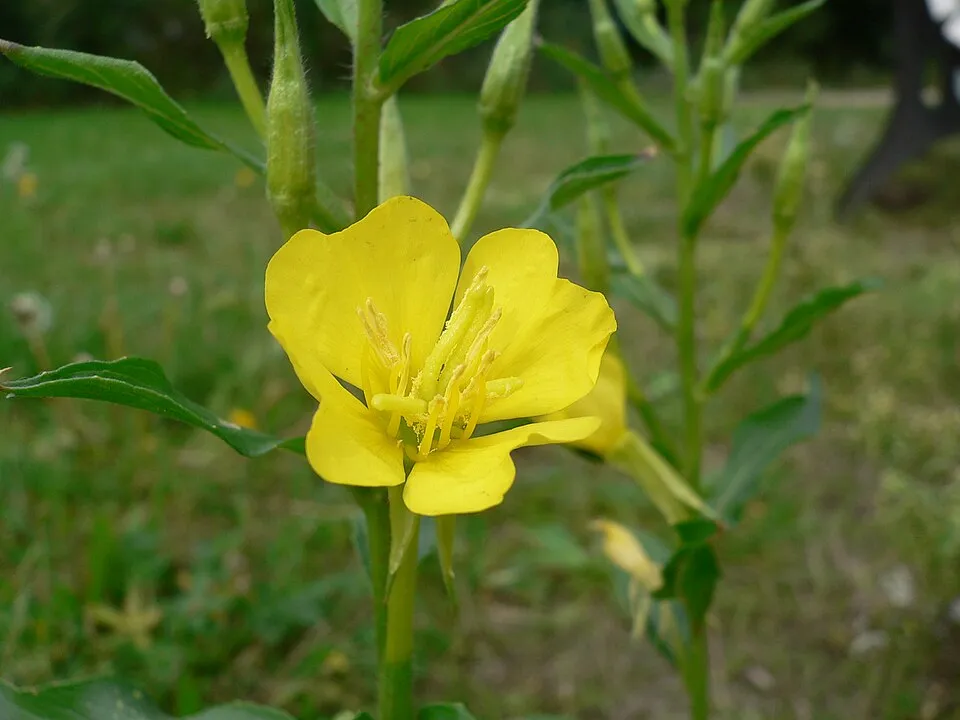
The flowers are what make this plant memorable. Each bloom is bright yellow, 1–2 in across, with four broad, slightly overlapping petals and a distinctive cross-shaped (X-form) stigma in the center. Flowers are borne in a terminal spike that elongates as the season progresses, with the lowermost flowers opening first. Blooms open at dusk, often visibly unfurling in under a minute (you can sit and watch it happen on a summer evening — genuinely worth doing once). They emit a faint sweet fragrance at night to attract sphinx moths. By the following noon, the petals have wilted to a translucent orange-pink and collapsed, but new buds further up the spike are ready to open that same evening. The long, slender hypanthium (floral tube) below the petals is a key character separating Oenothera from look-alike yellow four-petaled flowers.
After pollination, each flower develops into an upright, woody, four-chambered capsule ½–1½ in long that splits open at the top when ripe, releasing numerous tiny, angular, dark brown seeds (roughly 1–2 mm). A single plant can produce thousands of seeds, which accounts for the species' aggressive self-sowing habit. The seed capsules persist on the dried stalk through winter and are a distinctive identification feature even after the leaves have withered — look for the upright, cigar-shaped pods clustered around the upper stem.
Oenothera biennis is native to eastern and central North America and is now naturalized across temperate regions worldwide. In NE Oklahoma it is ubiquitous in disturbed, open habitats: roadsides, gravel shoulders, railroad rights-of-way, abandoned lots, old fields, fallow agricultural ground, overgrazed pastures, and the edges of parking lots and construction sites. It is a textbook pioneer species of bare or recently disturbed soil and one of the first natives to colonize a bulldozed site or a newly scraped lot.
Beyond the disturbed-ground niche, Common Evening Primrose also occurs naturally in tallgrass prairie remnants, glade margins, open woodlands, and along sandy or gravelly stream bars throughout the region. It is common in the Cross Timbers wherever the canopy opens up — old burn sites, treefall gaps, and the margins of prairie openings within the post oak-blackjack oak matrix. It is equally at home in the Arkansas River floodplain on sandy alluvium, on the limestone glades of the Ozark foothills, and in the heavy red clay of Tulsa's suburban sprawl. If you have not planted it and it shows up anyway, it has chosen your site.
[ nocturnal pollination · sphinx moths · specialist bees · seed-eating birds ]
Common Evening Primrose is one of the finest examples of sphingophily (hawk-moth pollination) in the NE Oklahoma flora. The pale yellow flowers open at dusk, emit a sweet fragrance, and produce nectar in a long floral tube accessible only to insects with a proboscis long enough to reach it. The primary pollinators are sphinx moths (family Sphingidae), especially Hyles lineata (white-lined sphinx), Manduca quinquemaculata (five-spotted hawkmoth / tomato hornworm adult), and Manduca sexta (Carolina sphinx / tobacco hornworm adult). These large moths hover precisely in front of each flower, uncoiling their long proboscis to drink nectar while dusting themselves with pollen. Watching sphinx moths work an Evening Primrose spike in the half-light after sunset, with the moths silhouetted against a fading sky, is one of the quiet pleasures of a native plant garden.
Although the flowers wilt by midday, morning hours see visitation from bumblebees (Bombus impatiens, B. pensylvanicus) and various halictid bees that work the still-fresh blooms before they collapse. The flowers are not especially rich in pollen compared to composites or mints, but they offer a consistent nectar source during the early morning window. Several specialist bees in the genus Lasioglossum (subgenus Sphecodogastra) are Oenothera specialists that forage exclusively on evening primrose pollen and are active during the crepuscular (twilight) period when the flowers first open — a remarkable example of temporal niche partitioning.
The small, oil-rich seeds of Common Evening Primrose are an important food source for winter birds in NE Oklahoma. American goldfinches are the most consistent visitors, perching on the dried stalks from October through February and extracting seeds from the upright capsules. Dark-eyed juncos, field sparrows, song sparrows, and pine siskins also forage on evening primrose seed. White-tailed deer browse the young rosettes in winter, and cottontail rabbits will eat both the basal leaves and the lower portions of the flowering stalk. The plant's abundant seed production and willingness to grow in marginal soil mean it effectively subsidizes the winter bird population with minimal competition for garden space.
As a pioneer species of disturbed soil, O. biennis plays a specific ecological role: it is among the first herbaceous plants to establish on bare mineral soil, stabilizing the surface with its taproot, adding organic matter through leaf litter, and creating microsites where slower-establishing perennials and grasses can germinate. The seeds remain viable in the soil seed bank for decades — one reason the species appears so reliably after soil disturbance. In a restoration context, evening primrose can be a useful nurse crop for prairie and meadow plantings, providing quick cover and wildlife value while slower perennials establish.
[ site selection · direct-sow · management · companion planting ]
Common Evening Primrose is exceptionally easy to grow — on the spectrum from "deliberate cultivation" to "it just showed up," it leans toward the latter. Direct-sow seed in fall or early spring onto bare, raked soil; the seed needs light to germinate, so press it into the surface rather than burying it. Pick a site with full sun for best flowering; the plant tolerates partial shade but will be leggier and bloom less. Virtually any soil will do, from pure sand to heavy clay, as long as drainage is reasonable. The species is drought-tolerant once the rosette is established but will grow taller and flower longer with occasional water during prolonged dry spells.
Common Evening Primrose self-sows prolifically. A single plant left to seed will produce hundreds of seedlings the following spring. This is either a feature or a problem depending on your goals:
Common Evening Primrose fits naturally into a wildlife meadow, prairie restoration, or informal cottage garden where its weedy rosette year and tall, angular second-year form are assets rather than liabilities. It pairs well with: Butterfly Milkweed and Common Sunflower for a pollinator strip that feeds both diurnal and nocturnal insects; Gray Goldenrod and Rough Blazing Star for late-season bird seed; and Little Bluestem or Sideoats Grama as a grass matrix that provides structural support. The Missouri Evening Primrose offers a low-growing counterpart for the front of the same planting.
The entire Common Evening Primrose plant is edible at various stages, and several parts have a long history of medicinal use by both Indigenous peoples and modern herbalists.
Evening Primrose Oil is one of the most widely used herbal supplements worldwide, standardized for its gamma-linolenic acid (GLA) content. GLA is an omega-6 fatty acid that serves as a precursor to anti-inflammatory prostaglandins in the body. Clinically, EPO is used for:
Indigenous peoples of North America used Evening Primrose differently — primarily as a poultice made from the mashed root or leaves for bruises, skin sores, and insect bites. The Cherokee used a root tea for obesity and as a general tonic. The Iroquois made a poultice from the whole plant for hemorrhoids. The common name "King's Cure-all" reflects the plant's broad traditional application across multiple body systems.
Hero photo: Rooted Revival. Strip photos courtesy of Wikimedia Commons contributors under their respective licenses (linked under each image).