// SPECIES PROFILE · PERENNIAL · NATIVE · GROUNDCOVER · DROUGHT-PROOF
Showy Evening Primrose — often called Pink Ladies or Mexican Evening Primrose — is the delicate, cup-shaped pink-to-white wildflower that carpets roadsides, old fields, and prairie edges across NE Oklahoma from April through July (and sporadically into fall). It is a low, sprawling, aggressively spreading native perennial that forms large colonies via rhizomes, creating a pink-and-white haze at ground level that stops traffic on County Line Road every May. Oenothera speciosa is arguably the most drought-proof native groundcover available for the Tulsa region — it thrives on neglect, heat, and unwatered clay, spreading across slopes, parking strips, and any sunny, well-drained ground where nothing else wants to grow. The flowers open in the evening, remain open through the morning, and close by afternoon, with each delicate bloom lasting just one day — but the colony produces new flowers daily for months on end.

[ field key — habit · leaf · flower · fruit ]
Low, sprawling, colony-forming perennial that spreads aggressively by underground rhizomes and above-ground stolons. Stems are slender, decumbent to ascending, 6–18 in tall, often reddish, and finely hairy. Individual plants are wispy and delicate, but the collective effect of a mature colony is a dense, continuous groundcover that excludes most weeds. The plant is deciduous in winter in Zone 7, dying back completely to the rhizomes and re-emerging in early spring. New shoots appear in March and grow rapidly, with flowers beginning in April.
Alternate, simple, lance-shaped to narrowly elliptical, 1–3 in long, with shallowly toothed to deeply pinnatifid (lobed) margins — the degree of leaf lobing is highly variable and ranges from nearly entire on some plants to deeply cut on others. Leaves are medium green, finely hairy on both surfaces, and may have a reddish midrib. The variable leaf lobing can make vegetative identification confusing, but the distinctive flowers are unmistakable once they appear. This leaf variability is a known character of O. speciosa and should not cause misidentification.
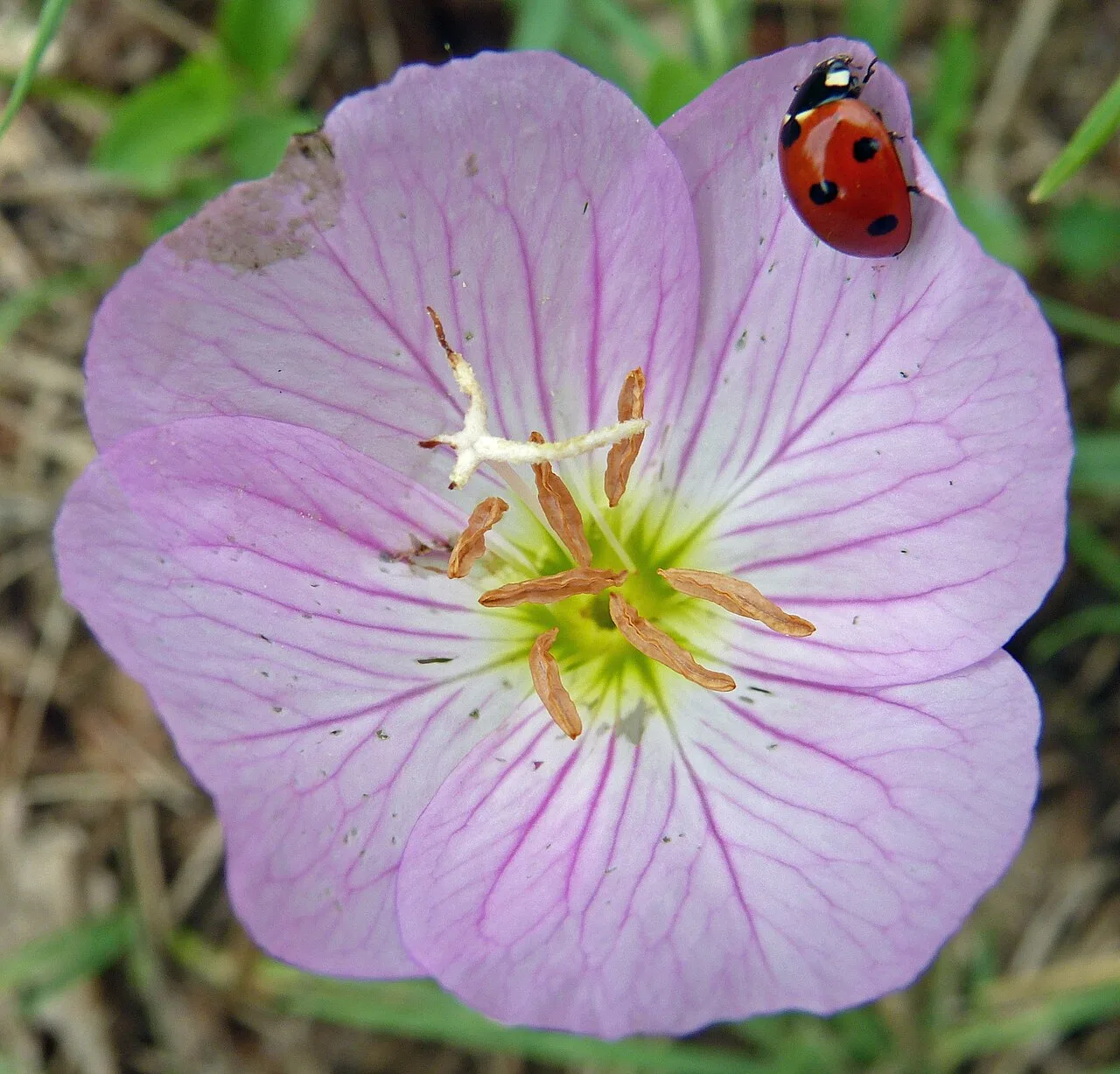
Flowers are large (2–3 in across), cup-shaped, and delicate, with four broad, tissue-thin petals that are pale pink to white with darker pink veins and a yellow to yellow-green center. The petals have a finely crinkled texture and a satiny sheen. The flowers open in the evening (crepuscular) and remain open through the following morning, closing by early afternoon. Each flower lasts only one day, but colonies produce new blooms daily for 8–12+ weeks. The pale color and evening opening suggest pollination by nocturnal sphinx moths, though daytime bees also visit the open flowers in the morning hours.
Fruits are elongated, club-shaped capsules about ½–1 in long, with prominent ribs, splitting open at maturity to release numerous small, angular, dark seeds. The seeds are produced abundantly and contribute to the plant's spread, though rhizome and stolon expansion is the primary means of colony formation. The plant self-sows readily into nearby bare ground, and a single established colony can produce thousands of seeds annually. Deadheading does little to prolong bloom — the colony produces flowers continuously regardless, and removing spent flowers primarily reduces self-seeding in unwanted areas.
Oenothera speciosa is native to the south-central US and northern Mexico, with a range extending from Nebraska and Missouri south through Oklahoma and Texas into Mexico. In NE Oklahoma, it is an abundant and conspicuous component of roadsides, old fields, prairies, open meadows, railroad rights-of-way, and disturbed ground throughout the region. It is one of the most visible and beloved spring wildflowers in the Tulsa area, forming vast pink drifts along highways and county roads from late April through June. The sheer visual impact of a mature O. speciosa colony in full bloom is one of the defining sights of the Oklahoma spring landscape.
The plant is remarkably adaptable: it thrives on the heavy red clay of NE Oklahoma subdivisions, on the sandy terraces of the Arkansas River, on limestone glades, on gravelly roadsides, and in the compacted soil of strip-mall parking lot islands. It needs only full sun and drainage — it will not persist in shade or in soil that stays saturated through winter. It is frequently seen in association with Indian blanket, black-eyed Susan, plains coreopsis, and lemon beebalm, forming a classic NE Oklahoma roadside wildflower community in late spring and early summer. The Oklahoma state wildflower is Gaillardia pulchella, but Oenothera speciosa gives it serious competition for roadside dominance each spring.
[ pollination · lepidoptera · wildlife · ecological role ]
The evening-opening, pale-colored, lightly fragrant flowers are a classic example of nocturnal moth pollination (sphingophily). Sphinx moths (Sphingidae) — especially the white-lined sphinx (Hyles lineata) — are the primary nocturnal pollinators, visiting at dusk to drink nectar with their long proboscises. During the morning hours before the flowers close, bumblebees, honeybees, sweat bees, and various solitary bees also visit for nectar and pollen. The combination of nocturnal and diurnal pollination ensures reproductive success regardless of weather conditions or moth activity levels.
Oenothera species are larval hosts for the white-lined sphinx moth (Hyles lineata) and several other sphinx moths whose caterpillars (hornworms) feed on the foliage and flowers. The primrose moth (Schinia florida), a beautiful pink day-flying moth that perfectly matches the color of Oenothera flowers, also uses the plant as a larval host. Adult butterflies of various species visit the open morning flowers for nectar.
The small seeds are consumed by songbirds including sparrows and finches. The foliage is occasionally browsed by deer and rabbits, though the plant's rapid growth and colony-forming habit mean this rarely has a significant impact on the overall colony. Small mammals may consume the seeds from the ground beneath the plants. The dense growth provides ground-level cover for small wildlife including toads, lizards, and ground-nesting native bees.
The dense, rhizomatous colonies of O. speciosa provide effective erosion control on slopes, road cuts, and embankments where their network of underground stems stabilizes soil. The early-spring emergence and prolonged bloom support pollinator populations during a critical period when many other nectar sources are between bloom cycles. In the prairie ecosystem, the plant occupies a low, spreading niche that complements the taller grasses and forbs above it, creating a multi-layered community structure that maximizes habitat complexity.
[ site selection · planting · management · companion planting ]
Showy Evening Primrose is the groundcover for the tough, unirrigated, sun-drenched spaces where lawn grass dies and perennials sulk. Slopes, parking strips, roadside embankments, the gravelly edge of the driveway, and the hot strip between sidewalk and street are all ideal. Do not plant it in a mixed perennial border — it will spread aggressively and overwhelm less competitive neighbors within a single growing season. Plant it where it can form a continuous carpet without constraint, or install a rhizome barrier if containment is needed.
Once established, Showy Evening Primrose is essentially zero-maintenance. It needs no supplemental water, no fertilizer, and no deadheading. It is one of the most drought-tolerant native perennials in the NE Oklahoma flora and will survive the hottest, driest Tulsa summers without complaint. To control spread, mow or edge the perimeter of the colony annually. To rejuvenate a tired or overgrown patch, mow to 2–3 in in late winter before new growth begins — the plants will resprout vigorously. The plant has no significant pests or diseases, though powdery mildew may appear on foliage in late summer during especially humid weather. This is purely cosmetic.
Because of its aggressive spreading habit, O. speciosa is best used as a monocultural groundcover in tough, sunny sites, or underplanted beneath robust plants that can compete. Tree companions include eastern redbud and Chickasaw plum, which leaf out above the primrose and cast light shade by the time the bloom is fading. Shrub companions include roughleaf dogwood. Tall, clumping grasses like big bluestem and switchgrass can also coexist with the primrose's lower growth. For a spring wildflower community on a large scale, combine with Indian blanket and plains coreopsis — these annuals will self-sow among the primrose and complement its pink with vivid red-and-yellow blooms, creating the classic Oklahoma roadside palette.
There is no significant record of Oenothera speciosa being used as a food or medicine in the Indigenous ethnobotanical record. Some Oenothera species are used in herbalism — evening primrose oil is pressed from the seeds of O. biennis (common evening primrose) and used as a source of gamma-linolenic acid (GLA) for treating inflammatory conditions — but O. speciosa is not commercially significant in this regard. The young leaves and shoots of some evening primroses are edible as cooked greens (with a peppery flavor), and the roots of some species were used by Indigenous peoples as a food source, but O. speciosa is far more valuable as an ornamental groundcover and ecological plant than as a foraged food.
The specific epithet speciosa means "showy" in Latin, and the plant lives up to the name. Its primary cultural value is as one of the most beloved and visually spectacular wildflowers of the southern Great Plains — a plant that defines the Oklahoma spring roadside as vividly as the Indian blanket and coreopsis that bloom alongside it. Drive any rural road in Osage, Rogers, or Wagoner County in May, and the vast pink drifts of O. speciosa are unmistakable, transforming the ordinary roadside into a living watercolor.
Hero photo: Rooted Revival. Strip photos courtesy of Wikimedia Commons contributors under their respective licenses (linked under each image).