home/plants/gray-goldenrod

// SPECIES PROFILE · PERENNIAL · NATIVE · DROUGHT-TOUGH

Gray Goldenrod

Solidago nemoralis

Gray Goldenrod is the most drought-tolerant goldenrod in eastern North America — a compact, clump-forming perennial with distinctive gray-green, hairy foliage and wand-like, one-sided plumes of golden-yellow flowers that appear in late summer and persist through September. Solidago nemoralis is the goldenrod of dry, thin-soil prairies, old fields, abandoned pastures, and rocky glades — the goldenrod you find growing in the worst soil on the property while its tall, moisture-loving relatives have long since wilted. In NE Oklahoma, it is common throughout the Cross Timbers and tallgrass prairie, where its late-season bloom provides critical nectar for migrating monarch butterflies and fuel for dozens of native bee species fattening up for winter. Unlike the tall, spreading goldenrods that can overwhelm a garden (S. canadensis and S. altissima), Gray Goldenrod stays compact, does not run aggressively, and can be tucked into a dry border, rock garden, or prairie planting without fear of it taking over. For the gardener with hot, dry, problematic soil who still wants to feed fall pollinators, this is the goldenrod.

// QUICK FACTS
Family
Asteraceae (sunflower family)
Life cycle
Herbaceous perennial; clump-forming, not aggressive
Native range
Eastern & central N. America — all of OK, across Plains & East
USDA hardiness
Zones 3–8 (Tulsa = 7a/7b)
Mature size
1–2.5 ft tall; 1–2 ft spread
Bloom
August–October (NE OK)
Flower
Golden-yellow, one-sided wand-like plumes
Sun
Full sun
Soil
Dry, sandy, rocky, or thin; tolerates clay; pH 5.0–7.5
Water
Low; extremely drought-tolerant
Wildlife
Monarch migration fuel · native bee plant · late-season nectar
Special feature
Most drought-tolerant Solidago; compact, non-aggressive
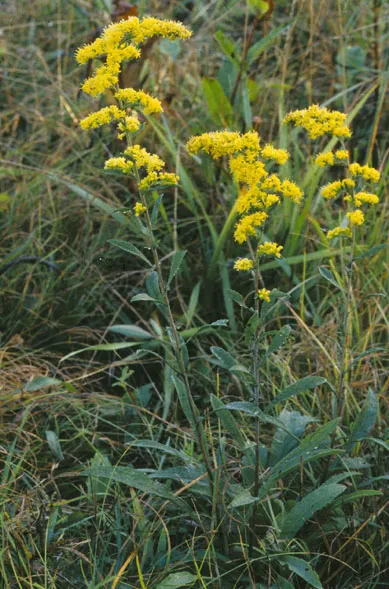
Gray Goldenrod (Solidago nemoralis) with one-sided plumes of golden-yellow flowers
Solidago nemoralis in late summer — wand-like one-sided golden-yellow plumes on a compact, drought-tough plant. Photo: Rooted Revival.

Identification

Habit & Leaves

Compact, clump-forming perennial 1–2.5 ft tall, with upright, wand-like stems that often arch gracefully at the tip. The entire plant is covered with fine grayish hairs, giving foliage and stems a distinctive gray-green cast — the origin of the common name and a reliable field mark. Basal leaves are spatula-shaped and toothed; stem leaves are smaller, lance-shaped, and progressively reduced upward. The foliage is dense and tidy.

Flowers

Golden-yellow flower heads arranged in one-sided, wand-like panicles that curve gracefully at the tip. The inflorescence is typically 4–10 in long, with the flower heads crowded along the upper side of the arching branches — this "one-sided" arrangement is a key identification character. Blooms from August through October, peaking in September when monarchs are migrating south.

Habitat & Range in NE Oklahoma

Solidago nemoralis is common throughout NE Oklahoma in dry prairies, old fields, rocky glades, abandoned pastures, and roadsides. It thrives in the poorest, driest, most abused soils — gravelly road shoulders, thin limestone glades, compacted clay — where other plants give up. It is a reliable component of Cross Timbers openings and tallgrass prairie remnants on drought-prone sites.

Ecology & Wildlife Value

Monarch Migration Fuel

Gray Goldenrod blooms during the peak of the monarch butterfly southward migration (September–October in NE Oklahoma), providing high-energy nectar at a critical moment. Monarchs, along with painted ladies, red admirals, and other migrating butterflies, feed heavily on the golden-yellow blooms. The plant also supports numerous native bee species, including mining bees, sweat bees, and bumblebees, with both nectar and pollen. Goldenrods are often incorrectly blamed for hay fever (their pollen is heavy and insect-transported, not windborne; ragweed is the culprit).

Lepidoptera Host

Supports caterpillars of over 100 species of moths and butterflies in eastern North America, including the goldenrod flower moth (Schinia nundina) and the brown-hooded owlet (Cucullia convexipennis). Winter seed heads feed American goldfinches, dark-eyed juncos, and various sparrows.

Horticulture & Care

Site selection

Gray Goldenrod needs full sun and well-drained soil. It thrives in dry, poor, thin, rocky, or sandy soils and will flop and decline in rich, moist garden soil. This is the plant for the strip by the driveway, the hellstrip, the rock garden, or the dry prairie planting.

Planting & Maintenance

Companion planting

Excellent with Little Bluestem, Stiff Goldenrod, Butterfly Milkweed, Whorled Milkweed, Purple Coneflower, Narrow-Leaved Coneflower, Aromatic Aster, and Sideoats Grama.

Photo Reference

Gray Goldenrod wand-like one-sided flower plumes
// Flowers — one-sided golden-yellow plumes, August–October
Wikimedia Commons
Wikimedia Commons
Gray Goldenrod gray-green hairy leaves
// Leaves — gray-green, hairy, spatula-shaped basal leaves
Wikimedia Commons
Wikimedia Commons
Monarch butterfly on Gray Goldenrod
// Monarch — migrating monarch fueling on late-season nectar
Wikimedia Commons
Wikimedia Commons
Gray Goldenrod in dry prairie
// Habit — compact, clump-forming, 1–2.5 ft, drought-proof
Wikimedia Commons
Wikimedia Commons

Sources & Further Reading