home/ plants/ cobaea-beardtongue

// SPECIES PROFILE · PERENNIAL · NATIVE · BUMBLEBEE SPECIALIST

Cobaea Beardtongue

Penstemon cobaea

Cobaea Beardtongue is the showiest native Penstemon in the tallgrass prairie region — a robust perennial 1–2 ft tall with a low rosette of fleshy leaves and stout flowering stems bearing large, inflated, pale purple-to-white tubular flowers with distinctively marked throats. The flowers are pollinated almost exclusively by bumblebees, which are large enough to force their way into the wide, bell-shaped corolla and reach the nectar at the base. Penstemon cobaea is a specialist of limestone glades, rocky prairies, and calcareous outcrops in the Cross Timbers and eastern Oklahoma, and it brings a genuinely dramatic floral display to the dry, sunny rock garden or prairie border. It is one of the few native penstemons that can hold its own visually against the showiest garden perennials while demanding nothing but sun, drainage, and limestone gravel.

// QUICK FACTS
Family
Plantaginaceae (plantain family, formerly Scrophulariaceae)
Life cycle
Herbaceous perennial
Native range
Central US; Nebraska and Missouri south to Texas; eastern Oklahoma and Cross Timbers region
USDA hardiness
Zones 5–8 (Tulsa = 7a/7b)
Mature size
1–2 ft tall, 0.75–1.5 ft wide
Bloom
May – June (NE OK); relatively brief, 2–3 weeks
Flower color
Pale purple to white, occasionally pink-tinged; throat marked with darker purple guidelines
Sun
Full sun
Soil
Dry, well-drained; limestone-derived, rocky, sandy, or gravelly
Water
Low; drought-tolerant
Wildlife value
Bumblebee specialist · hummingbird-visited
Conservation
G5 — secure globally; local and scattered in limestone glades and rocky prairies of NE Oklahoma
Cobaea Beardtongue (Penstemon cobaea) with large inflated pale purple tubular flowers
Penstemon cobaea in bloom — the large, inflated flowers and marked throat are diagnostic. Photo: Rooted Revival.

Identification

[ field key — habit · leaf · flower · fruit ]

Habit & Stem

Robust, clump-forming perennial from a woody crown. A low basal rosette of large, fleshy leaves persists through winter in milder years, giving the plant year-round presence in the rock garden. One to several stout, erect flowering stems rise 1–2 ft, bearing pairs of opposite leaves and terminating in a cluster of large flowers. Stems are finely hairy to glandular-pubescent in the inflorescence, becoming sticky to the touch. The plant dies back to the basal rosette after flowering, and the rosette expands slowly from the woody crown over years.

Leaves

Opposite, simple, and fleshy-succulent. Basal leaves are broadly spatulate to obovate, 2–6 in long, with entire to shallowly toothed margins and a thick, almost succulent texture. Stem leaves are smaller, narrower (lanceolate), and clasping at the base. The fleshy, somewhat glaucous (waxy blue-green) foliage is an adaptation to the plant's dry, exposed habitat, reducing water loss and reflecting intense sunlight. The robust, almost leathery texture of the basal rosette distinguishes P. cobaea from the smaller, finer-leaved penstemons of the western US.

Flowers

The flowers are large and showy (1.5–2 in long), borne in a loose terminal cluster (a thyrse). The corolla is broadly tubular to bell-shaped, strongly inflated (almost balloon-like), with five rounded, spreading lobes. Color is pale purple to lavender-white (occasionally pure white or pink-tinged), with darker purple guidelines (nectar guides) inside the throat that direct pollinators to the nectar. The fifth stamen (the "beardtongue" or staminode) is densely bearded with golden-yellow hairs, giving the genus its common name. Flowers open sequentially from the bottom of the cluster upward over about two weeks.

Fruit & Taxonomy

Fruits are small, dry capsules containing numerous tiny, angular, dark seeds. Capsules split open at maturity to release the seeds, which are wind-dispersed over short distances. The seeds require light for germination and should be surface-sown. The specific epithet cobaea honors Father Bernardo Cobo (1582–1657), a Spanish Jesuit missionary and naturalist who worked in Mexico and Peru, though this species is entirely North American. The genus Penstemon contains over 250 species, making it one of the largest genera of flowering plants endemic to North America, and P. cobaea is among the showiest of the tallgrass prairie species.

Habitat & Range in NE Oklahoma

Penstemon cobaea has a range centered on the southern and central Great Plains and Ozark border region, from Nebraska and Missouri south through Kansas and Oklahoma into Texas. In NE Oklahoma, it is a limestone and calcareous substrate specialist, found on limestone glades, rocky prairie openings, calcareous outcrops, and the thin-soiled margins of Cross Timbers woodlands where limestone bedrock is at or near the surface. It is consistently associated with high-calcium, alkaline soils and is a good indicator of calcareous substrates in the field — if you find P. cobaea growing naturally, you are almost certainly standing on limestone.

In the Tulsa region, Cobaea Beardtongue is locally common on the limestone glades and rocky prairie remnants of Osage, Rogers, and northern Tulsa counties, and on the limestone bluffs along the Arkansas River. It often grows in association with little bluestem, sideoats grama, pale purple coneflower, and Missouri evening primrose. Outside of limestone-derived soils, it is generally absent — the species is so strongly calciphilic that it can be used as a field indicator of calcareous geology in the Cross Timbers region.

Ecology & Wildlife Value

[ bumblebee pollination · hummingbirds · seed ecology · ecological role ]

Bumblebee Pollination

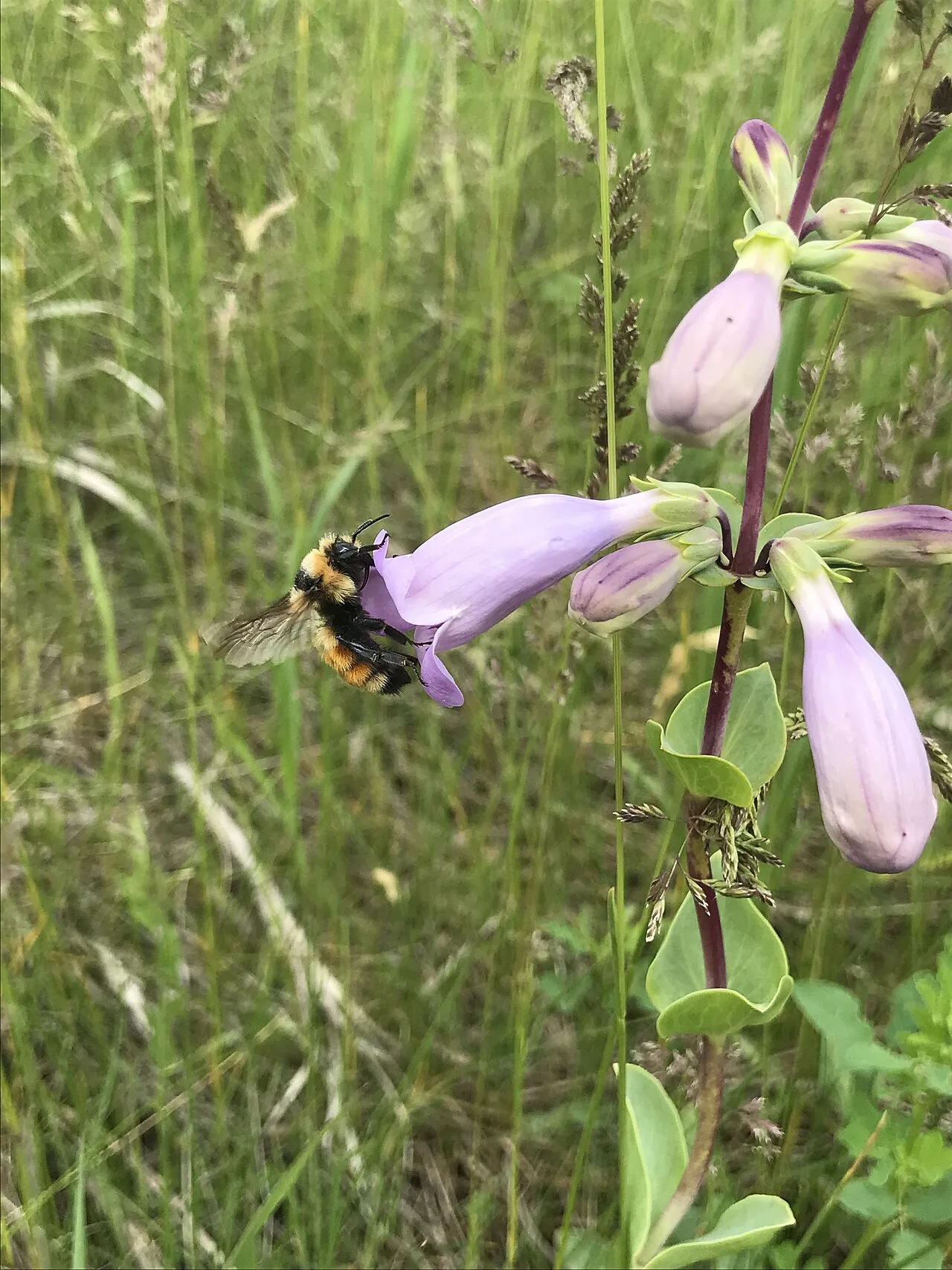
The large, inflated flowers are a classic example of bumblebee pollination (melittophily). Only bees large enough to push past the bearded staminode and crawl into the corolla tube can access the nectar and effect pollination. American bumble bees (Bombus pensylvanicus), brown-belted bumble bees (B. griseocollis), and common eastern bumble bees (B. impatiens) are the primary pollinators in NE Oklahoma. Smaller bees cannot effectively trip the flower, though they may collect pollen from the anthers. The golden bearded staminode serves as a tactile landing guide and a physical barrier that excludes small, ineffective pollinators.

Hummingbirds

Ruby-throated hummingbirds occasionally visit the flowers for nectar, particularly early in the season when fewer red tubular flowers (their preferred morphology) are available. The pale purple-to-white color is less typical of hummingbird-pollinated flowers, but the tubular shape and abundant nectar make P. cobaea a useful supplementary nectar source during the spring migration period. This dual pollination strategy (bumblebees as primary, hummingbirds as secondary) is common among tallgrass prairie penstemons.

Seed Ecology

The tiny, dust-like seeds are wind-dispersed and require bare mineral soil and light for germination. In the wild, seeds germinate in small soil pockets on glade surfaces, in the cracks of limestone outcrops, and in the disturbed soil of prairie dog mounds and bison wallows — all habitats that mimic the bare-soil conditions the species requires for successful seedling establishment. The seeds have no specialized dispersal mechanism beyond wind and gravity, and most fall within a few feet of the parent plant.

Ecological Role

As a spring-blooming species in limestone glades and dry prairies, Cobaea Beardtongue provides crucial early-season nectar and pollen for bumblebee queens establishing colonies. The fleshy basal leaves provide a modest amount of forage for small herbivores, though the plant's glandular pubescence and chemical defenses limit herbivory. In the glade ecosystem, P. cobaea occupies a niche as one of the showiest and most reliable spring nectar sources in an otherwise harsh and resource-poor environment.

Horticulture & Care

[ site selection · establishment · care · companion planting ]

Site selection & establishment

Cobaea Beardtongue requires full sun and extremely well-drained, preferably alkaline (limestone-derived) soil. It thrives in the rock garden, limestone scree, dry stone wall planting, or the un-irrigated edge of a gravel path. Heavy clay soils must be amended with coarse sand, gravel, and crushed limestone to ensure winter drainage — this plant will not survive in soil that stays wet in winter. This is an outstanding plant for a limestone-themed glade garden or xeric border where its dramatic, showy flowers provide a genuine visual spectacle each May.

Care & maintenance

Once established in suitable soil, Cobaea Beardtongue is low-maintenance and long-lived. Do not fertilize (encourages floppy growth and reduces bloom). Do not over-water — crown rot in wet winter soil is the primary cause of death. Cut spent flowering stalks to the ground after bloom if desired; leave the basal rosette intact. The plant is generally pest-free and disease-free in NE Oklahoma, though slugs and snails may occasionally damage the fleshy basal leaves in wet springs.

Companion planting

For a limestone glade garden, pair with pale purple coneflower, Missouri evening primrose, narrow-leaved coneflower, butterfly milkweed, little bluestem, and sideoats grama. For spring bloom sequencing, combine with cream wild indigo and Carolina larkspur, which bloom at approximately the same time in May and share a preference for calcareous soils. The dramatic, inflated flowers of P. cobaea reward close planting near a path or seating area where they can be appreciated in detail.

Edible & Cultural Uses

Penstemon cobaea has no significant record of edible or medicinal use in the ethnobotanical literature. Some Indigenous peoples of the Great Plains used Penstemon species medicinally (primarily the roots as a toothache remedy), but the specific use of P. cobaea is not well-documented. The plant's value is horticultural and ecological: a showy, bumblebee-supporting, limestone-adapted native for the rock garden and dry border. The genus Penstemon is entirely endemic to North America, with its center of diversity in the Intermountain West, and the tallgrass prairie species like P. cobaea represent the eastern outposts of this characteristically American genus.

Photo Reference

Close-up of Penstemon cobaea large inflated flower with marked throat
// Flower — large, inflated, pale purple with purple nectar guides
Wikimedia Commons
Wikimedia Commons
Basal rosette of fleshy leaves of Penstemon cobaea
// Basal rosette — large, fleshy, spatulate leaves persistent through winter
Wikimedia Commons
Wikimedia Commons
Bumblebee entering Penstemon cobaea flower
// Bombus sp. — bumblebees are the primary pollinators
Wikimedia Commons
Wikimedia Commons
Penstemon cobaea growing on a limestone glade
// Habitat — limestone glade with little bluestem and sideoats grama
Wikimedia Commons
Wikimedia Commons
Penstemon cobaea plant in full bloom
// Plant in bloom — showy display on a limestone prairie remnant
Wikimedia Commons
Wikimedia Commons

Sources & Further Reading

  • USDA NRCS PLANTS Database — Penstemon cobaea: plants.usda.gov/plant-profile/PECO5
  • Lady Bird Johnson Wildflower Center — Native Plant Database: wildflower.org — PECO5
  • Great Plains Flora Association (1986). Flora of the Great Plains. University Press of Kansas.
  • Oklahoma Biological Survey — Penstemon distribution in Oklahoma.
  • Lodewick, K. & Lodewick, R. (1999). Key to the Genus Penstemon. K. Lodewick (taxonomic reference).
  • Wikipedia — Penstemon cobaea: en.wikipedia.org/wiki/Penstemon_cobaea (CC BY-SA 4.0).

Hero photo: Rooted Revival. Strip photos courtesy of Wikimedia Commons contributors under their respective licenses (linked under each image).