// SPECIES PROFILE · PERENNIAL · NATIVE · NITROGEN-FIXER
Cream Wild Indigo is a low, shrubby prairie perennial that sends up arching stems from a massive, woody rootstock in early spring — well before the warm-season grasses have woken up. Its drooping racemes of creamy-white, pea-like flowers appear in April and early May, nodding among newly expanding leaves on stems that rarely exceed 2 ft. Baptisia bracteata is the earliest-blooming and most diminutive of the three Baptisia species found in NE Oklahoma, distinguished from blue wild indigo (B. australis) by its lower stature, earlier bloom, and distinctly paler flowers. Like all Baptisia, it is a deep-rooted, nitrogen-fixing legume that, once established, will outlive the gardener who planted it — specimens 30–50 years old are not uncommon on undisturbed prairie remnants.

[ field key — habit · leaf · flower · fruit · special features ]
Low, mounded perennial emerging from a woody, deep-branching taproot and crown. Stems are arching to decumbent, 1–2 ft long, often leaning outward to form a loose, spreading clump rather than an erect vase like B. australis. Stems are pale green, finely hairy when young, and hollow at maturity. The overall impression in bloom is of a low, bushy plant smothered in cream-colored flowers. In winter, the dried stems and inflated pods persist as a structural element in the dormant prairie garden.
Alternate, trifoliate (three-parted), with each leaflet 1–3 in long, obovate to oblanceolate, and gray-green to medium green. Leaflets are entire-margined with a rounded or slightly notched tip. The leaves are smaller and proportionally broader than those of B. australis, giving the plant a finer overall texture. Prominent stipules (bracts) at the leaf bases are a key identifying feature — large, leafy, and persistent, they give the species its epithet bracteata ("with bracts"). Foliage turns black at the first hard freeze and collapses by mid-winter.
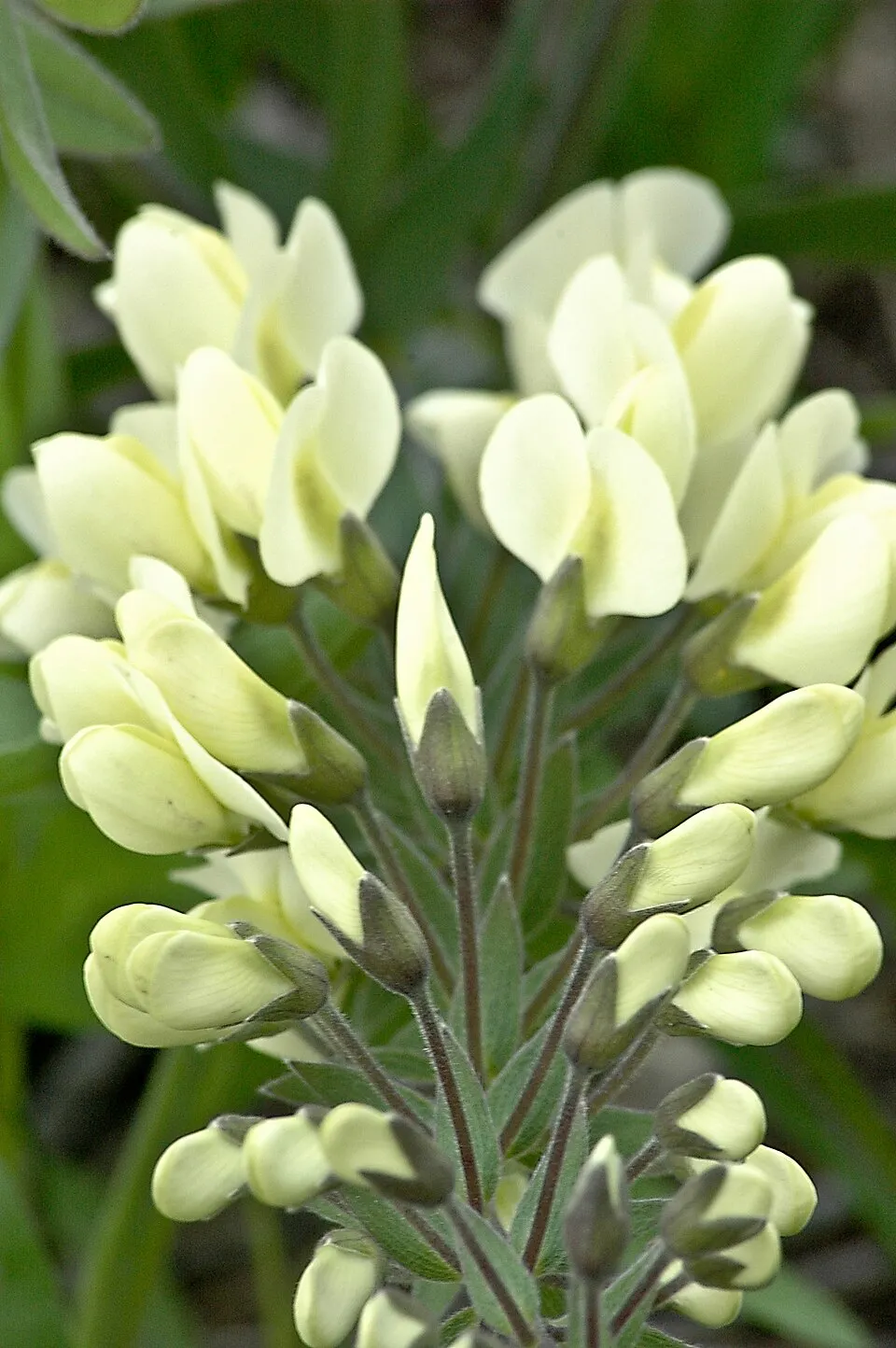
Flowers are creamy white to pale yellow, occasionally tinged with lavender at the base, about ¾–1 in long, with the classic asymmetrical pea-flower shape: a broad upright banner, two lateral wings, and a fused keel enclosing the stamens and pistil. Blooms are borne in loose, drooping racemes 4–10 in long that arch outward and downward from the stem tips. Each raceme holds 15–30+ flowers that open sequentially from the bottom upward. Unlike B. australis, which holds its racemes erect, the nodding inflorescence of B. bracteata is a field-ready diagnostic. Bumblebees are the primary pollinators — the flower requires a heavy insect to force the keel open and expose the pollen.
The fruit is a swollen, oval, woody pod 1–1.5 in long with a sharp terminal beak, turning from green to dark brown or black at maturity in late summer. Pods are thick-walled and persist on the plant through winter, rattling conspicuously in the wind. Each pod contains several loose, hard, kidney-shaped seeds that require scarification (physical abrasion of the seed coat) for reliable germination — in nature, this is accomplished by freeze-thaw cycles, soil microbes, and passage through fire. The dried stalks with their rattling pods are a characteristic winter feature of unplowed prairie remnants in the Cross Timbers.
Baptisia bracteata ranges across the central and eastern United States, from the eastern Great Plains through the Midwest and into the Southeast. In Oklahoma, it is concentrated in the eastern half of the state including the Cross Timbers, tallgrass prairie, and Ozark-influenced woodlands of NE Oklahoma. This is a plant of dry to mesic open sites: unplowed tallgrass prairie remnants, sandstone and limestone glades, post-oak savannah openings, and the sunny edges of blackjack-post oak woodlands. It also shows up on roadsides, powerline cuts, and old fencerows with intact native sod.
In the Tulsa region, look for Cream Wild Indigo in prairie remnants of Rogers and Osage counties, in the natural openings of the Cross Timbers sandstone barrens, and on the drier, upper slopes of glades where the soil is thin and fast-draining. It is notably more common on acidic, sandy or rocky soils derived from sandstone than on the dense limestone clays, though it will grow on calcareous substrates. Unlike B. australis, which thrives in richer, deeper prairie loams, B. bracteata is more often associated with nutrient-poor, marginal soils — a strategy made possible by its own nitrogen-fixing ability.
[ nitrogen fixation · pollinators · lepidoptera hosts · wildlife ]
As a member of the Fabaceae, Baptisia bracteata forms root nodules housing nitrogen-fixing rhizobia, converting atmospheric nitrogen into plant-available forms. Unlike annual legumes that release most of their fixed nitrogen when they die, a long-lived Baptisia locks nitrogen into its massive perennial root system for decades, releasing it incrementally through root turnover and leaf litter. In a prairie restoration context, this means a slow, sustained nitrogen subsidy to neighboring warm-season grasses and forbs — exactly the kind of gradual enrichment that builds native prairie soil over centuries rather than burning it out in a single season.
The large, complex pea flowers of Baptisia are pollinated almost exclusively by large-bodied bumblebees — primarily queens emerging from hibernation in early spring. The flower requires the bee's weight to depress the keel and expose the hidden stamens, a mechanism called tripping. Common visitors in NE Oklahoma include the American bumble bee (Bombus pensylvanicus), the two-spotted bumble bee (B. bimaculatus), and the brown-belted bumble bee (B. griseocollis). Smaller bees and honeybees can collect pollen from already-tripped flowers but are generally too light to trip fresh blooms.
Baptisia species serve as larval hosts for several butterflies and moths. The wild indigo duskywing (Erynnis baptisiae) is a skipper whose caterpillars feed specifically on Baptisia foliage, tying leaves together with silk for shelter. The frosted elfin (Callophrys irus) also uses Baptisia as a host in parts of its range. The orange sulphur (Colias eurytheme) and clouded sulphur (C. philodice) may oviposit on Baptisia in the absence of their primary legume hosts.
The large, hard seeds are consumed by northern bobwhite quail, wild turkey, and small rodents. Deer and rabbits browse young shoots in spring, though mature foliage is somewhat unpalatable due to alkaloid compounds common to the genus. The dried, persistent stems and pods provide winter cover for overwintering insects including native bee larvae that nest in hollow stems — leave the dead top growth standing until late winter or early spring cleanup.
[ propagation · site · care · companion planting ]
Crowd Cream Wild Indigo and it will sulk; give it space, sun, and drainage and it will live for decades. This is a plant for the dry prairie garden, glade planting, or sunny rock garden — not for rich amended beds or irrigated borders. Full sun produces the best form and heaviest bloom; in shade, stems sprawl and flowering declines sharply. Well-drained soil is non-negotiable — the deep taproot will rot in heavy clay that stays saturated through winter. If you garden on Tulsa's characteristic red clay, plant on a slight mound or slope, or amend the planting hole with coarse sand and fine gravel.
Seed: The most reliable method. Collect pods when they turn dark brown and begin to split in late summer. Scarify seeds by rubbing between two sheets of sandpaper or nicking with a file, then cold-moist stratify for 30–60 days or direct-sow in fall for natural stratification over winter. Expect germination in spring when soil temperatures reach 60–70°F. Seedlings are slow the first year, investing heavily in the taproot, and may not bloom until their third or fourth season. Division: Not recommended — the deep, woody root system resents disturbance, and divided plants often die or take years to recover.
Do not fertilize. Added nitrogen suppresses nodulation and encourages weak, floppy growth. Cut dead stems to the ground in late winter before new growth emerges. The plant is remarkably pest-free and disease-free in NE Oklahoma gardens — the alkaloid compounds that make the foliage unpalatable to most herbivores also discourage the usual suspects. The only notable problem is crown rot in poorly-drained winter soil, which is avoided entirely by planting in a fast-draining site.
In a dry prairie or glade garden, pair Cream Wild Indigo with little bluestem and sideoats grama as the grass matrix, pale purple coneflower and Missouri evening primrose for complementary spring-to-summer bloom, and aromatic aster for fall color. In a larger prairie restoration, it mixes naturally with butterfly milkweed, prairie blazing star, and lance-leaf coreopsis. Because of its low stature, position Baptisia bracteata near the front of the planting or along the edge of a path where the nodding racemes can be appreciated at close range.
Baptisia species are not edible — the foliage, roots, and seeds contain quinolizidine alkaloids (including baptisine and cytisine) that are toxic if ingested in quantity. The common name "wild indigo" comes from the historical use of Baptisia as a substitute for true indigo dye (Indigofera tinctoria). While Baptisia does not produce true indigo blue, the plants yield a pale blue to grayish dye that early European settlers and Indigenous peoples used as a less-colorfast alternative. B. australis (blue wild indigo) was more commonly used for this purpose, but B. bracteata was employed wherever it grew abundantly.
Several Indigenous nations of the Plains and Midwest used Baptisia preparations medicinally — as a purgative, an antiseptic wash for wounds and skin conditions, and a tea for fever. These uses are noted for historical context only; the plants are potent and potentially dangerous and should not be used for self-medication.
Hero photo: Rooted Revival. Strip photos courtesy of Wikimedia Commons contributors under their respective licenses (linked under each image).