home/ plants/ carolina-larkspur

// SPECIES PROFILE · PERENNIAL · NATIVE · SPRING PRAIRIE BLOOM

Carolina Larkspur

Delphinium carolinianum

Carolina Larkspur is the native Delphinium that puts the tall, extravagant hybrid delphiniums of English borders to shame — not with size, but with grace, resilience, and ecological authenticity. It is a slender, upright perennial 1–3 ft tall with deeply divided, threadlike leaves and a tall raceme of spurred, pale blue-to-white (occasionally deep blue) flowers that opens in May in the tallgrass prairie and glades of NE Oklahoma. The flowers are pollinated by long-tongued bumblebees and ruby-throated hummingbirds, both of which can reach the nectar concealed at the tip of the long, narrow spur. Delphinium carolinianum is a plant of dry, rocky, well-drained soils in the Cross Timbers and on the limestone glades of the Ozark margins. It is short-lived as an individual (3–5 years), but self-sows reliably in suitable conditions, perpetuating itself as a fleeting spring presence that rewards close attention. All parts of the plant are toxic (containing diterpenoid alkaloids), so it must be placed with care around children, pets, and livestock.

// QUICK FACTS
Family
Ranunculaceae (buttercup family)
Life cycle
Herbaceous perennial; short-lived (3–5 years); self-seeds
Native range
Central and southeastern US; from Texas north to Minnesota, east to Georgia and Florida; throughout Oklahoma
USDA hardiness
Zones 4–8 (Tulsa = 7a/7b)
Mature size
1–3 ft tall, 0.5–1 ft wide
Bloom
May (NE OK); relatively brief, 2–3 weeks
Flower color
Pale blue to white, occasionally deeper blue; spurred
Sun
Full sun to light shade
Soil
Dry to mesic, well-drained; sandy, rocky, or limestone-derived
Water
Low to medium
Wildlife value
Hummingbird pollinator · long-tongued bumblebee plant
Conservation
G5 — secure globally; locally frequent in dry prairies, glades, and open woods of NE Oklahoma
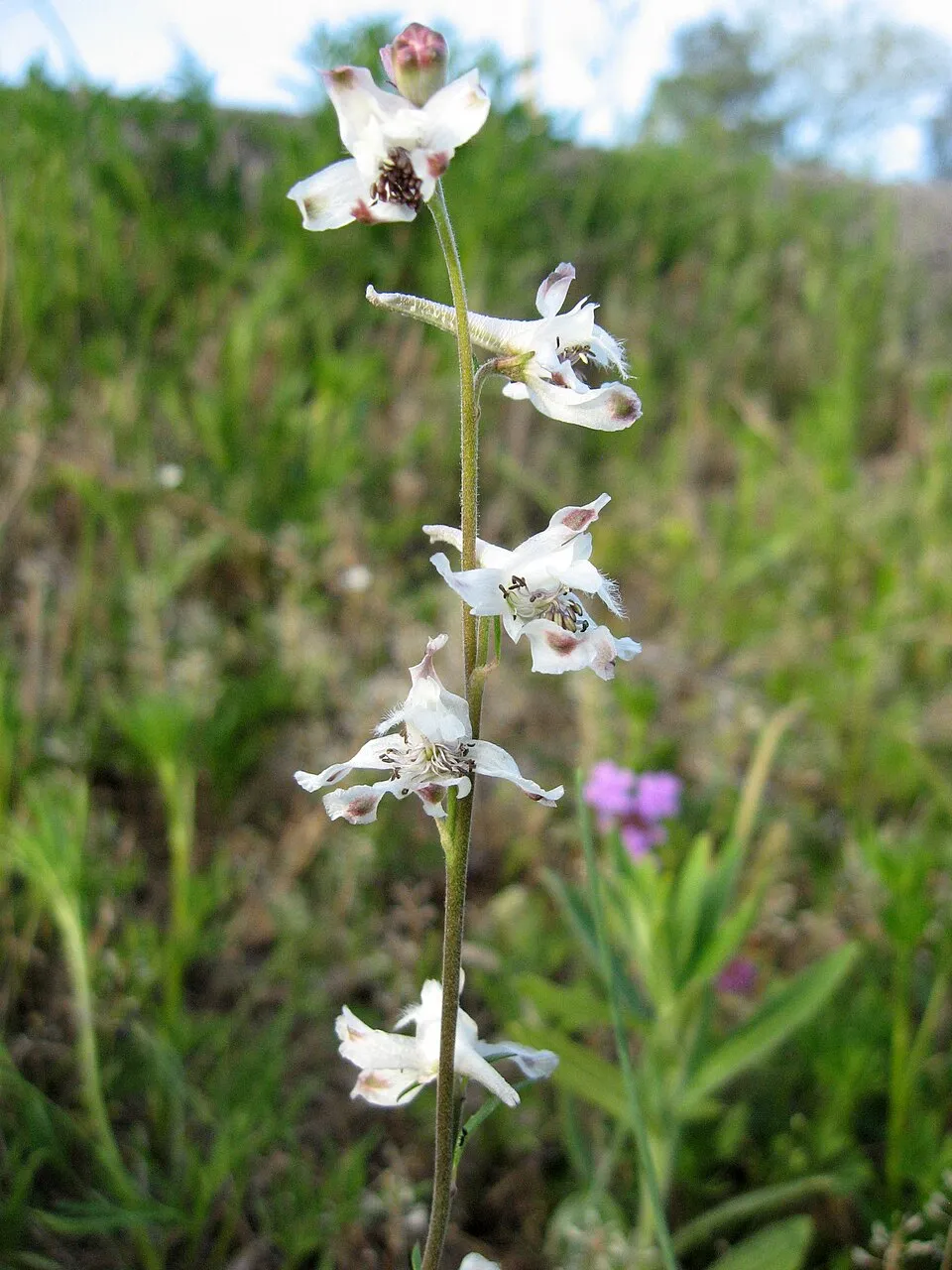
Carolina Larkspur (Delphinium carolinianum) with tall raceme of spurred pale blue flowers
Delphinium carolinianum in May bloom — the long spur on each flower holds nectar accessible only to long-tongued bees and hummingbirds. Photo: Rooted Revival.

Identification

[ field key — habit · leaf · flower · fruit · special features ]

Habit & Stem

Slender, upright perennial from a cluster of fibrous, tuber-like roots. A single, unbranched flowering stem rises from a basal cluster of leaves. Stems are smooth (glabrous), green, and somewhat succulent when young, becoming fibrous as they mature. The plant has a delicate, airy quality — nothing like the dense, heavy hybrid delphiniums of garden catalogs. Stems often lean slightly under the weight of the inflorescence but are generally self-supporting on dry prairie sites where wind exposure keeps them stocky.

Leaves

Deeply divided, almost threadlike: the basal leaves are 2–5 in wide, palmately dissected into 3–7 narrow, linear segments each further divided, giving the foliage a fine, ferny, almost carrot-like texture. Stem leaves are smaller and less divided. The finely cut foliage is a key identification character that distinguishes D. carolinianum from the coarser-leaved western larkspurs. Leaves are concentrated in the lower portion of the plant, leaving the upper stem largely bare except for the inflorescence. The basal leaves often wither by the time the flowers are fully open.

Flowers

Flowers are borne in a tall, narrow raceme 6–18 in long, with 10–30 individual blooms spaced along the upper stem. Each flower is about ¾–1 in across, with five showy, petal-like sepals (the actual petals are small and concealed within). The uppermost sepal extends backward into a long, narrow spur that contains the nectar — the defining feature of the genus. Flower color ranges from pale sky-blue to white, occasionally deeper blue, with a tuft of small, whitish petals in the center forming a "bee." The spur is about ½–¾ in long, requiring a tongue at least that long to reach the nectar reward. Flowers open from the bottom of the raceme upward over about two weeks.

Fruit & Toxicity

Fruits are three-parted follicles (dry, splitting capsules) that release numerous small, dark, angular seeds. The seeds self-sow readily in nearby open, well-drained soil, and are dispersed short distances by ants attracted to a fatty elaiosome on the seed. CAUTION: all parts of the plant contain toxic diterpenoid alkaloids (delphinine, ajacine, and related compounds) and are poisonous to humans and livestock if ingested. Symptoms include nausea, weakness, and in severe cases, respiratory paralysis. Do not plant where livestock graze, and keep away from children who might be tempted to taste the flowers. Wear gloves when handling. Despite the toxicity, deer and rabbits generally avoid the plant, making it useful in areas with heavy browse pressure.

Habitat & Range in NE Oklahoma

Delphinium carolinianum ranges across the central and southeastern United States, from the Great Plains eastward to Georgia and Florida. In NE Oklahoma, it is a plant of dry, rocky prairies, limestone and sandstone glades, open post-oak woods, and the thin-soiled margins of Cross Timbers savannahs. It occurs on both limestone-derived and sandstone-derived substrates but is most frequently encountered on calcareous (limestone) glades and outcrops in the Ozark foothills and along the Arkansas River bluffs. In the Tulsa region, look for it on limestone glade remnants in Osage County, rocky prairie openings in the Cross Timbers, and the dry, sunny margins of post-oak woodlands.

It typically grows in association with little bluestem, sideoats grama, pale purple coneflower, Missouri evening primrose, and the spring-flowering community of glade forbs that includes cream wild indigo. The species is more frequently encountered on limestone than sandstone in the Tulsa region, reflecting its preference for calcareous, alkaline soils in this part of its range.

Ecology & Wildlife Value

[ pollination · herbivory · seed dispersal · ecological role ]

Pollination

The long, narrow nectar spur is a classic example of specialized pollination by long-tongued insects and hummingbirds. Ruby-throated hummingbirds (Archilochus colubris) are regular visitors in NE Oklahoma — the pale blue-to-white flowers are typical of hummingbird-pollinated plants despite lacking the red coloration more commonly associated with hummingbird flowers. Long-tongued bumblebees (Bombus pensylvanicus, B. bimaculatus) and large carpenter bees (Xylocopa virginica) also pollinate the flowers, though carpenter bees may occasionally rob nectar by biting through the base of the spur rather than entering the flower properly.

Herbivory & Defenses

The toxic alkaloids provide effective chemical defense against most herbivores. Deer, rabbits, and livestock generally avoid the plant — in areas of heavy deer pressure, Carolina Larkspur often persists when more palatable forbs have been eliminated. The finely divided, threadlike leaves reduce leaf surface area and water loss, an adaptation to the hot, dry glade and prairie habitats where the plant occurs. Few insect herbivores have evolved tolerance to Delphinium alkaloids, and the plant has minimal pest issues in cultivation or in the wild.

Seed Dispersal

The small, angular seeds are ballistically dispersed from the splitting follicles and also dispersed short distances by ants (myrmecochory), which are attracted to a small, fatty appendage (elaiosome) on the seed. The seeds require cold-moist stratification to break dormancy and germinate in spring. In the wild, seedlings establish in small patches of bare, disturbed soil — the species is a gap-colonizer in the prairie matrix, depending on the natural disturbance created by burrowing animals, fire scars, and erosion to create suitable germination sites.

Ecological Role

As a spring-blooming species in the tallgrass prairie and glade ecosystems, Carolina Larkspur provides early-season nectar and pollen when relatively few other plants are in bloom. It bridges the gap between spring ephemerals and the peak summer bloom of the warm-season grasses and forbs, supporting bumblebee queens establishing new colonies and hummingbirds returning from migration. The plant's relatively brief bloom period is offset by its reliability as a nectar source during a critical phenological window in the prairie growing season.

Horticulture & Care

[ site selection · establishment · care · companion planting ]

Site selection & establishment

Carolina Larkspur wants full sun and sharp drainage — it rots in heavy, wet soil over winter. Plant on a slope, in a rock garden, at the edge of a prairie planting, or in a raised bed with sandy, gravelly soil. It does not compete well with dense, tall grasses and is best placed at the front of a prairie planting or in a dedicated glade garden where its delicate form can be appreciated up close. Because of its toxicity, place it where children and pets will not handle or taste it.

Care & maintenance

Once established, the plant requires minimal care. Do not fertilize — rich soil produces weak, floppy growth and reduces bloom. Water sparingly during establishment; mature plants need no supplemental irrigation in NE Oklahoma. Cut dead stems to the ground in late winter. The plant is short-lived (3–5 years per individual) but self-sows reliably if seed is allowed to fall and the soil surface is not heavily mulched — leave some seed heads standing through summer to ensure self-sowing. A light gravel mulch mimicking the plant's natural glade habitat is preferable to organic mulches, which can hold too much moisture against the crown. All parts are toxic — wear gloves when handling and keep children and pets away.

Companion planting

In a dry prairie or glade garden, pair with little bluestem, pale purple coneflower, Missouri evening primrose, butterfly milkweed, and purple poppy mallow. For a hummingbird-focused planting, combine with wild columbine, cardinal flower, Cobaea beardtongue (which blooms at overlapping times), and trumpet honeysuckle. The pale blue flowers of D. carolinianum provide welcome color contrast among the yellows and purples that dominate the spring prairie.

Edible & Cultural Uses

Delphinium species are NOT edible and are dangerously toxic. The alkaloids delphinine, ajacine, and related compounds cause nausea, vomiting, weakness, convulsions, and potentially fatal respiratory paralysis. There is no safe culinary use for any part of the plant. Historically, crushed seeds of some Delphinium species were used externally as a parasiticide (for lice and scabies), but this is an obsolete and dangerous practice not recommended today. Appreciate Carolina Larkspur for its beauty, its role in supporting hummingbirds and bumblebees, and its contribution to the spring prairie ecosystem — not as a foraged plant. The genus includes many garden ornamentals (the hybrid delphiniums and larkspurs of horticulture), but all share the same toxic properties.

The specific epithet carolinianum translates to "of the Carolinas," reflecting where the species was first described, though its native range extends far westward through the tallgrass prairie. The common name "larkspur" refers to the flower's resemblance to the spur on a lark's foot. In the language of flowers, delphinium symbolizes lightness and levity — fitting for a plant whose airy, delicate blooms seem to float above the prairie grasses.

Photo Reference

Close-up of Delphinium carolinianum spurred flowers
// Flower detail — pale blue spurred flowers with hummingbird pollination syndrome
Wikimedia Commons
Wikimedia Commons
Deeply divided, threadlike leaves of Delphinium carolinianum
// Leaves — palmately dissected into narrow, threadlike segments
Wikimedia Commons
Wikimedia Commons
Delphinium carolinianum plant in prairie setting
// Plant habit — slender, 1–3 ft tall on a limestone glade
Wikimedia Commons
Wikimedia Commons
Ruby-throated hummingbird visiting Delphinium carolinianum
// Ruby-throated hummingbird — a regular pollinator of Carolina Larkspur in NE Oklahoma
Wikimedia Commons
Wikimedia Commons
Delphinium carolinianum follicles and seeds
// Fruits — three-parted follicles releasing small angular seeds
Wikimedia Commons
Wikimedia Commons

Sources & Further Reading

  • USDA NRCS PLANTS Database — Delphinium carolinianum: plants.usda.gov/plant-profile/DECA4
  • Lady Bird Johnson Wildflower Center — Native Plant Database: wildflower.org — DECA4
  • Great Plains Flora Association (1986). Flora of the Great Plains. University Press of Kansas.
  • Oklahoma Biological Survey — Delphinium carolinianum distribution in Oklahoma.
  • Kingsbury, J.M. (1964). Poisonous Plants of the United States and Canada. Prentice-Hall (toxicity of Delphinium alkaloids).
  • Wikipedia — Delphinium carolinianum: en.wikipedia.org/wiki/Delphinium_carolinianum (CC BY-SA 4.0).

Hero photo: Rooted Revival. Strip photos courtesy of Wikimedia Commons contributors under their respective licenses (linked under each image).