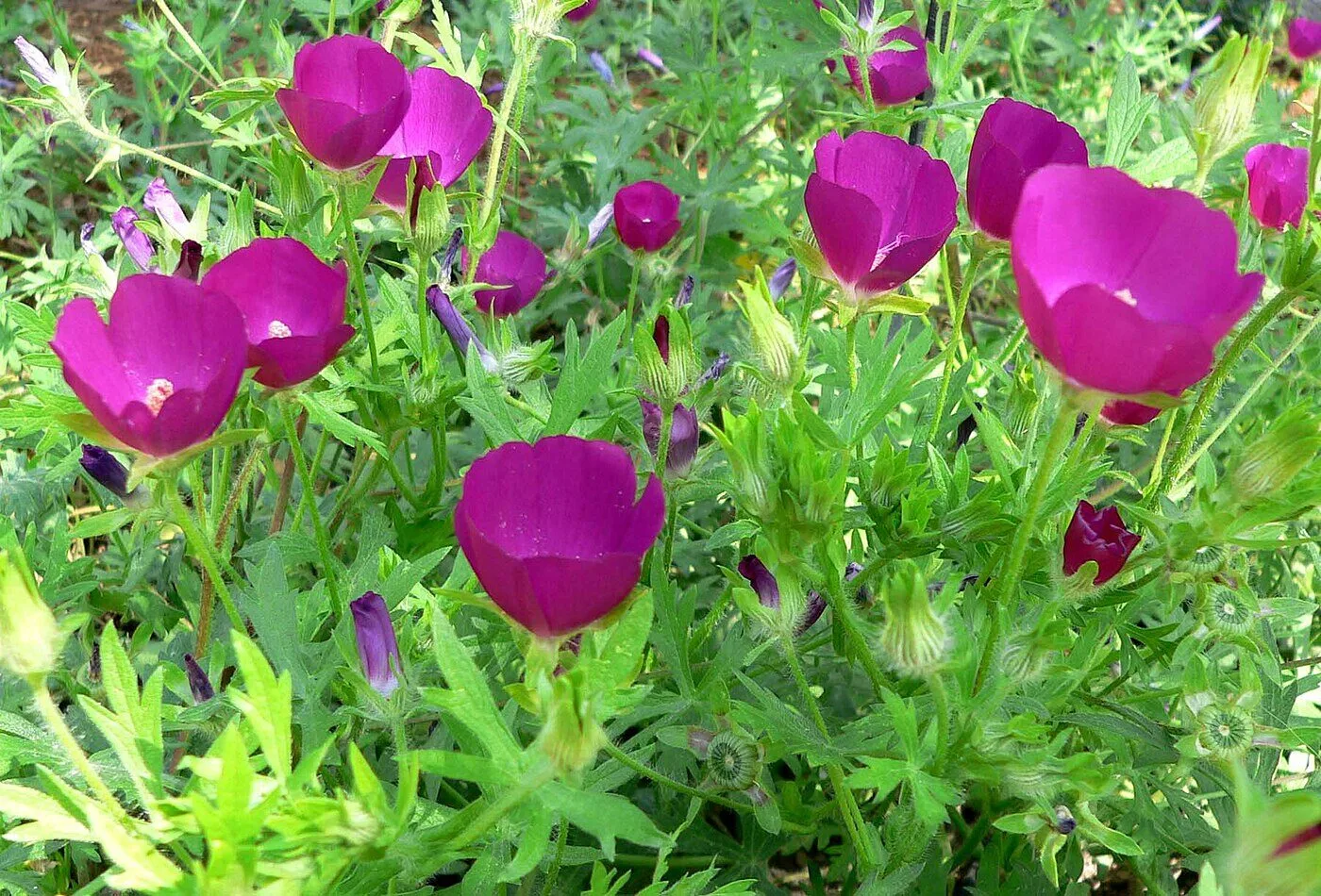
// SPECIES PROFILE · PERENNIAL FORB · NATIVE · GROUNDCOVER
The trailing wine-cup of the Cross Timbers and southern Plains, purple poppy mallow opens its electric magenta cup-shaped flowers each morning from late April through July, closing them by late afternoon. A long, edible parsnip-like taproot — sometimes a foot long and as thick as a child's wrist — lets the plant survive Oklahoma drought and August heat with no irrigation, sprawling across rocky pasture, sandy roadside, and well-drained Tulsa-region garden alike. One of the most drought-hardy and lowest-maintenance showy natives in the regional palette.

[ field key — flower · leaf · habit · root ]
Five wedge-shaped magenta to purple-pink petals 1–1.5 in long, slightly overlapping at the base, often with a sharp white triangle at the throat. Petals form an open chalice or shallow cup — never reflexed. Below the calyx sit three narrow involucral bracts (the species name involucrata); these distinguish C. involucrata from other Callirhoe species. Flowers open in mid-morning and close by late afternoon; each lasts a single day.
Alternate, long-petioled, deeply palmately divided into 5–7 narrow lobes with each lobe further dissected — a distinctive snowflake or many-fingered shape. Lower leaves slightly larger and more deeply cut than upper. Surface roughened with short stiff hairs (typical mallow texture); margins entire to coarsely toothed. The leaf shape alone is enough to identify the plant out of flower.
Multiple decumbent stems radiate from a central crown and spread 2–4 ft along the ground, only 6–12 in tall. Below ground sits a massive woody taproot — commonly 8–12 in long, occasionally to 24 in, and 1–2 in thick at the crown — resembling a parsnip in shape and white flesh. This taproot is the plant's drought-defense and longevity organ, and is the reason established plants resent transplant.
Other Callirhoe: C. digitata (fringed poppy mallow) is taller and more upright, with no involucral bracts; C. alcaeoides (light poppy mallow) has paler pink-to-white flowers. Old-world common mallow (Malva neglecta) has small mauve flowers and round, scalloped leaves — quite different. Hibiscus laevis (halberd-leaf rose mallow) of riverbanks is much larger and showier with white-pink flowers. The trailing magenta wine-cup of dry Cross Timbers pasture is unmistakable.
Callirhoe involucrata is widespread across the southern Plains and documented in most counties of central and western Oklahoma. In NE Oklahoma it is common but more localized, found along railroad embankments, county-road shoulders, abandoned pastures, the open uplands of the Cross Timbers, and the gravelly westernmost remnants of the Tallgrass Prairie. It thrives on shallow, well-drained, often rocky soils over sandstone, limestone, and Permian clay where competing vegetation is sparse.
The species is at its most abundant on dry caliche flats and gravelly Cross Timbers ridges of Osage, Pawnee, and Tulsa counties, and on the sandy alluvial terraces of the Arkansas River. It tolerates the heavy red clay of the Tulsa basin if drainage is sharp; in poorly-drained sites — lawn turf, irrigated beds, lawn-edge plantings — it rots in the first wet winter. The pattern is consistent across the Plains: dry, lean, sun-baked = good; rich, moist, fertilized = death.
Historically, the Plains population was maintained by drought, fire, and bison disturbance, and the species has held up well to both fire suppression and modern roadside mowing — the prostrate habit goes under the mower blade and the deep taproot resprouts after damage.
[ pollinators · skippers · drought ecology · deer ]
Open chalice-form flowers are visited heavily by small to medium native bees — halictids, andrenids, Megachile, and the mallow specialist Diadasia bees, which are oligolectic on Malvaceae — as well as syrphid (hover) flies, soldier beetles, and small butterflies (especially skippers and hairstreaks). Honey bees use the pollen but are less efficient pollinators than the native specialists.
Multiple checkered skipper butterflies (Pyrgus communis, P. albescens) use mallows including Callirhoe as larval hosts. Larvae construct silk-and-leaf shelters and feed by night. The plant also hosts the gray hairstreak (Strymon melinus), a generalist whose caterpillars feed on mallow flower buds and developing fruit.
The taproot stores water and carbohydrates and lets purple poppy mallow tolerate the deepest summer drought without irrigation: plants die back to the crown in extreme dry, then resprout with the next significant rain. This life strategy — a tap-rooted forb that sprawls when wet, retreats when dry — is the same one used by leadplant, compass plant, and other deep-Plains forbs.
The slightly mucilaginous mallow-family foliage is largely ignored by white-tailed deer, rabbits, and livestock when other forbs are available. Combined with its drought tolerance and showy bloom, this makes purple poppy mallow one of the most reliable native forbs for deer-pressured Tulsa-area landscapes.
Site-and-forget. Plant once into well-drained soil, water until established, then leave it alone. Purple poppy mallow does not respond to fertilizer, supplemental water, or "improvement" of any kind; it responds poorly to all of them. The single most common cause of death is overcare.
[ siting · transplanting · pruning · propagation ]
Plant container-grown stock from March through May in NE Oklahoma. Direct-sow seed in late autumn (Nov–Dec) for natural cold stratification and spring germination. Avoid moving established plants — the long taproot makes transplant a near-certain failure for anything older than its first year.
From seed: seed has a hard coat and benefits from scarification (a few seconds of light sandpaper rub) followed by 30 days of cold-moist stratification; sow in fall on bare ground. Germination rates improve markedly with scarification. From cuttings: rare; difficult; best to start from seed or buy plants. From division: the taproot does not divide cleanly; transplant only first-year plants while the root is still small.
| Selection | Origin | Distinguishing feature | Notes for Tulsa |
|---|---|---|---|
| Wild type / OK ecotype | regional collections | Standard magenta cup, white throat | First choice for restoration and gardens; locally adapted |
| 'Logan Calhoun' | nursery selection (Texas origin) | White-flowered selection of C. involucrata | Striking white form; needs same lean dry conditions |
| White-flowered seedling | occasional wild variant | Same plant in white | Plant alongside magenta type for contrast |
Purple poppy mallow holds the lowest layer of a dry-meadow planting. Pair with mid-height bunchgrasses (Bouteloua curtipendula, Schizachyrium scoparium) and upright forbs (Echinacea pallida, Liatris punctata) for a self-supporting community.
Purple poppy mallow has a documented record of indigenous food and medicinal use across the southern Plains, and a long history as one of the most graceful native ornamentals for Plains rock gardens. The genus name Callirhoe refers to a Greek nymph — an unusually poetic scientific name for a North American native.
[ guild · polyculture · cross-layer pairings ]
In a dry mixed-grass prairie planting, purple poppy mallow pairs naturally with: new jersey tea (Ceanothus americanus), big bluestem (Andropogon gerardii), aromatic aster (Symphyotrichum oblongifolium), buffalograss (Bouteloua dactyloides), black-eyed susan (Rudbeckia hirta), and little bluestem (Schizachyrium scoparium).
Combine purple poppy mallow with the warm-season grasses listed above for a self-sustaining matrix.