// SPECIES PROFILE · PERENNIAL · NATIVE · FRITILLARY HOST
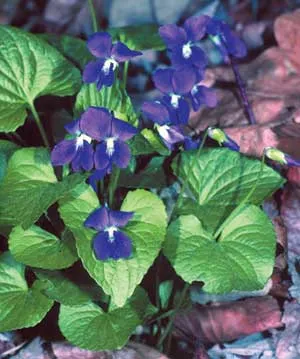
The Common Blue Violet is the quiet, indispensable engine of the eastern North American woodland floor — a low, colony-forming perennial that spreads by rhizomes and seed across moist lawns, shaded yards, woodland edges, and bottomland meadows throughout NE Oklahoma. Its heart-shaped leaves and classic purple-violet flowers emerge in early spring, often before the oaks have fully leafed out, and it blooms again more sparingly through summer and fall. This is not merely a pretty spring wildflower: Viola sororia is the essential larval host plant for multiple fritillary butterfly species, including the great spangled fritillary (Speyeria cybele) and the meadow fritillary (Boloria bellona), whose caterpillars eat nothing but violet leaves. If you want fritillaries in your garden, you must have violets. Period. Tolerates mowing, making it a perfect native component of bee lawns and a deliberate alternative to the ecological dead zone of turfgrass monoculture.

[ field key — habit · leaf · flower · fruit · cleistogamous capsules ]
Low, acaulescent (stemless) perennial 4–8 in tall, with leaves and flowers arising directly from a short, thick rhizome at or just below the soil surface. Forms dense colonies over time via underground rhizomes and prolific self-seeding. The plant lacks an above-ground stem entirely — what appears to be a stem is actually the leaf petiole and flower peduncle. New plants emerge from the rhizome tips, creating expanding patches that can cover several square feet in a few seasons.
All leaves basal, arising directly from the rhizome crown. Blades are broadly ovate to heart-shaped (cordate), 1–3 in across, with a notched base and a rounded to bluntly pointed tip. Margins are finely scalloped (crenate-toothed). The upper surface is medium to dark green and glabrous to sparsely hairy; the lower surface is paler and may be pubescent (hairy), especially along the veins. The petiole is long, slender, and often reddish at the base. Leaves emerge early — often in late February or early March in the Tulsa area — and persist through most of the growing season.
The familiar violet flower is 3/4–1 in across, with five petals arranged in the classic violet form: two lateral petals, two upper petals, and a lower petal that extends into a short, nectar-holding spur at the back. The petals are deep violet-purple with white throats marked by dark purple veins that serve as nectar guides for bees. The center of the flower is whitish with a small tuft of hairs. Flowers appear singly on slender, slightly nodding peduncles 3–6 in tall. Blooms are chasmogamous (opening normally for cross-pollination) in spring, pollinated primarily by queen bumblebees, andrenid mining bees, and mason bees active in cool early-season weather.
After the showy spring flowers fade, Viola sororia produces a second, hidden bloom: cleistogamous flowers that never open, self-pollinate inside the bud, and develop into seed capsules on short, downward-bending stalks at or below the leaf litter line. These inconspicuous capsules appear from late spring through fall and are the plant's primary reproductive strategy. Each capsule is a small, three-parted explosive capsule that splits open at maturity, flinging seeds several feet. The seeds bear a small, lipid-rich elaiosome that attracts ants (Formica, Aphaenogaster), who carry the seeds to their nests, eat the elaiosome, and discard the intact seed in their nutrient-rich midden — effectively planting the violet for you.
The combination of stemless habit (no above-ground stem), heart-shaped leaves with scalloped margins, and classic purple-violet flowers in early spring distinguishes Viola sororia from other Oklahoma violets. Viola missouriensis (Missouri violet) is extremely similar and some taxonomists treat it as a variety of V. sororia; its leaves tend to be more sharply toothed and more triangular. Viola bicolor (field pansy) is an annual with smaller, paler flowers and narrower leaves. Viola pedata (bird's-foot violet) has deeply dissected leaves and large, flat, upward-facing flowers found in dry, sandy soils of the Cross Timbers.
Leaves emerge in late winter to early spring (late February–March) as soil temperatures rise into the 40s. Chasmogamous flowers appear in March through early May, peaking with the first flush of spring ephemerals. Cleistogamous capsules form from late April onward. Foliage persists through summer, though plants in full sun or dry soil may go partially summer-dormant (leaves yellow and die back) during July–August drought. Fresh leaves often emerge with autumn rains and cooling temperatures. In mild winters, a basal rosette of leaves remains green through December.
Viola sororia is native to the eastern half of North America and is common throughout all of Oklahoma east of the Panhandle, with its center of abundance squarely in the eastern deciduous forest and its western outposts in the Cross Timbers. In NE Oklahoma you will find it in moist, shaded woods (especially post-oak and blackjack-oak woodlands, hickory groves, and bottomland forests), along streambanks, and extensively in older residential lawns and yards — particularly those that are not treated with broadleaf herbicides. In the Tulsa area, it is one of the most abundant native wildflowers in established neighborhoods with mature shade trees.
The species thrives in the dappled understory of the Cross Timbers post-oak savannah, where it forms carpets beneath Quercus stellata and Q. marilandica. It is equally at home in the deeper soils of riparian zones along the Arkansas, Verdigris, and Neosho rivers, and in the remnant tallgrass prairie draws and swales where shading and moisture accumulate. You will also see it along roadsides, in cemeteries, and in any unmowed corner of older parks and institutional grounds — often forming a dense, continuous groundcover that turns purple for a few weeks each April.
[ fritillary butterfly host · ant dispersal · early-season bee forage · keystone spring species ]
Viola sororia is the primary larval host for several fritillary butterflies across eastern North America. In NE Oklahoma, the most prominent is the great spangled fritillary (Speyeria cybele) — a large, brilliant orange-and-black butterfly whose caterpillars feed exclusively on violet leaves, typically at night, hiding in leaf litter during the day. Also hosted: the meadow fritillary (Boloria bellona), the variegated fritillary (Euptoieta claudia), and the regal fritillary (Speyeria idalia), though the regal has become rare and local in Oklahoma due to prairie habitat loss. Female fritillaries do not lay eggs directly on violet plants; instead, they oviposit near violets in late summer and fall, and the newly hatched caterpillars overwinter in leaf litter, emerging in spring to find the fresh violet leaves. This means you need violets every year, in place, reliably — a tidy, raked garden where all the leaf litter is removed each fall denies caterpillars their overwintering refuge.
The spring chasmogamous flowers are pollinated primarily by queen bumblebees (Bombus impatiens, B. pensylvanicus, B. griseocollis) emerging from hibernation, along with andrenid mining bees (Andrena violae, a violet specialist), mason bees (Osmia spp.), and early- flying halictid sweat bees. The flowers also receive visits from small butterflies, bee flies (Bombyliidae), and syrphid flies. Nectar production is modest — violets are not a heavy nectar source — but in early spring, when few other flowers are open, they provide critical early-season fuel for the first foraging bees.
Violet seeds have a specialized relationship with ants called myrmecochory. Each seed bears a lipid-rich elaiosome, a small, fleshy appendage that ants find irresistible. Ants — particularly species of Aphaenogaster and Formica — carry the seed to their underground nest, feed the elaiosome to their larvae, and discard the still-viable seed in an underground waste chamber (midden). This midden is moist, nutrient-dense, and protected from seed predators and fire — the perfect germination site. This ant-driven dispersal is one reason violets appear in new, seemingly inaccessible locations — they have been planted there by ants. The relationship is obligate for dispersal distance; without the right ant species present, violet seeds still germinate near the parent plant but do not colonize new areas.
As a spring ephemeral-adjacent groundcover, violets fill a critical niche in the forest floor community. They emerge early, capture sunlight before canopy closure, and build a persistent, dense leaf canopy that suppresses weeds and stabilizes soil through the growing season. Their dense fibrous root systems help hold woodland slope soils. Violets are also a tolerant, low-growing companion to taller woodland forbs, fitting into the ground layer beneath plants like Solomon's seal, mayapple, and ferns without competing for vertical space. Wild turkeys and mourning doves consume violet seeds; eastern cottontail rabbits browse the foliage.
[ establishment · bee lawns · companion planting · mowing tolerance ]
Common Blue Violets are shade-flexible generalists that perform best in part shade to full shade with consistent moisture. In full sun in NE Oklahoma they survive — particularly in lawns — but the foliage often looks ragged by July and may go dormant early unless irrigated. The ideal site mimics their natural habitat: the dappled shade beneath deciduous hardwoods like post oak, Shumard oak, or black hickory, with a natural leaf-litter mulch. They tolerate heavy clay as long as drainage is adequate and the soil is not compacted to concrete.
Violets establish most readily from transplants or divisions rather than seed. You can dig small clumps from existing colonies (with permission) in early spring or fall. Plant divisions 6–12 in apart; they will fill in within two to three seasons. Seeds require a period of cold-moist stratification (60–90 days) and are best sown fresh in fall directly onto prepared soil. Do not cover violet seeds — they need light to germinate. Press them gently into the soil surface and keep evenly moist until the first true leaves appear. Ant-planting is also an option: scatter collected seeds near ant mounds in the planting area and let the ants do the work.
Violets tolerate regular mowing set at 3–4 inches — the blades simply cut the leaves back, and the plant regrows from the rhizome crown below the cut line. They will not bloom when constantly mowed in spring, but the foliage persists and continues to provide host-plant value for fritillary caterpillars. For a bee lawn (low-input, diverse turf), allow violets to grow unmowed from late March through early May so the flowers can open for bees, then resume mowing. Viola sororia is one of the easiest native plants to integrate into an existing lawn without removing turf — simply stop applying broadleaf herbicides and give the violets a chance to spread. They will coexist with buffalograss and fine fescues in sunny areas, and with shade-tolerant turf species under trees.
In a woodland garden, underplant violets beneath eastern redbud, downy serviceberry, spicebush, and American hornbeam. Interplant with Solomon's seal, mayapple, wild ginger, Christmas fern, and maidenhair fern for a structured woodland floor community. In shade gardens, pair with coralberry and fragrant sumac as low shrub layers. Violets also grow well at the base of American beautyberry and roughleaf dogwood, where they receive filtered light and benefit from the shrubs' leaf litter.
Both the leaves and flowers of Viola sororia are edible and have been used by Indigenous peoples and settlers for food and medicine across eastern North America. The young leaves are rich in vitamins A and C (containing more vitamin C by weight than oranges) and can be eaten raw in salads or cooked as a potherb. The flavor is mild, slightly mucilaginous, and pleasant. The flowers have a sweet, delicate flavor and are used fresh as a garnish, candied for cake decoration, frozen in ice cubes, or scattered over salads. Violet syrup, made by steeping fresh flowers, is a traditional spring tonic and cordial.
Medicinally, violets have a long history in both Indigenous and settler herbalism. The leaves and flowers are demulcent (soothing to mucous membranes) and were used in teas, poultices, and syrups for coughs, sore throats, and skin irritations. The Cherokee used violet leaf poultices for headaches, and violet-root preparations as an emetic. The plant contains salicylic acid (the precursor to aspirin) in small amounts, which may account for its traditional use as a mild analgesic. A violet-leaf salve is one of the gentlest herbal preparations for chapped skin and minor abrasions.
Hero photo: Rooted Revival. Strip photos courtesy of Wikimedia Commons contributors under their respective licenses (linked under each image).