home/ plants/ wild-garlic

// SPECIES PROFILE · PERENNIAL · NATIVE · EDIBLE BULB

Wild Garlic

Allium canadense

Wild Garlic is the native allium that grows in moist prairies, meadows, open woods, and roadsides across NE Oklahoma — a low-growing, grass-leaved perennial whose onion-scented leaves and bulbs are edible and whose clusters of small, pink-to-white bell-shaped flowers (often replaced by tiny bulbils) appear in late spring. Allium canadense is a perfect native substitute for garlic chives or ornamental alliums in the permaculture landscape — it provides the same culinary punch, supports native pollinators when it flowers, and expands gently by bulb offsets and bulbils without becoming invasive. Every part of the plant smells distinctly of garlic-onion when crushed, making it easy to identify and impossible to confuse with toxic look-alikes (death camas, star-of-Bethlehem) that lack the allium odor. This scent-based identification rule is a non-negotiable safety protocol for anyone foraging wild alliums.

// QUICK FACTS
Family
Amaryllidaceae (amaryllis family; subfamily Allioideae)
Life cycle
Herbaceous perennial bulb
Native range
Eastern and central US and Canada; from Texas north to the Great Lakes, east to the Atlantic; throughout Oklahoma
USDA hardiness
Zones 4–8 (Tulsa = 7a/7b)
Mature size
1–2 ft tall (including flower stalk), 6–12 in wide
Bloom
May – June (NE OK)
Flower color
Pink to white, bell-shaped; often replaced by bulbils
Sun
Full sun to partial shade
Soil
Moist to mesic; adaptable to clay, loam, and sandy loam
Water
Medium; prefers consistent moisture
Wildlife value
Small bee forage · edible for humans · bulb forage for small mammals
Conservation
G5 — secure globally; common in moist prairies, meadows, open woods, and roadsides throughout NE Oklahoma
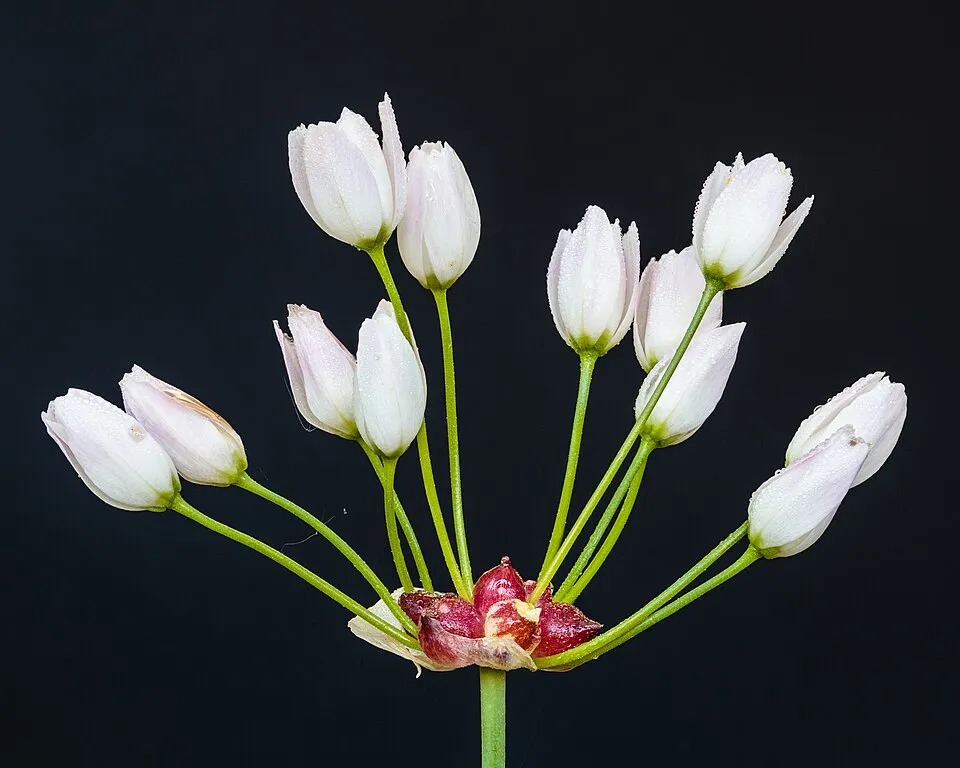
Wild Garlic (Allium canadense) with grass-like leaves and cluster of pink-to-white flowers and bulbils
Allium canadense — the cluster often includes both flowers and small bulbils that drop and form new plants. Photo: Rooted Revival.

Identification

[ field key — habit · leaf · flower · bulb · distinguishing from toxic look-alikes ]

Habit & Stem

Low-growing, clump-forming bulbous perennial. Grass-like, narrow, channeled leaves emerge from a small, layered bulb in early spring (March–April in Tulsa). A single, slender, solid flowering scape (stalk) rises 1–2 ft, topped with a spherical to dome-shaped cluster (umbel) of flowers and/or bulbils. The foliage dies back by mid-summer as the bulb goes dormant, disappearing entirely until the following spring. This summer dormancy is a characteristic adaptation of many spring-flowering bulbs from seasonally moist habitats.

Leaves

Basal, linear, grass-like, 6–12 in long and ⅛–¼ in wide, channeled (slightly folded along the midrib) and solid (not hollow). The leaves are dark green, smooth, and smell strongly of garlic-onion when crushed — this is the single most important identification character and the one that guarantees safety when foraging. The leaves emerge in early spring, well before the flowering stalk, and begin to wither by the time the flowers open. The lower portion of the leaf sheaths is often tinged with pink or purple at the base.

Flowers & Bulbils

The inflorescence is a dome-shaped umbel of 10–30+ small (¼–½ in) bell-shaped flowers on individual stalks (pedicels). Flowers are pink to white (rarely deep pink) with six pointed tepals (petal-like segments). However, the umbel is frequently dominated or entirely replaced by small, egg-shaped bulbils — tiny, onion-like structures that fall to the ground and grow into new plants. Some umbels produce only bulbils; others produce both bulbils and a few flowers; rarely, a plant produces an umbel of mostly flowers. This mix of bulbils and flowers is a distinctive and diagnostic field character for A. canadense.

Bulb & Distinction from Toxic Plants

The bulb is small (½–¾ in diameter), layered, and covered with a fibrous, net-like outer coat, smelling strongly of garlic-onion when cut or crushed. Critical safety note: several toxic plants can be confused with wild alliums in the field. Zigadenus species (death camas) have showier white flowers in a looser raceme and NO onion odor. Ornithogalum umbellatum (star-of-Bethlehem) has white star-like flowers with a green stripe on each tepal and NO onion odor. Nothoscordum bivalve (crow poison) resembles a small white allium but also lacks the garlic-onion scent. The onion-garlic scent is the reliable, non-negotiable safe identification character.

Habitat & Range in NE Oklahoma

Allium canadense is one of the most widespread native alliums in North America, occurring from the Great Plains east to the Atlantic, south to Texas and Florida, and north into Canada. In NE Oklahoma, it is a common plant of moist prairies, meadows, open woods, bottomland forests, roadsides, and old fields. It is frequently seen along rural roadsides in Osage, Rogers, and Wagoner counties, in the moist grassy margins of farm ponds and stock tanks, in the understory of open bottomland hardwood forests along the Arkansas and Verdigris rivers, and in suburban lawns and parks where the soil stays damp through spring.

Wild Garlic prefers consistently moist soil during its active growing season (spring) but tolerates the dry summer dormant period well. It is often found in association with big bluestem, switchgrass, eastern gamagrass, and other moisture-loving grasses and forbs. In lawns and meadows that are mowed regularly, the leaves may persist as a low, grassy colony that releases a strong garlic scent when walked on or mowed — a distinctive sensory experience of spring in rural Oklahoma.

Ecology & Wildlife Value

[ pollinators · herbivory · ecological role ]

Pollinators

When actual flowers are produced (rather than bulbils), they are visited by small native bees including sweat bees (Lasioglossum), mining bees (Andrena), and small solitary bees. Syrphid flies and small beetles also visit. However, because many umbels produce only bulbils (asexual reproduction), the plant's pollination ecology is limited compared to the showier ornamental alliums. The species relies more heavily on asexual reproduction via bulb offsets and bulbils than on seed production for population maintenance.

Herbivory

The sulfur compounds that give wild garlic its characteristic odor and flavor (alliin, allicin, and related thiosulfinates) serve as chemical defenses against herbivory. Most mammals, including deer and rabbits, avoid the foliage. However, small rodents (voles, mice) and wild turkeys will dig up and consume the bulbs, particularly in winter when other food is scarce. The plants generally survive this predation through their abundance, bulb offsets, and the production of aerial bulbils that establish new plants away from the parent.

Ecological Role

As a spring ephemeral in the moist prairie and woodland understory, Wild Garlic captures early-season sunlight before the warm-season grasses leaf out. The bulbs and foliage then senesce (die back) by mid-summer, returning nutrients to the soil. The plant's ability to reproduce both sexually (seeds from chasmogamous flowers) and asexually (bulb offsets from the parent bulb and bulbils dropped from the inflorescence) ensures population persistence under a wide range of environmental conditions.

Caution for Livestock

When consumed in quantity (particularly by dairy cattle grazing on wild garlic-infested pasture), the sulfur compounds can impart a garlic flavor to milk and meat. This is a quality issue rather than a toxicity concern. In a home permaculture setting, wild garlic is far more likely to be a welcome volunteer and a valued edible than a problem — most livestock avoid it unless forage is extremely limited.

Horticulture & Care

[ site selection · planting · care · companion planting ]

Site selection & establishment

Wild Garlic is easily established from bulbs or bulbils planted in fall (October–November in Tulsa) in moist to mesic soil. It adapts well to a wide range of conditions including the heavy clay common in NE Oklahoma, provided the soil stays damp through spring. It tolerates full sun to partial shade and naturalizes readily in lawns, meadows, orchard understories, and moist woodland edges. Its spring growth habit means it can thrive beneath deciduous trees, completing its life cycle before the canopy fully leafs out.

Care & maintenance

Wild Garlic requires essentially no care once established. It is a volunteer that persists and spreads gently without becoming aggressive or invasive. Allow the foliage to die back naturally in summer — this period of senescence feeds the bulb for the following year's growth. Do not cut back yellowing leaves prematurely. No fertilizer is needed, and supplemental water is rarely required in NE Oklahoma's climate. The plant has no significant pests or diseases. If you want to contain its spread in a formal garden, simply harvest the bulbils before they drop in late spring.

Companion planting

In a permaculture or edible landscape, plant Wild Garlic as an understory layer beneath pecans, American persimmons, or other fruit and nut trees in a food forest. Its spring growth cycle complements summer crops nicely — the garlic foliage dies back just as tomatoes and squash are expanding. For a native edible landscape, combine with wild bergamot, maypop, and common milkweed (for edible shoots and pods). In a moist prairie garden, pair with Canadian milkvetch, cardinal flower, and Ohio spiderwort. The plant also works well as a garlic chive substitute at the edge of a vegetable garden, where its early-spring greens can be harvested before the main vegetable season begins.

Edible & Cultural Uses

Wild Garlic is a valuable wild edible with a long history of use by Indigenous peoples and early settlers throughout its range. Every part of the plant is edible: the bulbs, leaves, scapes (flower stalks), flowers, and bulbils all share the characteristic garlic-onion flavor and can be used raw or cooked. The leaves are best harvested in early spring before the plant flowers, when they are at their most tender. Use them like garlic chives: chopped fresh into salads, scrambled eggs, soups, or pesto. The bulbs are small but intensely flavored, excellent for pickling or as a seasoning. The bulbils at the top of the flower stalk can be collected in late spring and used exactly like the underground bulbs.

Indigenous peoples throughout the plant's range used Wild Garlic as a staple flavoring and food. The Cherokee and Creek peoples of the Southeast and Oklahoma used the bulbs and leaves extensively in cooking and as a spring tonic. Several Plains tribes also harvested wild alliums as a seasonal food and medicine after the winter lean period. Unlike cultivated garlic (Allium sativum), which requires fall planting, careful management, and annual harvest, Wild Garlic is a perennialized, self-sustaining, zero-maintenance garlic substitute for the permaculture landscape — it comes back on its own every spring without any effort from the gardener, providing a reliable, free, and ecologically integrated source of allium flavor.

Foraging safety: Always confirm the garlic-onion odor before harvesting any wild allium. The toxic look-alikes (death camas, star-of-Bethlehem, crow poison) have NO onion or garlic scent. If it doesn't smell like garlic or onion when crushed, do not eat it. This is the one inviolable rule of allium foraging, and it has never failed.

Photo Reference

Close-up of Allium canadense flowers and bulbils in umbel
// Umbel — pink flowers and small bulbils in the same cluster
Wikimedia Commons
Wikimedia Commons
Grass-like leaves of Allium canadense
// Leaves — narrow, channeled, grass-like, strongly garlic-scented
Wikimedia Commons
Wikimedia Commons
Small layered bulbs of Allium canadense
// Bulbs — small, layered, fibrous-coated; edible and intensely flavored
Wikimedia Commons
Wikimedia Commons
Allium canadense colony in a moist meadow
// Habitat — moist meadow colony in NE Oklahoma
Wikimedia Commons
Wikimedia Commons
Allium canadense bulbils ready to fall and propagate
// Bulbils — tiny onion-like propagules; each falls and grows a new plant
Wikimedia Commons
Wikimedia Commons

Sources & Further Reading

  • USDA NRCS PLANTS Database — Allium canadense: plants.usda.gov/plant-profile/ALCA3
  • Lady Bird Johnson Wildflower Center — Native Plant Database: wildflower.org — ALCA3
  • Kindscher, K. (1987). Edible Wild Plants of the Prairie. University Press of Kansas.
  • Moerman, D.E. (1998). Native American Ethnobotany. Timber Press.
  • Thayer, S. (2006). The Forager's Harvest. Forager's Harvest Press (includes detailed allium foraging safety guidance).
  • Oklahoma Biological Survey — Allium canadense distribution in Oklahoma.
  • Wikipedia — Allium canadense: en.wikipedia.org/wiki/Allium_canadense (CC BY-SA 4.0).

Hero photo: Rooted Revival. Strip photos courtesy of Wikimedia Commons contributors under their respective licenses (linked under each image).