// SPECIES PROFILE · PERENNIAL · NATIVE · NITROGEN-FIXER
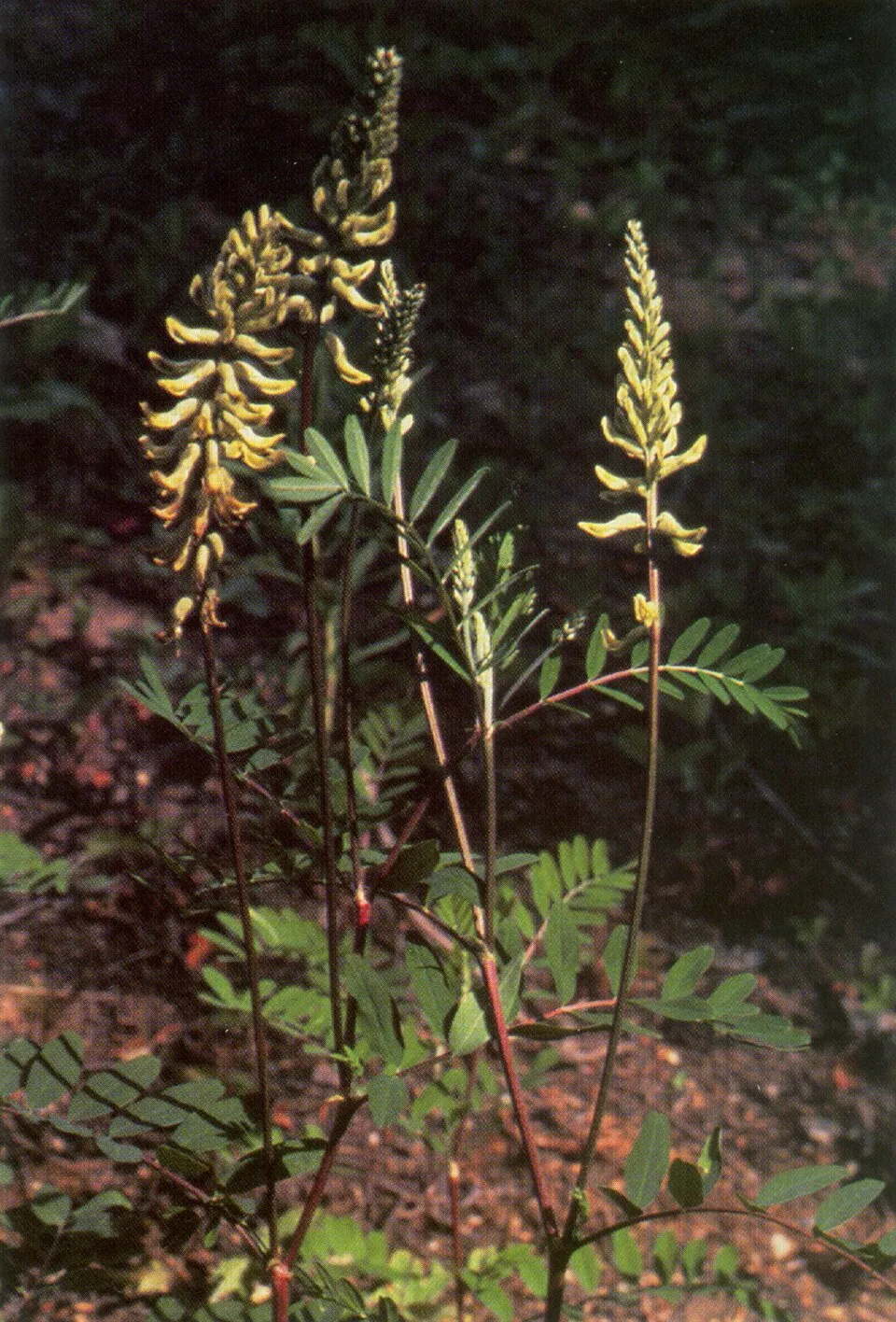
Canadian Milkvetch is a nitrogen-fixing prairie perennial that bridges two worlds: the open tallgrass prairie and the dappled edges of woodlands and streambanks. Its upright stems rise 2–4 ft, bearing compound leaves and dense, spike-like racemes of creamy-white to greenish-yellow pea flowers in early summer. Astragalus canadensis is pollinated primarily by bumblebees — the only insects strong enough to force open the keel petals and access the hidden pollen and nectar. This is one of the most widespread and adaptable Astragalus species in North America, occurring in nearly every US state and Canadian province, and it is a faithful component of moist prairies, meadow edges, and bottomland openings throughout NE Oklahoma. Unlike some of the Western locoweeds (Astragalus and Oxytropis species that accumulate selenium and cause livestock poisoning), A. canadensis is generally non-toxic and is considered good forage.

[ field key — habit · leaf · flower · fruit · special features ]
Upright, clump-forming perennial with multiple erect or ascending stems arising from a branching caudex (woody crown) atop a deep taproot. Stems are stout, ridged or grooved, and variably hairy (ranging from nearly smooth to finely pubescent). They are typically unbranched below the inflorescence. The plant dies back to the ground each winter and re-sprouts in mid-spring, reaching 2–4 ft by early summer. In moist, fertile sites, stems may be luxuriant and top-heavy, sometimes lodging if not supported by neighboring grasses; in drier, leaner soils, plants are shorter and stiffer.
Alternate, pinnately compound, 6–12 in long with 15–31 narrowly oblong to elliptical leaflets, each about 1–2 in long. Leaflets are dark green above, paler beneath, with entire margins and often a small notch or bristle at the tip. The leaf surface ranges from smooth to finely hairy depending on the population. The compound leaves are proportionally large and lush for a prairie legume — the foliage mass is substantial and contributes significantly to the plant's role as forage and nitrogen-fixing biomass.
Flowers are borne in dense, spike-like racemes 2–8 in long atop erect peduncles that rise well above the foliage. Each raceme holds 30–70 individual flowers packed closely together, giving the inflorescence a cylindrical, bottlebrush-like appearance. Individual flowers are about ½–¾ in long, creamy white to greenish-yellow (occasionally tinged faintly purple at the base), with the typical asymmetrical pea-flower shape. The raceme elongates as the season progresses, with new flowers opening at the top as older, lower flowers fade. The bloom period extends for 4–6 weeks as the raceme continuously produces new flowers from the tip.
The fruit is a small, plump, cylindrical to oblong pod (legume) about ½–¾ in long, turning from green to dark brown or black at maturity. Pods are erect (held upright) on the raceme stalk and contain 2–6 small, kidney-shaped seeds. The genus Astragalus is one of the largest genera of flowering plants in the world (over 3,000 species), and North America is its center of diversity. A. canadensis is distinguished from many of its relatives by its large size, moist habitat preference, and non-toxic foliage — it lacks the selenium-accumulating properties that make some Western Astragalus species (the "locoweeds") poisonous to livestock. The common name "milkvetch" is somewhat misleading: it refers to the traditional belief that these plants increased milk production in goats, not to any milky sap.
Astragalus canadensis has one of the widest native ranges of any North American legume, occurring in nearly every US state (absent only from some parts of the deep Southeast) and across most of Canada. In Oklahoma, it is found statewide but is most abundant in the eastern tallgrass prairie, Cross Timbers, and Ozark border regions of NE Oklahoma. This is a plant of moist to mesic open sites: bottomland prairies along the Arkansas and Verdigris rivers, moist meadow edges, roadside ditches, open woodland borders, streambanks, and the partially-shaded edges of post-oak and blackjack-oak savannah.
In the Tulsa region, Canadian Milkvetch is common in the moist prairie hay meadows of Osage, Rogers, and Wagoner counties, along the grassy shoulders of county roads where runoff accumulates, and in the partially-open understory of bottomland hardwood forests where canopy gaps allow sufficient light. It frequently grows in association with big bluestem, switchgrass, indiangrass, tall goldenrod, and a suite of tall, moisture-loving prairie forbs. It is less common on the dry, rocky upland prairies and sandstone glades preferred by Baptisia and Dalea — A. canadensis wants soil that holds moisture through the summer.
[ nitrogen fixation · bumblebee pollination · lepidoptera · wildlife ]
Like all legumes, A. canadensis forms root nodules housing nitrogen-fixing rhizobial bacteria, converting atmospheric N2 into plant-available ammonium. The genus Astragalus is known to associate with a specific group of rhizobia (predominantly Mesorhizobium species), though Astragalus-compatible rhizobia are widespread in North American soils and inoculation is rarely necessary. The nitrogen contribution benefits the surrounding plant community and makes Canadian Milkvetch a useful component of forage mixes and prairie restorations where soil nitrogen is limiting.
The complex pea flowers of A. canadensis are pollinated almost exclusively by large bumblebees (primarily Bombus pensylvanicus, B. griseocollis, B. impatiens, and B. bimaculatus in NE Oklahoma). The flower requires a heavy insect to depress the keel and expose the stamens — a mechanism that excludes smaller bees, flies, and honeybees as effective pollinators, though honeybees may collect pollen from already-tripped flowers. The extended bloom period (6+ weeks) and sequential flower opening create a reliable daily nectar and pollen source for bumblebee colonies through the early-to-mid-summer period when many other prairie legumes have finished blooming.
Astragalus canadensis is a larval host for the clouded sulphur (Colias philodice) and the orange sulphur (C. eurytheme), two of the most common and widespread butterflies in NE Oklahoma. Several blue butterflies (subfamily Polyommatinae) including the eastern-tailed blue (Cupido comyntas) and the silvery blue (Glaucopsyche lygdamus) are also recorded on Astragalus species. The dense foliage provides substantial caterpillar biomass that supports insectivorous birds.
The small, hard seeds are consumed by northern bobwhite quail, wild turkey, mourning doves, and several sparrow species. The foliage is highly palatable to white-tailed deer and is also browsed by cottontail rabbits. A. canadensis is rated as excellent wildlife forage and is often included in wildlife food plot and CRP (Conservation Reserve Program) seed mixes in Oklahoma and adjacent states. Unlike some Western Astragalus species (the locoweeds) that accumulate toxic levels of selenium, A. canadensis is generally safe and nutritious for livestock and wildlife consumption.
[ site selection · establishment · care · companion planting ]
Canadian Milkvetch occupies a different niche from most of the other prairie legumes described in this guide: it wants moist soil — not wetland standing water, but ground that stays consistently damp through the growing season rather than baking dry in the July sun. This makes it an excellent choice for the rain garden, bioswale, moist meadow, or the lower edge of a prairie planting where runoff collects. In a garden setting, a site that receives morning sun and light afternoon shade (or filtered light through scattered oaks) is ideal. Full sun is tolerated and produces the heaviest bloom, but only if soil moisture is adequate; on dry sites, the plant will be stunted and short-lived.
Once established in a suitable moist site, Canadian Milkvetch is low-maintenance. Do not fertilize (suppresses nodulation). Supplemental water may be needed during extended summer drought if the site is marginal. In a tall prairie setting, the plant benefits from the physical support of surrounding grasses that prevent flopping. Cut dead stems to the ground in late winter. The plant may be relatively short-lived compared to Baptisia or Dalea (individual crowns typically persist 3–7 years), but it self-sows readily in moist, open soil, maintaining a population without replanting. There are no significant pest or disease problems in NE Oklahoma gardens.
In a moist prairie garden or rain garden, combine Canadian Milkvetch with tall, moisture-tolerant grasses like big bluestem, switchgrass, and eastern gamagrass. For a forb layer, pair with Joe-Pye weed, cardinal flower, tall goldenrod, New England aster, and common milkweed. In a woodland-edge planting, position it at the sunny outer edge where it receives morning sun beneath scattered post oaks or bur oaks. Its lush foliage and extended bloom period make it a valuable structural mid-layer plant that bridges spring and late-summer prairie bloom cycles.
Astragalus canadensis has a modest ethnobotanical record. Several Indigenous peoples of the Great Plains and Eastern Woodlands used the roots of Astragalus species medicinally, primarily as a tea or poultice for treating fevers, wounds, and respiratory complaints. The plant is not generally considered edible for humans (the seeds are small and hard, and the foliage contains compounds that may cause digestive upset if eaten raw in quantity), though it has no significant toxicity and was historically considered safe forage for horses and cattle. Note: this is a different genus from the Chinese medicinal herb Astragalus membranaceus (huang qi), though they are closely related.
The common name "milkvetch" derives from the European folk belief that certain Astragalus species increased milk yield in lactating goats and cows when grazed — a property that may have a basis in the plant's high protein content and palatability but has not been scientifically verified for A. canadensis specifically. The plant's primary contemporary value is ecological: nitrogen-fixing, bumblebee-supporting, and wildlife-forage contributions to moist prairie and woodland-edge plant communities.
Hero photo: Rooted Revival. Strip photos courtesy of Wikimedia Commons contributors under their respective licenses (linked under each image).