// SPECIES PROFILE · PERENNIAL · NATIVE · NITROGEN-FIXER
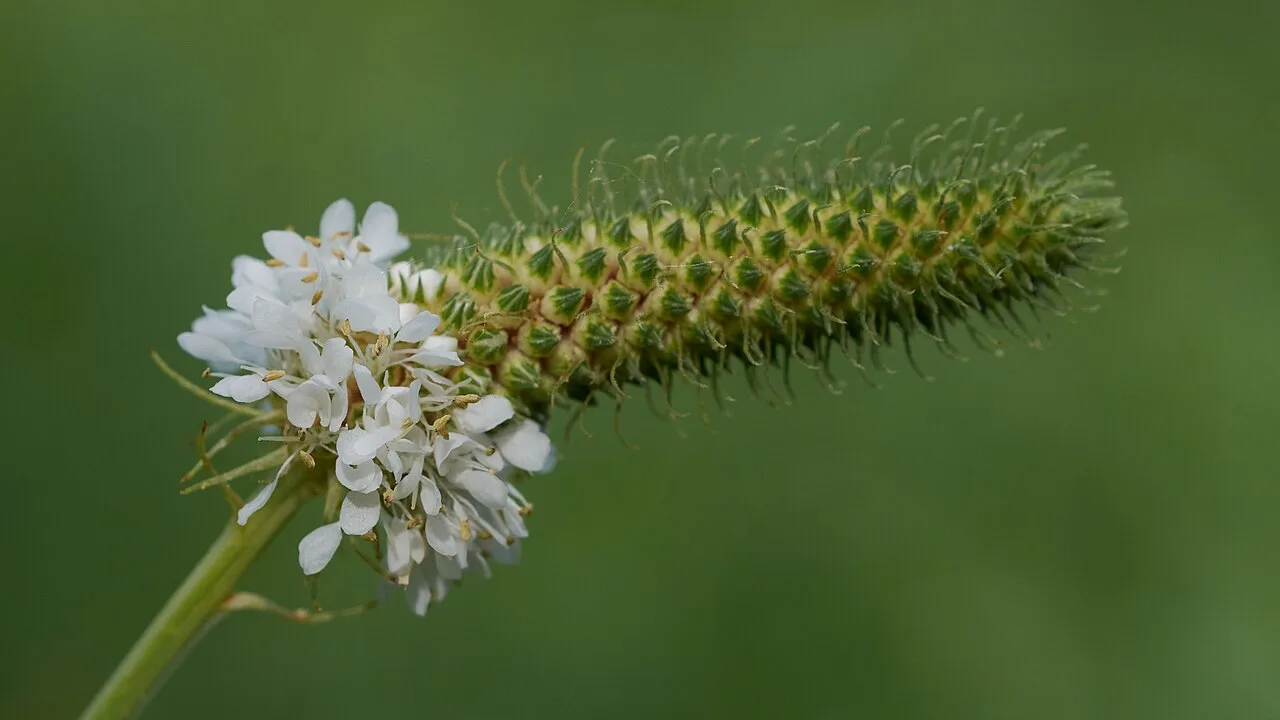
White Prairie Clover is the elegant, understated nitrogen-fixer that should be in every NE Oklahoma prairie garden but rarely is. Slender, wiry stems rise 1–2 ft from a deep taproot, topped with dense, cylindrical spikes of pure white flowers that bloom from the bottom upward in a slow, methodical progression through June and July. Each tiny pea flower in the spike opens for only one day, with a fresh ring of blooms appearing each morning before the previous ring withers — a daily unfolding reminiscent of a Liatris spike run in reverse. Dalea candida is, acre for acre, one of the best native bee plants in the tallgrass prairie: its flowers are visited by an extraordinary diversity of bumblebees, mining bees, sweat bees, leafcutter bees, and small solitary wasps. As a nitrogen-fixing legume in the Fabaceae, it also quietly enriches the soil beneath it, making it a perfect companion for the warm-season grasses and showier forbs that dominate a prairie planting.

[ field key — habit · leaf · flower · fruit · special features ]
Slender, upright perennial with a clump-forming habit and multiple unbranched flowering stems rising from a woody crown. Stems are thin, wiry, and smooth (glabrous), green to reddish, with an airy, see-through quality that allows light to reach shorter plants beneath. The overall form is neat and vertical — no flopping or sprawling — and the deep taproot (often exceeding 4 ft) makes it nearly immune to drought and wind. Plants do not spread vegetatively but slowly increase the crown diameter with age. Individual plants have been documented living 25+ years on intact prairie remnants.
Alternate, pinnately compound with 5–7 narrow, linear leaflets each about ½–1 in long. Leaflets are dark green, smooth, and gland-dotted (translucent dots visible when held to light) — a characteristic of the genus Dalea. The glands produce aromatic, resinous compounds that give the foliage a faint spicy fragrance when crushed. Leaves are concentrated on the lower half of the flowering stem, with the upper stem largely bare except for the terminal inflorescence.
The inflorescence is a dense, cylindrical spike 1–3 in long and about ½ in wide, composed of dozens of tiny (about ¼ in) individual pea flowers. Each flower is pure white, sometimes faintly green-tinged, with the standard five petals of a typical legume flower: a broad upright banner, two lateral wings, and two fused keel petals. Flowers open from the bottom of the spike upward, with typically 5–10 flowers open in a single ring on any given morning. Each individual flower lasts about 6–8 hours, then withers as a new ring opens above it the following day. The spike structure and sequential bloom make D. candida easily distinguished from purple prairie clover (D. purpurea), whose purple flowers open simultaneously from the bottom, middle, and top of the spike.
Fruits are small, one-seeded, indehiscent pods (technically legumes but functionally resembling achenes) enclosed within the persistent dried calyx. Each pod is about 2–3 mm and contains a single smooth, olive-brown seed. The dried flower spikes persist on the plant into fall and winter, providing structural interest and a source of seeds for granivorous birds and small mammals. Seeds require scarification for reliable germination and may remain viable in the soil seed bank for several years.
Dalea candida is a classic plant of the tallgrass and mixed-grass prairies, ranging from the Canadian prairies south through the Great Plains to Texas and eastward into the Midwestern states. In NE Oklahoma, it is found in dry to mesic tallgrass prairie remnants, open post-oak-blackjack oak savannahs, sandstone and limestone glade margins, and along the grassy shoulders of rural roads. It favors well-drained, often gravelly or rocky soils in full sun; you'll find it growing on the drier upper slopes of prairie remnants where the soil is thinner and competition from the taller warm-season grasses is less intense.
In the Tulsa region, White Prairie Clover occurs in native prairie hay meadows in Osage County, on sandstone barrens in the Cross Timbers, and in the open grassland openings of Keystone Wildlife Management Area and the smaller natural areas surrounding Skiatook and Oologah lakes. It is frequently associated with little bluestem, sideoats grama, prairie dropseed, and a diverse community of mid-height prairie forbs. D. candida is less common on the heavy, poorly-drained red clay soils that dominate much of metropolitan Tulsa — it prefers the sandier, loess-influenced soils of the upland prairie remnants.
[ nitrogen fixation · bee diversity · lepidoptera · wildlife ]
Dalea candida is a nitrogen-fixing legume, forming root nodules with rhizobial bacteria that convert atmospheric N2 to plant-available ammonium. The fixed nitrogen is used primarily for the plant's own growth and seed production, but some enters the soil ecosystem through fine root turnover, leaf litter decomposition, and the decay of the entire root system when individual plants senesce. In a prairie matrix dominated by nitrogen-demanding C4 grasses, the slow nitrogen subsidy from scattered Dalea plants contributes subtly but persistently to the fertility mosaic on which the entire plant community depends.
This is one of the premiere native bee plants in the tallgrass prairie, attracting a wider diversity of bees than almost any other mid-summer forb. Documented visitors in Oklahoma and adjacent states include: bumblebees (Bombus pensylvanicus, B. griseocollis, B. impatiens), mining bees (Andrena spp.), sweat bees (Lasioglossum, Agapostemon, Halictus), leafcutter bees (Megachile spp.), long-horned bees (Melissodes), cuckoo bees (Triepeolus, Nomada), and small carpenter bees (Ceratina). The sequential bloom pattern (one ring per day) means individual plants produce flowers over an extended window, effectively creating a reliable daily nectar and pollen source for 2–4 weeks.
Dalea species serve as larval hosts for the southern dogface sulphur (Zerene cesonia), a showy yellow butterfly whose caterpillars feed on the foliage. The marine blue (Leptotes marina), a small hairstreak butterfly, also uses Dalea as a host. Adult butterflies of many species visit the flowers for nectar, including eastern-tailed blues, checkered skippers, and various sulphurs.
The small seeds are consumed by northern bobwhite quail, wild turkey, mourning doves, and several sparrow species (especially field sparrows, Savannah sparrows, and song sparrows in winter prairie habitats). Small mammals including deer mice and thirteen-lined ground squirrels forage on the seeds. The foliage is moderately palatable to deer and rabbits, though the plant's low stature and occurrence within dense prairie grasses provide some natural protection from heavy browsing.
[ establishment · seed · care · companion planting ]
White Prairie Clover is reliably established from seed, though patience is required. Scarify seeds by rubbing between fine sandpaper or using a brief hot water soak (pour near-boiling water over seeds, allow to cool, soak overnight). Direct-sow in late fall (October–November in Tulsa) for natural cold-moist stratification over winter, or cold-moist stratify indoors for 30–60 days and sow in spring. Sow ¼ in deep into a weed-free, firm seedbed. Germination is often staggered over several weeks. Seedlings invest heavily in the taproot during their first year; above-ground growth is modest and plants typically do not bloom until their second or third season.
Once established, White Prairie Clover is essentially maintenance-free. It needs no supplemental water, no fertilizer (fertilizing suppresses nodulation), and no staking despite its slender stems. It is extremely drought-tolerant, moderately tolerant of spring and fall prescribed fire (a natural component of its prairie habitat), and has essentially no serious pests or diseases in NE Oklahoma gardens. Cut dead stems to the ground in late winter. Avoid heavy mulch directly over the crown, which can encourage rot; a light gravel mulch is better than wood chips.
In a dry prairie garden, White Prairie Clover pairs naturally with mid-height grasses like little bluestem, sideoats grama, and prairie dropseed. For a forb-rich matrix, combine with purple prairie clover (the purple-and-white dual Dalea planting is a bee bonanza), pale purple coneflower, butterfly milkweed, narrow-leaved coneflower, and wild bergamot. The see-through, airy stems of D. candida make it an excellent "blender plant" — it ties together bolder architectural species without competing visually, and the long bloom window bridges the gap between early prairie flowers and the late-summer goldenrods and asters.
Dalea candida has a limited ethnobotanical record compared to some other prairie legumes. Indigenous peoples of the Great Plains are recorded as having used the dried flower spikes and roots of several Dalea species medicinally, primarily as infusions for treating digestive complaints and as a mild astringent. The seeds are too small and the pods too fibrous for Dalea candida to have been a significant human food source, unlike the larger-seeded Desmanthus and Baptisia. The plant's primary historical and contemporary value is ecological: a soil-enriching, bee-supporting, nitrogen-fixing component of the tallgrass prairie plant community.
The closely related purple prairie clover (Dalea purpurea) has a somewhat fuller record of Indigenous use, including its application as a tea for heart ailments (several Plains cultures) and the use of the tough, fibrous stems in small-scale basketry. Both species are among the most heavily bee-visited plants in any prairie restoration and should be valued primarily for their ecological services.
Hero photo: Rooted Revival. Strip photos courtesy of Wikimedia Commons contributors under their respective licenses (linked under each image).