// SPECIES PROFILE · SHRUB/TREE · NATIVE · DROUGHT-HARDY · WILDLIFE FRUIT
Sparkleberry is a unique native blueberry — the only one that routinely grows as a large shrub or small tree 10–25 ft tall, with distinctive peeling, cinnamon-colored bark and glossy, semi-evergreen leaves. It produces small black berries that are inedibly gritty and seedy to humans but beloved by wildlife and persistent into winter. Vaccinium arboreum is a plant of the Cross Timbers and southeastern pine-oak uplands, and it is the most drought-tolerant Vaccinium species in North America — a blueberry that does not need the acidic, boggy conditions of its relatives. In NE Oklahoma, it dots the dry, rocky understory of post oak-blackjack oak woods and the sandy margins of sandstone glades, a species perfectly adapted to the region's hot, thin-soiled uplands.

[ field key — habit · bark · leaf · flower · fruit · distinguishing features ]
Sparkleberry is the largest Vaccinium in North America, typically growing as a large, multi-stemmed shrub 10–15 ft tall on dry, thin soils, but capable of reaching 20–25 ft as a single-trunked small tree on richer sites. The bark is the plant's most eye-catching feature: smooth and cinnamon-brown to reddish, peeling in thin, curling flakes and strips to reveal a paler, grayish inner bark — it looks like a small version of a river birch wearing a Vaccinium suit. Older trunks develop a darker, more blocky, ridged bark at the base. The branching is irregular and often somewhat twisted, giving sparkleberry a distinctly artistic silhouette in the winter landscape.
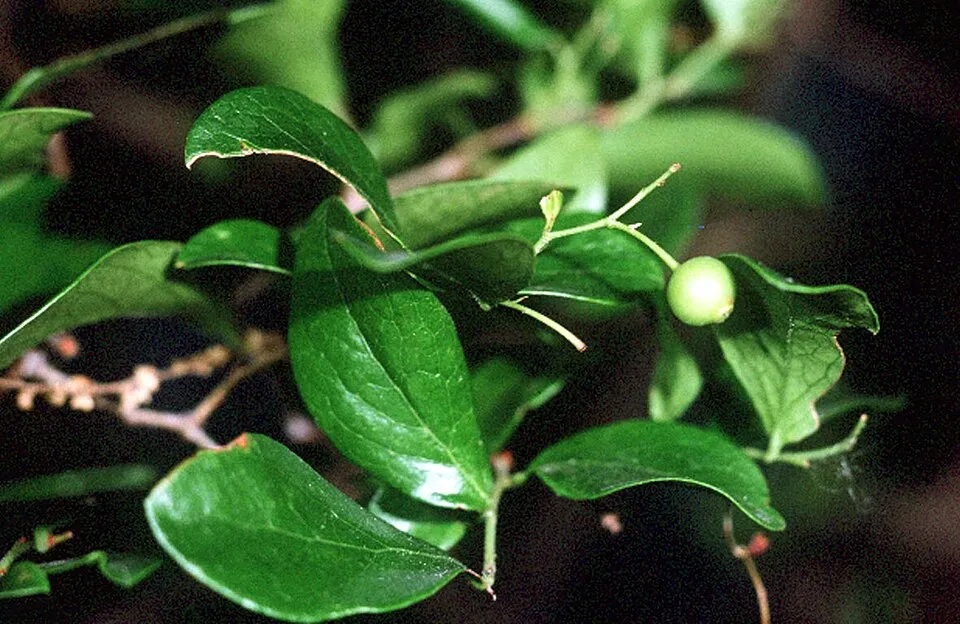
Leaves are simple, alternate, oval to obovate, 1–2 in long and ½–1 in wide, with entire or very finely toothed margins and a short petiole. The upper surface is dark green and highly glossy, almost lacquered-looking, with a leathery texture. The underside is paler and dotted with tiny resin glands. Sparkleberry is semi-evergreen to deciduous: in the Tulsa region, it holds its leaves through much of the winter, dropping them in late winter or early spring as new growth begins. The leaves often turn reddish to burgundy-purple in cold weather before falling — one of the few sources of winter color in the understory.
The flowers are unmistakably blueberry-like: small, white, pendulous, bell-shaped (urceolate) blossoms, ⅛–¼ in long, borne in axillary racemes of 3–12 flowers on the new growth of the season. Each flower has five tiny, recurved lobes at the mouth of the bell. The bloom period in NE Oklahoma runs May through June, substantially later than the lowbush and highbush blueberries of eastern gardens, which bloom in March–April. The flowers are pollinated by bumblebees and other native bees capable of buzz-pollinating the enclosed anthers, as well as by various small bees and flies.
The fruit is a small, round berry ¼–⅓ in in diameter, glossy black when ripe, and contains 8–10 hard, noticeable seeds. This is the crux of sparkleberry's relationship with humans: the seeds are large enough and hard enough that the fruit is unpleasantly gritty and seedy to eat fresh, earning it the dismissive name "farkleberry." However, the berries persist on the plant well into winter (persistence is unusually long compared to most Vaccinium species), making them a valuable late-season wildlife food. The fruit ripens in late summer (September–October) and may hang on the branches through February if not consumed by birds. Key distinguishing features: erect, woody habit (not low and spreading like most Vaccinium); peeling reddish bark; and the combination of glossy, leathery, semi-evergreen leaves with small, bell-shaped white flowers.
Vaccinium arboreum ranges across the southeastern quarter of the United States, with eastern Oklahoma near the western limit of its distribution. In NE Oklahoma, sparkleberry is a characteristic species of the Cross Timbers ecoregion, where it grows as an understory shrub in dry, open post oak-blackjack oak woodland on sandy or rocky, acidic soils. It is especially common on sandstone and chert ridges, glade margins, and the edges of rocky slopes where the soil is thin, well-drained, and never waterlogged. Look for it in the upland woods of the Osage Hills, the sandstone escarpments west of Tulsa, and in the oak-pine transition zones of the Ozark foothills in Cherokee and Delaware counties.
Sparkleberry is an indicator of dry, acidic sites in NE Oklahoma — if you see it, you are standing on soil that drains quickly and has a low pH. It frequently grows alongside post oak, blackjack oak, black hickory, aromatic aster, and the grasses of the little bluestem-shortgrass community. It is virtually never found in the rich, moist bottomlands that support pecan and sycamore — sparkleberry occupies the opposite end of the moisture spectrum among NE Oklahoma's native woody plants.
[ winter fruit · bird ecology · pollinator support · upland woodland ecology ]
Sparkleberry's most ecologically significant trait is the extended persistence of its fruit. While most soft mast (berries) in NE Oklahoma ripens and is consumed within a few weeks, sparkleberry berries can hang on the branches from September through February. This makes them a rare and valuable winter food source at a time when other fruits and insects are scarce. Birds that feed on winter sparkleberry fruit include American robins, cedar waxwings, Eastern bluebirds, yellow-rumped warblers, hermit thrushes, Northern mockingbirds, and brown thrashers. The fruit is also consumed by wild turkeys, Northern bobwhite quail, raccoons, opossums, and foxes throughout the fall and winter.
Sparkleberry flowers are pollinated by a range of native bees, including southeastern blueberry bee (Habropoda laboriosa), a specialist pollinator of wild blueberries. Bumblebees, mining bees, and small carpenter bees also work the flowers. The late bloom period (May–June) fills a gap between the early spring flush of tree flowers and the peak of summer meadow blooms, providing nectar for bee species that are provisioning nests during late spring.
As a Vaccinium species, sparkleberry serves as a larval host for the brown elfin butterfly (Callophrys augustinus) and the striped hairstreak (Satyrium liparops), as well as several moth species including the major blueberry leafroller and the huckleberry sphinx. The glossy, semi-evergreen leaves provide winter shelter for small insects and the birds that forage for them.
In the Cross Timbers woodland community, sparkleberry fills a mid-level understory niche, occupying the space between the grassy/herbaceous forest floor and the oak-hickory canopy. Its deep, fibrous, drought-adapted root system accesses moisture in rock fissures that shallower-rooted plants cannot reach, and its semi-evergreen foliage provides structure and cover during the winter when the deciduous oaks above are bare. The litter from its leathery, slowly decomposing leaves contributes to the acidic duff layer characteristic of Cross Timbers woodland soils.
[ site selection · soil · planting · maintenance · companion planting · food forest role ]
Sparkleberry demands well-drained, acidic soil and will fail quickly in the heavy, alkaline, seasonally waterlogged clay of many Tulsa yards. The ideal site is a raised, sandy or gravelly bed, a slope, or a naturally dry, rocky location where water never stands. If your soil is heavy clay, plant sparkleberry on a mound or in a raised bed amended with pine bark fines, coarse sand, and peat moss to create the acidic, fast-draining root zone it requires.
Sparkleberry fits naturally into a Cross Timbers-style woodland planting or a xeric (dry) food forest edge. Pairs well with: post oak, blackjack oak, and chinkapin oak as the canopy; aromatic aster, little bluestem, and prairie dropseed in the herbaceous understory; and rusty blackhaw, American beautyberry, or New Jersey tea in the shrub layer. Sparkleberry is also an excellent understory beneath Shumard oak or black tupelo on well-drained slopes. In a food forest, recognize that sparkleberry's fruit is primarily for wildlife, not the table — plant it for the birds, the winter berry display, and the unique architectural character of its bark, not for a blueberry harvest.
Sparkleberry is not commonly available in retail nurseries, but it can be propagated by seed or semi-hardwood cuttings. Seeds require cold-moist stratification for 60–90 days (mimicking the natural winter-chill cycle), after which germination is slow and irregular — do not be discouraged if seeds take 2–3 months to germinate in spring. Seed-grown plants are variable and may take 5–8 years to reach flowering size. Semi-hardwood cuttings taken in mid-summer (June–July), treated with rooting hormone, and placed under intermittent mist will root in 8–12 weeks, though the success rate is moderate. For the home gardener, the most practical route is to source a container-grown plant from a native plant nursery specializing in southeastern or Cross Timbers species, or to participate in native plant society sales where sparkleberry occasionally appears. Once you have one established plant, volunteer seedlings often appear nearby in the acidic duff beneath the parent — these can be carefully dug and transplanted while dormant in late winter.
Let's be honest about sparkleberry fruit: it is not a human food crop in the way that cultivated blueberries are. The berries are small, seedy, and gritty, and while they are technically edible and have a mild, slightly sweet flavor, the mouthfeel is unpleasant to most people. That said, they are not worthless — they simply require processing to be enjoyable.
Sparkleberry's unique combination of peeling cinnamon bark, glossy foliage, and sculptural branch architecture makes it a standout in the native landscape. It works beautifully as a specimen understory tree in a dry, shaded corner where few other woody plants thrive, as part of a mixed shrub border along a woodland edge, or as an architectural accent against a stone wall or fence, where its exfoliating bark catches low-angle winter light. In a larger landscape, a grouping of three or five sparkleberries spaced 10–15 ft apart creates a natural grove effect that is particularly striking in winter when the cinnamon trunks are framed by the open architecture of the oak canopy above.
For the designer working with the Cross Timbers palette, sparkleberry provides something rare: an ericaceous (acid-loving) native woody plant that tolerates the hot, dry summers and occasional droughts that would kill a rhododendron or mountain laurel. It can be used in combination with sandstone boulders, dry creek beds, and native grasses to create a naturalistic Cross Timbers landscape vignette that requires almost no irrigation once established. The winter berry display, while seedy to humans, is visually striking — hundreds of small black berries against the backdrop of glossy, burgundy-tinted foliage and peeling cinnamon bark. In a landscape increasingly dominated by the same dozen ornamental shrubs, sparkleberry reads as something genuinely different and distinctly of this place.
Hero photo: Rooted Revival. Strip photos courtesy of Wikimedia Commons contributors under their respective licenses (linked under each image).