// SPECIES PROFILE · TREE · NATIVE · BOTTOMLAND SPECIALIST
Shellbark Hickory produces the largest nuts of any hickory and what many foragers consider the sweetest, richest-tasting kernel in the entire genus. The nuts can exceed 2 inches across with a thick husk that splits cleanly into four sections, revealing a pale, thick-shelled nut with sweet, oily meat that rivals the best pecan. Carya laciniosa is the most moisture-demanding of the hickories, a specialist of deep, rich bottomland soils along the major river systems of the eastern US. In NE Oklahoma, it is found in the alluvial terraces of the Arkansas and Verdigris River valleys, sharing these rich-soil habitats with Pecan and Black Walnut. The bark is thick, loose, and shaggy — like peeling sheets of gray slate — making it readily distinguishable even in winter. The tree is long-lived, slow to begin nut production (10–15 years from planting, peak production at 40+), but once established it will outproduce any other wild nut tree pound for pound in the rich bottomland soils of our river valleys.

[ field key — bark · leaf · nut · twig · habit ]
A large, straight-trunked deciduous tree with a narrow, oblong crown when forest-grown and a broader, more open crown in the open. The bark is the best identification character: on mature trunks it is thick, loose, and shaggy, peeling away from the trunk in long, wide, curling plates of a pale gray color. It is shaggier than Shagbark Hickory (Carya ovata), with plates that are broader, thicker, and less curly. Young bark is smooth and gray, but shagginess develops early — often by 10–15 years of age.
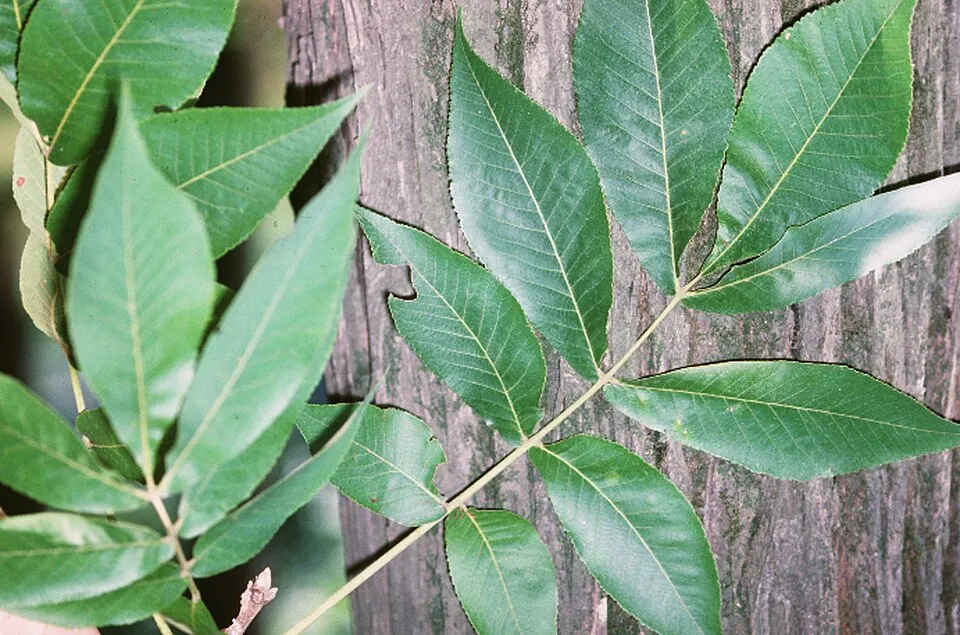
Alternate, pinnately compound, 12–22 in long with usually 7 leaflets (rarely 5 or 9). The terminal leaflet is the largest. Leaflets are lanceolate to oblong, 4–8 in long, with finely toothed margins, dark yellow-green above and paler and softly hairy below. The rachis (central leaf stalk) is stout and usually hairy. Fall color is a rich golden-yellow, among the best of the hickories. The crushed foliage has a pleasant, spicy-resinous hickory scent.
Monoecious. Male flowers are in pendulous, greenish-yellow catkins 4–6 in long, produced in clusters of three at the base of new growth. Female flowers are tiny, at the tips of new shoots, and wind-pollinated. Bloom coincides with leaf emergence in mid-to-late April. Shellbark hickory pollen can fertilize Pecan flowers and vice versa, adding complexity to pecan orchard pollination management.
The fruit is a thick-husked drupe, 1.5–2.5 in long and nearly as wide, the largest of any hickory. The husk is thick (up to 1⁄2 in), four-ridged, and splits cleanly to the base into four sections when mature in October. Inside is a thick-shelled, pale tan nut with a large, sweet, oily kernel that is generally considered the finest-tasting of all wild hickories — richer than Shagbark, less astringent than Black Hickory. The shell is harder to crack than pecan, but the reward justifies the effort. Nuts ripen September–October.
Carya laciniosa reaches the southwestern limit of its natural range in eastern Oklahoma. It is a bottomland specialist, restricted to the deep, rich, moist alluvial soils of major river floodplains. In NE Oklahoma, it is found along the Arkansas River and Verdigris River floodplains, growing with Pecan, Black Walnut, American Sycamore, and Eastern Cottonwood. It is the most moisture-demanding of the hickories and is absent from the drier upland and Cross Timbers sites where Black Hickory and Mockernut Hickory dominate.
In the landscape, Shellbark Hickory demands more water than other hickories and should be sited in a low area, near a water source, or in deeply amended soil with consistent moisture. It will not thrive on dry, thin soils or exposed ridge tops. Given the right site — deep, rich bottomland soil with a high water table — it is the premier wild nut tree for the NE Oklahoma food forest.
[ premier wildlife nut · Lepidoptera host · cavity habitat ]
Shellbark hickory nuts are a first-order wildlife food in bottomland forests. Eastern gray squirrels and fox squirrels are the primary mammalian consumers and dispersers, burying nuts throughout the floodplain. Wild turkey, wood duck, mallard, blue jay, red-bellied woodpecker, and white- tailed deer all consume the nuts. Because the nuts are so large and energy-dense, they are particularly important for wildlife fattening in the fall. A single mature tree in a heavy mast year produces bushels of nuts.
Like all hickories, C. laciniosa supports caterpillars of the hickory horned devil (Citheronia regalis), the luna moth (Actias luna), the royal walnut moth (Citheronia regalis), and the banded hairstreak (Satyrium calanus). The Juglandaceae as a family supports over 200 species of native Lepidoptera, and hickories are second only to oaks in their importance as caterpillar host plants in eastern deciduous forests.
[ site selection · deep taproot · nut production timeline ]
Shellbark Hickory must have deep, rich, consistently moist soil. In a Tulsa-area landscape, this means a low spot in the yard, a rain garden margin, near a pond or creek, or a site with deep amended soil and reliable irrigation. Full sun is necessary for nut production. The tree develops a massive taproot as a seedling and is notoriously difficult to transplant once established. Plan the planting site carefully; you will not be moving it later.
In a bottomland food forest, pair Shellbark Hickory with Pecan, Black Walnut, and American Persimmon in the canopy. In the mid-story, Pawpaw, Spicebush, and American Hazelnut thrive in the dappled shade. Note: black walnut produces juglone, which can suppress some understory plants; hickories do not have this effect.
Shellbark hickory nuts are the premier wild nut of eastern North America for human consumption. The kernel is sweet, rich, and oily, with a flavor often described as superior to pecan — more concentrated and nuanced, with hints of maple and butter. The nuts were a staple food for Indigenous peoples throughout the eastern US; archaeological sites in the Ohio and Mississippi Valleys contain large caches of carbonized shellbark hickory nuts, indicating they were stored in quantity for winter use. The nuts were cracked, the meats picked out, and the kernels eaten raw, roasted, or pounded into a paste (powcohicora / "hickory milk") that was used as a soup base, cooking fat, and infant food. "Hickory" itself is a shortening of the Algonquian pawcohiccora, referring to this nut milk.
The wood is dense, hard, and shock-resistant, used historically for tool handles, wagon spokes, and sporting goods. It is one of the strongest North American hardwoods. Smoking meat with hickory wood is a tradition across the South and Midwest, and shellbark hickory is considered among the best smoking woods for its rich, sweet smoke flavor.
Hero photo: Rooted Revival. Strip photos courtesy of Wikimedia Commons contributors under their respective licenses (linked under each image).