home/ plants/ mexican-plum

// SPECIES PROFILE · TREE · NATIVE · EARLY-SPRING POLLINATOR · EDIBLE FRUIT

Mexican Plum

Prunus mexicana

Mexican plum is a small deciduous tree 15–25 ft tall with dark, furrowed bark and an eruption of fragrant white-to-pale-pink flowers in earliest spring — so early that the showy bloom often unfolds before any leaves have emerged, transforming a bare tree into a cloud of white against the late-winter landscape. It produces small, purple-red plums with a tart-sweet flavor excellent for preserves and jelly — if you can beat the wildlife to them. Prunus mexicana is native to the south-central US and northeastern Mexico, and in NE Oklahoma it inhabits woodland edges, fencerows, and rocky slopes throughout the Cross Timbers and Ozark foothills. It is, bar none, the earliest-spring pollinator powerhouse among North American native plums — its February–March bloom feeds queen bumblebees emerging from hibernation, early solitary bees, and any butterfly brave enough to fly in late winter.

// QUICK FACTS
Family
Rosaceae (rose family)
Life cycle
Deciduous perennial tree; moderate lifespan 40–60 years
Native range
South-central US and northeastern Mexico — Missouri to Alabama, south to Texas, west to Coahuila; common in eastern and central OK
USDA hardiness
Zones 5–9 (Tulsa = 7a/7b — well within ideal range)
Mature size
15–25 ft tall, 15–20 ft spread; occasionally to 35 ft on rich sites
Bloom
February – April (NE OK); among the earliest woody plants to flower
Flower
Clusters of 2–5 fragrant, 5-petaled white to pale-pink flowers, ½–¾ in wide; appearing before or with emerging leaves
Fruit
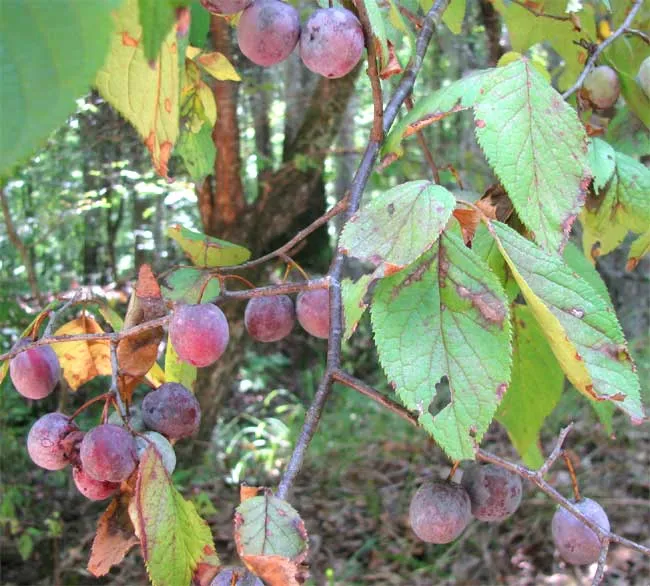
Purple-red drupe (plum) 1–1¼ in diameter, with a bluish bloom; tart-sweet; ripens August–September
Sun
Full sun to partial shade; blooms and fruits most heavily in full sun
Soil
Adaptable — sandy loam, clay loam, rocky limestone soils; well-drained. pH 5.5–7.8
Water
Medium; drought-tolerant once established; tolerates the hot, dry Oklahoma summer but grows best with occasional deep watering
Wildlife
Critical early-spring nectar for bees · larval host for tiger swallowtail, red-spotted purple, cecropia moth · fruit for birds and mammals
Conservation
G5 — Secure; not listed; common in its range
Mexican Plum (Prunus mexicana) in full bloom — masses of fragrant white flowers covering bare branches in earliest spring
Prunus mexicana in full early-spring bloom — white flowers before leaves, feeding the season's first pollinators. Photo: Rooted Revival.

Identification

[ field key — habit · bark · leaf · flower · fruit · distinguishing features ]

Habit, Bark & Twigs

A small to medium deciduous tree 15–25 ft tall with a short trunk and a broad, rounded to somewhat irregular crown. The bark is distinctive: on young trunks and branches, it is dark gray-brown to nearly black, smooth but developing shallow fissures and scaly plates with age, somewhat resembling young black cherry bark but darker. Twigs are slender, reddish-brown, and often end in a sharp, thorn-like spur on older wood. The overall form is more open and wide-spreading than the thicket-forming Chickasaw plum or American plum, with Mexican plum typically growing as a single-trunked tree rather than a multi-stemmed shrub.

Leaves

Leaves are simple, alternate, ovate to broadly elliptic, 2–5 in long and 1–2.5 in wide. The blades are dark green and slightly rough above, paler and softly pubescent beneath, with sharply serrate (saw-toothed) margins and a distinctively long, acuminate, curled or folded tip — the leaf apex often has a small, asymmetrical twist or curve. The petiole is ½–1 in long and may or may not have small glands near the leaf base. Fall color is unremarkable — an occasional clear yellow, but often leaves simply turn brown and drop — this is not a tree grown for autumn display.

Flowers

The bloom is the Mexican plum's signature feature and the reason it deserves a spot in every NE Oklahoma landscape designed for pollinator support. Flowers appear very early — February to early April in the Tulsa region — often a full two to three weeks before most other woody plants break dormancy. They are borne in clusters of 2–5 on short spur branches, each flower ½–¾ in across with five white (occasionally faintly pink) petals, a cluster of prominent yellow stamens, and a sweet, delicate fragrance that carries in still air. Bloom usually precedes or coincides with leaf emergence, so a tree in full flower appears as a white cloud on a bare framework of dark branches. The early timing makes Mexican plum flowers particularly valuable to bumblebee queens and early solitary bees.

Fruit & Distinguishing Features

The fruit is a round to slightly oblong purple-red drupe (a plum), 1–1¼ in in diameter, covered with a bluish-white waxy bloom that rubs off to reveal the darker skin beneath. The flesh is yellow to orange, juicy, and tart-sweet, with a single large, flattened stone (pit). Ripening occurs from August into September in NE Oklahoma. The flavor varies from tree to tree — some Mexican plums are genuinely sweet and excellent fresh, while others are mouth-puckeringly tart and best reserved for cooking. The fruit is notably larger than that of Chickasaw plum and typically less astringent. Distinguishing Mexican plum from other native Oklahoma plums: the single-trunked tree form, very early bloom, and large (by wild plum standards) fruit with a bluish bloom are the key field marks.

Habitat & Range in NE Oklahoma

Prunus mexicana is native across a broad arc of the south-central US, with Oklahoma sitting comfortably within its core range. In NE Oklahoma, Mexican plum is most frequently encountered in woodland edges, limestone glade margins, rocky slopes, old fencerows, and the ecotone where forest meets prairie. It is especially characteristic of the Cross Timbers transition zone — that mosaic of post oak-blackjack oak savannah and tallgrass prairie that runs through Osage, Tulsa, Rogers, and Creek counties — where it occupies the brushy understory edge beneath scattered post oak and blackjack oak.

The species also appears regularly in the Ozark foothills of Cherokee, Delaware, and Adair counties, where it grows on limestone outcrops and in the thin, rocky soil of south- and west-facing slopes, often in association with chinkapin oak, aromatic aster, and little bluestem. Mexican plum is more drought-tolerant than the moisture-loving American plum and less colonial than Chickasaw plum — it tends to occur as scattered individual trees rather than dense thickets, which makes it a better fit for smaller landscapes where you want a graceful specimen tree rather than a plum jungle.

Ecology & Wildlife Value

[ early-spring pollinator ecology · Lepidoptera hosts · bird & mammal fruit · Prunus ecological role ]

Critical Early-Spring Nectar

Mexican plum's most important ecological role is its exceptionally early bloom period. In NE Oklahoma, the February–March flowers are one of the very first significant nectar and pollen sources available each year, arriving weeks before eastern redbud or serviceberry open. This timing feeds overwintered queen bumblebees (Bombus impatiens, B. pensylvanicus) as they emerge from hibernation and search for the energy to establish new colonies. Early solitary bees — mining bees (Andrena spp.), mason bees (Osmia spp.), and cellophane bees — also depend heavily on these flowers. The sweet fragrance draws honey bees on warm late-winter days and attracts early-flying butterflies like the mourning cloak and question mark.

Lepidoptera Hosts & Insect Ecology

As a Prunus species, Mexican plum hosts a substantial community of Lepidoptera. Key species include the Eastern tiger swallowtail (Papilio glaucus), the red-spotted purple (Limenitis arthemis astyanax), the coral hairstreak (Satyrium titus), the striped hairstreak (S. liparops), and the cecropia moth (Hyalophora cecropia). Prunus foliage supports more caterpillar species than nearly any other tree genus in eastern North America — over 450 species according to Tallamy's research — making plum trees exceptional insectary plants that feed the entire food web.

Fruit: Birds & Mammals

The plums ripen in August–September and are consumed by Northern mockingbirds, brown thrashers, Eastern bluebirds, cedar waxwings, American robins, wild turkeys, woodpeckers, foxes, raccoons, opossums, and white-tailed deer. The fruit crop can be heavy in good years, with branches bending under the weight of purple fruit. The late-summer ripening slots Mexican plum fruit into an important seasonal window between the early summer berries (mulberry, serviceberry) and the fall mast crop (oaks, hickories).

Woodland Edge Ecology

Mexican plum is a classic woodland edge species, thriving in the partial sun and shelter of the forest-field transition zone. In this role, it provides structural diversity, moderates temperature and wind at the forest edge, and its dense, low-branching crown creates excellent nesting habitat for songbirds. The early-leafing canopy (March–April) provides early spring cover before most other deciduous trees have fully leafed out. In a landscape design context, a Mexican plum planted on the south or west side of a taller tree stand will fill the mid-story edge niche beautifully, receiving full sun when it matters most (during bloom) and partial shade during the hottest hours of July and August.

Horticulture & Care

[ site selection · planting · maintenance · plum pests · companion planting · food forest role ]

Site selection & planting

Mexican plum is one of the more adaptable native plums and one of the most landscape-friendly. It accepts a range of soils — from the sandy loam of the Arkansas River terraces to the heavy, rocky clay of Tulsa's uplands — as long as drainage is decent. It tolerates drought better than most other Prunus species once established, a significant virtue in the NE Oklahoma climate where July and August can be brutally dry.

Maintenance

Pests & diseases

Mexican plum shares the vulnerabilities of most Prunus species in Oklahoma, but it is generally more resilient than fruiting European or Japanese plums:

Companion planting & food forest integration

Mexican plum fills the small tree / mid-story layer of a food forest, fitting between the taller canopy (oaks, hickories, pecan) and the shrub and herbaceous understory. Excellent companions include: eastern redbud and downy serviceberry for a staggered early-spring bloom sequence; elderberry and roughleaf dogwood in the shrub layer beneath; aromatic aster and purple coneflower in the sunny herbaceous layer at the tree's edge; and Virginia creeper or groundnut on the trunk if desired (the vine adds benefit without harming the tree). Mexican plum also partners well with Chickasaw plum and American plum in a mixed native plum hedgerow — the three species together provide bloom from February through April and fruit from July through September.

Edible & Cultural Uses

Mexican plum fruit is one of those regional wild foods that inspires fierce loyalty among those who grew up picking it. The plums are tart to tart-sweet, with a rich, complex flavor that intensifies when cooked and makes preserves, jams, and jellies that are a deep, translucent ruby-red and taste nothing like store-bought plum jelly — brighter, tangier, more aromatic. For the NE Oklahoma kitchen gardener:

Plant one for the bees, harvest the fruit as a bonus. Mexican plum's value as an early-spring pollinator beacon is so high that the edible fruit is best thought of as a generous extra — a tree that anchors the ecological calendar in February and feeds your jam pot in September. If the wildlife gets the plums before you do, the tree has still done its most important work.

Photo Reference

Mexican plum in full early-spring bloom — masses of white flowers on bare branches
// Bloom — masses of fragrant white flowers, February–March, before leaves emerge
Wikimedia Commons
Wikimedia Commons
Ripe Mexican plums on the branch — purple-red fruit with bluish bloom
// Ripe fruit — purple-red drupes with bluish bloom, ripening August–September
Wikimedia Commons
Wikimedia Commons
Mexican plum mature bark — dark, furrowed, scaly plates
// Bark — dark gray-brown, furrowed with age, scaling in irregular plates
Wikimedia Commons
Wikimedia Commons
Mature Mexican plum tree form — small tree with broad rounded crown
// Tree form — small single-trunked tree with broad, open crown
Wikimedia Commons
Wikimedia Commons
Queen bumblebee visiting Mexican plum flowers in early spring
// Early pollinator — bumblebee on Mexican plum flowers, one of the season's first nectar sources
Wikimedia Commons
Wikimedia Commons

Sources & Further Reading

  • USDA NRCS PLANTS Database — Prunus mexicana: plants.usda.gov/plant-profile/PRME
  • USDA NRCS Plant Guide — Mexican Plum (PRME), National Plant Data Center, 2006.
  • Lady Bird Johnson Wildflower Center — Native Plant Database: wildflower.org — PRME
  • Oklahoma State University Extension — Native Tree Selection for Oklahoma Landscapes.
  • Tallamy, D.W. (2007). Bringing Nature Home. Timber Press — Prunus as a top-ranked Lepidoptera host genus.
  • Dirr, M.A. (2009). Manual of Woody Landscape Plants. Stipes Publishing — authoritative treatment of native plums.
  • Moerman, D.E. (1998). Native American Ethnobotany. Timber Press — records of indigenous uses of wild Prunus species.
  • Wikipedia — Prunus mexicana: en.wikipedia.org/wiki/Prunus_mexicana (CC BY-SA 4.0; portions of the description, ecology and uses sections summarize Wikipedia content).

Hero photo: Rooted Revival. Strip photos courtesy of Wikimedia Commons contributors under their respective licenses (linked under each image).