home/ plants/ resinous-skullcap

// SPECIES PROFILE · PERENNIAL · NATIVE · GLADE ENDEMIC

Resinous Skullcap

Scutellaria resinosa

Resinous Skullcap is the compact, wood-stemmed mint that grows from rock crevices in the hottest, driest places in NE Oklahoma — limestone and sandstone glades where summer surface temperatures routinely exceed 130°F and annual rainfall is the only moisture the plants ever receive. Its many-branched, woody-based stems form a dense, low mound 6–12 in tall, covered in small, resin-dotted, aromatic leaves and, from late spring through summer, a succession of bright blue-purple, two-lipped flowers with prominent white markings on the lower lip. Scutellaria resinosa is a specialist of the harshest microhabitats in the Ozark foothills, Cross Timbers, and southern Great Plains, and it brings that extreme drought-tolerance into cultivation: this is one of the finest native plants for a crevice garden, rock wall pocket, or xeric landscape anywhere in the Tulsa region.

// QUICK FACTS
Family
Lamiaceae (mint family)
Life cycle
Perennial with a woody base (subshrub)
Native range
Central and south-central US; from Kansas and Colorado south to Texas; eastern Oklahoma
USDA hardiness
Zones 5–8 (Tulsa = 7a/7b)
Mature size
6–12 in tall, 12–18 in wide
Bloom
May – August (NE OK), with scattered blooms into fall
Flower color
Bright blue-purple with white markings on the lower lip
Sun
Full sun
Soil
Dry, rocky, well-drained; limestone or sandstone glade soils, gravel, sand
Water
Very low; extremely drought-tolerant; rots in wet soil
Wildlife value
Native bee specialist · butterfly nectar · glade ecosystem component
Conservation
G5 — secure globally; locally frequent in dry limestone and sandstone glades of the Ozark foothills and Cross Timbers
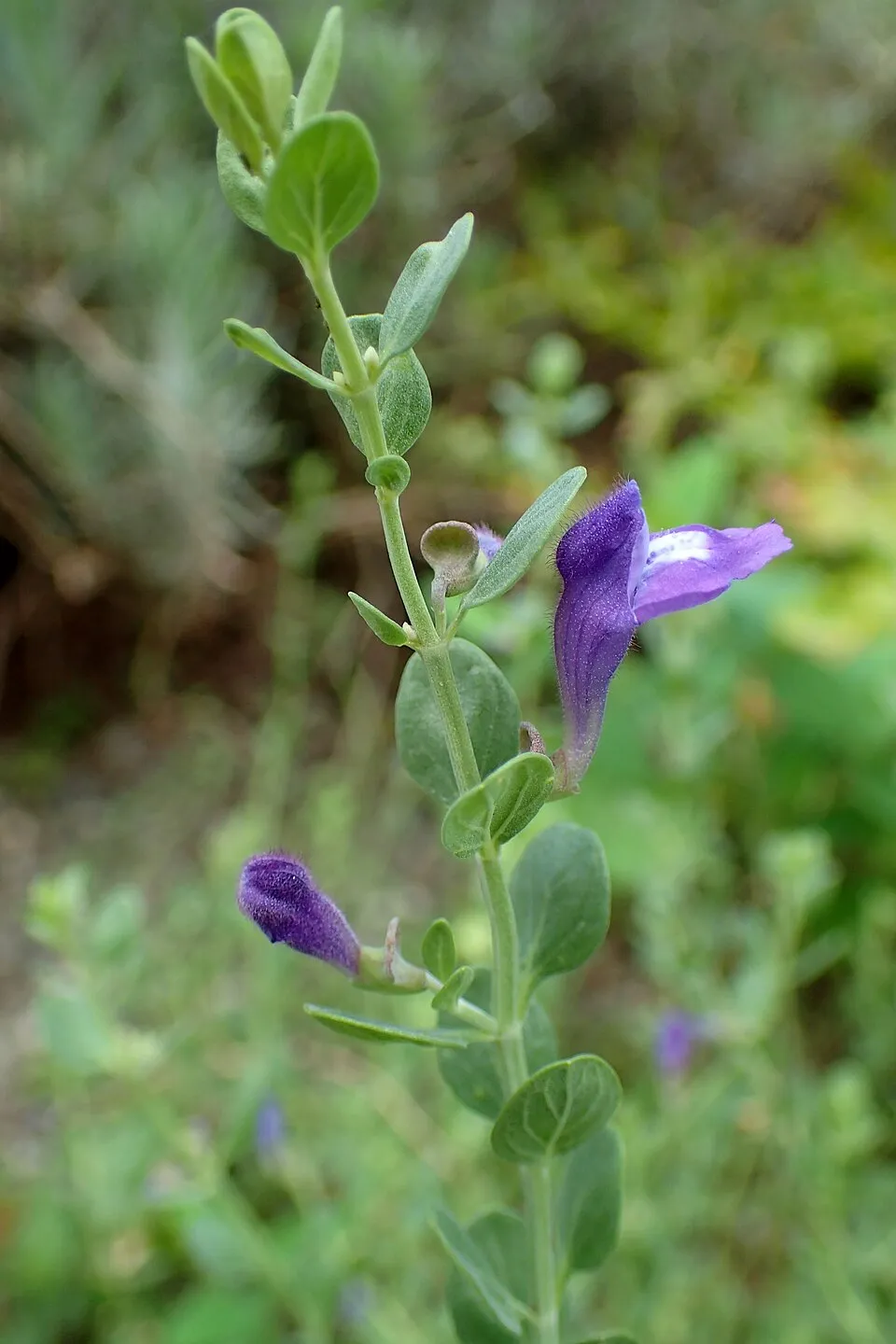
Resinous Skullcap (Scutellaria resinosa) with bright blue-purple two-lipped flowers and resin-dotted leaves
Scutellaria resinosa in bloom — the white-marked lower lip and resin-dotted foliage are diagnostic. Photo: Rooted Revival.

Identification

[ field key — habit · leaf · flower · fruit · special features ]

Habit & Stem

Low, compact, many-branched subshrub with a persistent woody base from which numerous slender, ascending to spreading stems arise each spring. Stems are square in cross-section (typical of the mint family), finely hairy, and densely covered with sessile resin glands that make them sticky to the touch. The plant forms a dense, rounded mound 6–12 in tall and 12–18 in wide, with a finely textured, heath-like appearance. Unlike many mints, this species does not spread aggressively by rhizomes — it stays where you put it, slowly expanding from the central woody crown.

Leaves

Opposite, simple, oval to oblong, small (½–1 in long), with entire margins and a rounded to blunt tip. Leaf surfaces are densely covered with transparent, sessile resin glands that give the foliage a sticky, varnished feel and a distinctive herbal-piney fragrance when crushed. The leaves are gray-green to olive-green, with the resin coating contributing to a slightly glaucous appearance that helps reflect intense sunlight. The glandular, aromatic foliage is a key identifying feature separating S. resinosa from other skullcaps in the region.

Flowers

Flowers are bright blue-purple, two-lipped (bilabiate), about ¾–1 in long, borne singly or in pairs in the upper leaf axils. The upper lip is hood-like (galea), while the lower lip is broad, three-lobed, and prominently marked with a white patch that serves as a nectar guide for bees. The calyx has the characteristic skullcap-shaped protuberance on the upper surface that gives the genus its common name. Flowers appear from late spring through summer, with scattered re-bloom into fall after rain events. The bloom is prolific for a plant of this size — a well-established plant can produce dozens of flowers open simultaneously.

Fruit & Special Features

Fruits are small nutlets (the typical fruit of the mint family) enclosed within the persistent calyx. The "skullcap" name comes from the calyx shape: after the flower falls, the upper and lower lips of the calyx close together, forming a structure that resembles a tiny helmet or skullcap. The genus name Scutellaria derives from the Latin scutella (a small dish or tray), referring to the calyx shape. The specific epithet resinosa refers to the abundant resin glands that cover the stems and leaves.

Habitat & Range in NE Oklahoma

Scutellaria resinosa is a plant of the southern Great Plains, Ozark highlands, and adjacent regions, with its core distribution in Kansas, Oklahoma, Texas, and Colorado. In NE Oklahoma, it is a glade and barrens specialist, found on dry limestone and sandstone glades, rocky prairie openings, and exposed, south-facing slopes with minimal soil development in the Ozark foothills and the Cross Timbers. This is a plant that grows in the cracks and crevices of bare rock, where its roots find purchase in thin accumulations of mineral soil and its leaves bake in reflected heat from the stone surface all summer.

In the Tulsa region, Resinous Skullcap occurs on the limestone glades along the Arkansas River bluffs and on the sandstone barrens of the Cross Timbers in Osage County and western Rogers County. It is often associated with little bluestem, various drought-tolerant sedges (Carex spp.), mosses and lichens, and a distinctive community of glade-endemic forbs including pale purple coneflower and false aloe. It is rarely abundant even in suitable habitat — typically scattered as individual plants or small clumps rather than forming dense stands — but it is reliably present on intact glade surfaces throughout the region.

Ecology & Wildlife Value

[ pollination · bees · herbivory · glade ecology ]

Pollinators

The two-lipped, blue-purple flowers with white nectar guides are visited by a range of native bees. Small to medium-sized bees are the primary pollinators: sweat bees (Lasioglossum, Agapostemon), small carpenter bees (Ceratina), leafcutter bees (Megachile), and bumblebees (Bombus spp.) all visit the flowers. The extended bloom period (late spring through summer) provides a steady nectar and pollen source for these bee populations during the hottest months when many other plants have reduced bloom.

Herbivory & Defenses

The resinous, aromatic foliage likely provides chemical defense against herbivores. The sticky resin glands may also deter small crawling insects from reaching the flowers and foliage. White-tailed deer generally avoid it, and it has essentially no significant insect pests in its native habitat or in cultivation. The plant's extreme drought-tolerance and preference for exposed rock surfaces are additional layers of defense: few herbivores forage regularly on bare glades in midsummer.

Butterfly Nectar

The flowers are visited by small butterflies including eastern-tailed blues, gray hairstreaks, and various skippers that can access the nectar at the base of the floral tube. Scutellaria species are not significant larval hosts for Lepidoptera, but the nectar contribution to butterfly populations in the glade ecosystem is ecologically meaningful.

Glade Ecosystem Role

Resinous Skullcap is a characteristic component of intact glade plant communities in the Ozark foothills and Cross Timbers. Its presence is an indicator of high-quality glade habitat with minimal soil disturbance and intact native vegetation. The plant's woody base and deep root system help stabilize the thin soil pockets within rock crevices, providing a modest but ecologically significant erosion-control function on exposed glade surfaces.

Horticulture & Care

[ site · soil · planting · companion · propagation ]

Site selection & soil

Resinous Skullcap demands the sharpest drainage you can provide. This is a crevice-garden plant, a rock-wall-pocket plant, a gravel-scree plant — not a border perennial for amended garden soil. It thrives in a rock garden, dry stone wall, crevice between boulders, or hypertufa trough filled with a gritty, lean, fast-draining mix. Full sun is essential for compact growth and heavy bloom. Do not plant in heavy clay, in an irrigated bed, or anywhere that holds winter moisture. A raised bed or berm constructed with coarse sand, gravel, and minimal organic matter is the best approach if you're gardening on Tulsa's heavy clay.

Care & propagation

Once established, Resinous Skullcap is nearly immortal in the right site. It needs no supplemental water, no fertilizer, and no winter protection. Light pruning to shape the mound can be done in early spring before new growth begins; otherwise, simply let it be. Seed: Collect nutlets when the calyx turns brown in late summer, sow on the surface of a gritty mix in fall or after 30 days cold-moist stratification in spring. Cuttings: Take softwood cuttings in early summer and root in a very sandy, well-drained medium. The plant has no significant pests or diseases in NE Oklahoma gardens.

Companion planting

In a glade garden or rock garden, plant Resinous Skullcap with other extreme-drought species: false aloe, Missouri evening primrose, purple poppy mallow, pale purple coneflower, butterfly milkweed, and small sedums. For texture contrast, add fine-textured little bluestem or sideoats grama as the grass accent. The low, compact form of S. resinosa makes it an ideal front-of-bed plant for the sunny rock garden, where its blue-purple flowers and aromatic foliage can be appreciated up close.

Edible & Cultural Uses

Scutellaria species have a long history of medicinal use. Several species, most notably S. lateriflora (American skullcap) and S. baicalensis (Chinese skullcap), are used as sedatives and nervines in both Western herbalism and Traditional Chinese Medicine. However, S. resinosa has no documented medicinal or edible use in the ethnobotanical record. Its value is horticultural and ecological: a tough, beautiful, drought-proof native for the rock garden and crevice planting that supports native bee populations through the hottest months of the year.

Photo Reference

Close-up of Scutellaria resinosa blue-purple flower with white-marked lower lip
// Flower — blue-purple with white nectar guide on the lower lip
Wikimedia Commons
Wikimedia Commons
Scutellaria resinosa compact mound form
// Habit — low, compact mound 6–12 in tall on a glade surface
Wikimedia Commons
Wikimedia Commons
Scutellaria resinosa resin-dotted, aromatic leaves
// Leaves — small, oval, covered with sticky resin glands; aromatic when crushed
Wikimedia Commons
Wikimedia Commons
Scutellaria resinosa growing from a rock crevice on a limestone glade
// Glade habitat — growing from a crevice on a limestone glade in the Ozark foothills
Wikimedia Commons
Wikimedia Commons
Native bee visiting Scutellaria resinosa flower
// Bee visitor — small sweat bee (Lasioglossum) nectaring
Wikimedia Commons
Wikimedia Commons

Sources & Further Reading

  • USDA NRCS PLANTS Database — Scutellaria resinosa: plants.usda.gov/plant-profile/SCRE5
  • Lady Bird Johnson Wildflower Center — Native Plant Database: wildflower.org — SCRE5
  • Great Plains Flora Association (1986). Flora of the Great Plains. University Press of Kansas.
  • Oklahoma Biological Survey — distribution of Scutellaria species in Oklahoma glades and barrens.
  • Correll, D.S. & Johnston, M.C. (1970). Manual of the Vascular Plants of Texas. Texas Research Foundation.
  • Wikipedia — Scutellaria resinosa: en.wikipedia.org/wiki/Scutellaria_resinosa (CC BY-SA 4.0).

Hero photo: Rooted Revival. Strip photos courtesy of Wikimedia Commons contributors under their respective licenses (linked under each image).