// SPECIES PROFILE · PERENNIAL · NATIVE · GLADE SPECIALIST
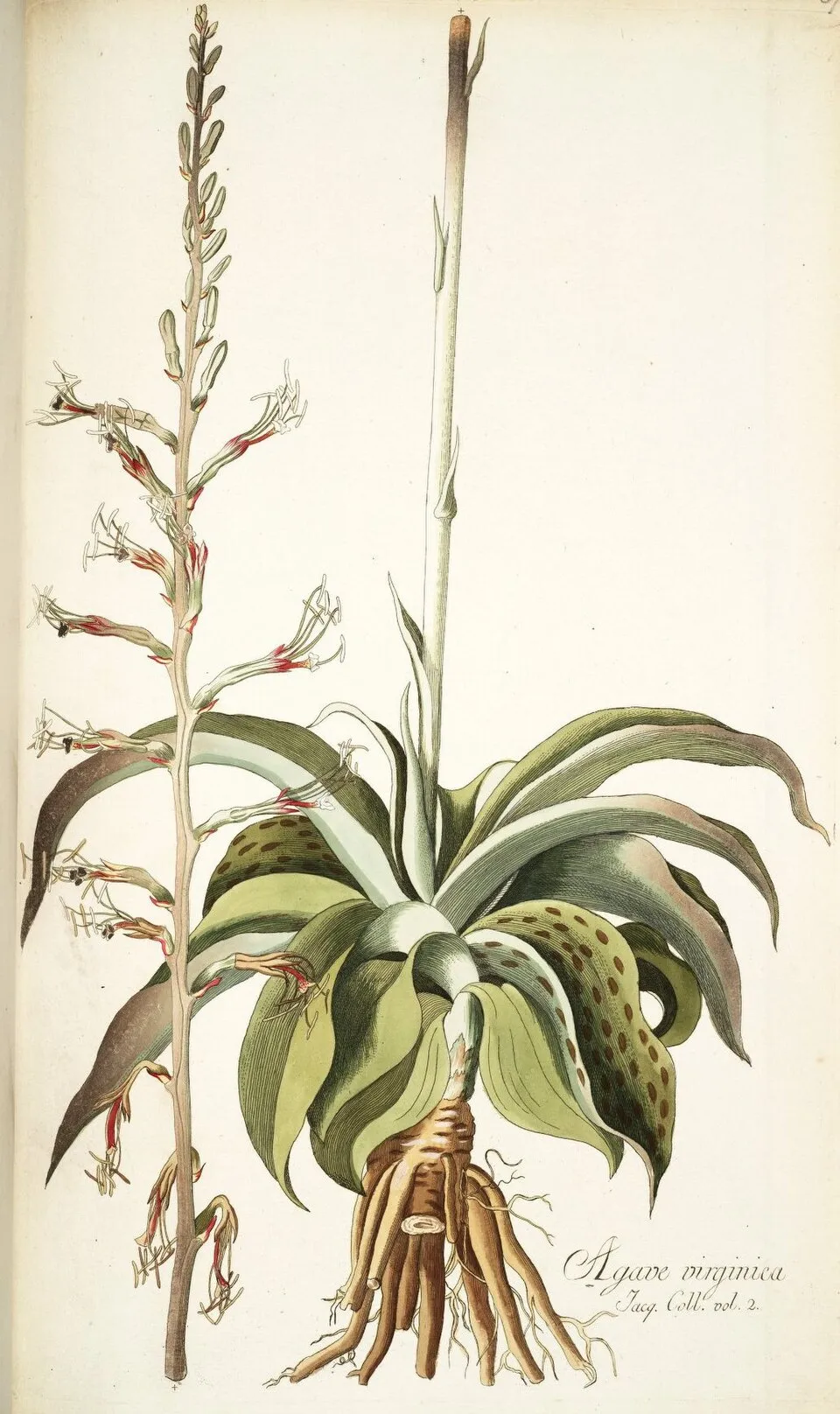
False Aloe is the native succulent that looks like it wandered up from the Chihuahuan Desert and decided to stay in the rocky glades and open woods of eastern Oklahoma. It forms a low, ground-hugging rosette of fleshy, wavy-edged, spotted leaves that strongly resemble an aloe or small agave, though it belongs to the asparagus family (Asparagaceae) along with hostas, yuccas, and garden asparagus. In early summer, a tall, slender flowering stalk 4–6 ft rises from the center of the rosette, bearing widely spaced, greenish-white, fragrant, tubular flowers that open at night and are pollinated exclusively by sphinx moths (family Sphingidae). Manfreda virginica is a plant of the driest, rockiest, most inhospitable ground in NE Oklahoma — sandstone glades, limestone barrens, and the sun-baked openings of Cross Timbers woodlands — and it brings a genuinely exotic, almost tropical presence to the native rock garden.

[ field key — rosette · leaf · flower · fruit · special features ]
Succulent, rosette-forming perennial from a short, bulb-like corm. The basal rosette consists of 6–12 fleshy, spreading to ascending leaves that emerge from the corm in spring and reach full size (6–12 in long, 1–2 in wide) by early summer. The rosette is low and ground-hugging, spreading 12–18 in across on mature plants. A single rosette produces one flowering stalk per year, typically dying back after flowering (monocarpic on a per-rosette basis), but new offsets (pups) emerge from the corm to perpetuate the clump. The plant goes dormant in winter, disappearing entirely until the following spring.
Leaves are succulent, linear-lanceolate, and channeled (slightly folded along the midrib), with distinctively wavy or undulating margins. The leaf surface is smooth and spotted with irregular darker green to brownish-purple blotches — the spotting pattern is highly variable between individuals and populations. Some plants are heavily spotted; others are nearly solid green. The leaf color ranges from bright green to glaucous blue-green depending on sun exposure and soil moisture. These leaves are what give the plant its "aloe" appearance and its high ornamental value for rock gardens and succulent collections.
The flowering stalk is tall (4–6 ft), slender, and unbranched, rising dramatically from the center of the rosette in early summer. Tubular flowers about 1–2 in long are arranged in a loose, spike-like raceme along the upper portion of the stalk, spaced 1–2 in apart. Each flower is greenish-white to pale yellow-green with six recurved tepals (petal-like segments) and long, prominently exserted stamens with bright yellow anthers. The flowers are fragrant (sweetly musky) and open at night, closing by late morning. The combination of nocturnal opening, pale color, strong fragrance, and abundant nectar in a long floral tube is the classic sphinx moth (hawk moth) pollination syndrome (sphingophily), and the moths visiting False Aloe at dusk in a NE Oklahoma glade are one of the more memorable wildlife experiences available to a native plant gardener.
Fruits are three-parted capsules that split open at maturity to release numerous flat, black seeds. The taxonomy of Manfreda has been unstable: recent molecular work places it within the genus Agave (as Agave virginica), and you may encounter it under either name. Do not confuse False Aloe with rattlesnake master (Eryngium yuccifolium), which has similarly yucca-like leaves but belongs to the carrot family (Apiaceae) and produces spiky white flower globes — entirely different in flower and fragrance. False Aloe is also unrelated to the true aloes (Aloe spp., family Asphodelaceae) of Africa, though the resemblance in leaf form is striking.
Manfreda virginica is distributed across the central and southeastern United States, from Texas and Oklahoma east through the Ozarks and into the mid-South. In Oklahoma, it is concentrated in the eastern portion of the state, with the core of its distribution in the Ozark foothills and Ouachita Mountains of eastern Oklahoma, extending westward into the Cross Timbers ecoregion on suitable rocky sites. This is a plant of dry, exposed, nutrient-poor sites: sandstone and limestone glades, rocky open woods, barrens, granite outcrops, and the thin-soiled margins of post-oak and blackjack-oak savannah. It grows where summer temperatures on bare rock can exceed 120°F and where winter soil moisture is minimal — conditions that would kill most native perennials outright.
In the Tulsa region, False Aloe can be found on the sandstone glades and barrens of the Cross Timbers in Osage and western Rogers counties, on the limestone glades scattered along the Arkansas River bluffs, and in the rocky openings of post-oak woodlands on sandstone substrates throughout the region. It is often associated with eastern redcedar, little bluestem, fragrant sumac, and a distinctive community of glade-endemic forbs including pale purple coneflower and the rare Echinacea angustifolia. Look for it on the driest, rockiest, most sun-blasted ground available — the places that look too harsh for anything green to grow are exactly where False Aloe thrives.
[ pollination · sphinx moths · herbivory · ecological niche ]
False Aloe is a textbook example of sphingophily (sphinx moth pollination). The flowers open at dusk, emit a strong sweet-musky fragrance, and offer abundant nectar at the base of a long, narrow floral tube. Sphinx moths (family Sphingidae) — large, fast-flying moths that hover like hummingbirds — are the primary and likely exclusive pollinators. Their exceptionally long proboscises (2–4 in in many species) allow them to access nectar that shorter-tongued insects cannot reach. In NE Oklahoma, likely pollinators include the white-lined sphinx (Hyles lineata), the five-spotted hawk moth (Manduca quinquemaculata), and the rustic sphinx (Manduca rustica).
The succulent, fleshy leaves of Manfreda virginica contain saponins and other secondary compounds that deter most herbivores. White-tailed deer generally avoid it, and it has few insect pests. The leaf-mining larvae of certain agave-feeding moths (family Prodoxidae, the yucca moths and their relatives) have been recorded on Manfreda, though this relationship is not as tightly co-evolved as the famous yucca moth – yucca mutualism. The plant's primary defense is its habitat: growing on bare rock in blazing sun limits the number of herbivores that can even find it.
The flat, lightweight seeds are wind-dispersed from the tall flowering stalk, which acts as a natural elevated launch platform — a common strategy among glade and barrens plants where the bare rock substrate makes ground-level dispersal less effective. Seeds that land in suitable rock crevices or thin soil pockets germinate following cold-moist stratification over winter.
False Aloe is a glade specialist, occupying one of the harshest ecological niches in eastern North America. Glades and barrens are island-like openings in the forest matrix where bedrock is at or near the surface, soils are thin to nonexistent, summer temperatures are extreme, and water availability is minimal. The plant community that occupies these sites — including Manfreda, various sedges, mosses, lichens, and specialized annuals — is unique and of high conservation interest throughout the Ozark and Cross Timbers regions.
[ site · soil · care · companion planting · propagation ]
The number one cause of death for False Aloe in cultivation is wet winter soil. This plant requires the sharpest drainage you can provide — think crevice garden, scree, gravel bed, or a raised mound of sandy, rocky soil that never stays saturated. It is the perfect plant for a rock garden, crevice planting, dry stone wall pocket, or large terracotta container with a gritty, fast-draining succulent mix. Full sun produces the best leaf spotting and the most reliable bloom, though light afternoon shade is tolerated in the hottest Tulsa summers. Do not plant it in the irrigated perennial border, in heavy clay, or anywhere that holds standing water in winter.
Once established in the right spot, False Aloe is essentially zero-care. It needs no supplemental water (rot is a far bigger risk than drought), no fertilizer, and no winter protection in Zone 7. The flowers are produced once per rosette, after which that rosette declines, but offsets (pups) at the base of the corm replace it. These can be separated and replanted in spring. Seed propagation: Collect seed from dried capsules in late summer, sow on the surface of a gritty mix in fall or after 30 days cold-moist stratification, and keep barely moist. Germination is slow but reliable, and seedlings develop the spotted leaves within their first year.
In a glade garden or rock garden, combine False Aloe with other dry-site specialists: pale purple coneflower, Missouri evening primrose, purple poppy mallow, butterfly milkweed, and aromatic aster. For a textural counterpoint, add little bluestem and sideoats grama as the grass matrix. The succulent, exotic-looking rosette of Manfreda creates dramatic contrast against the fine-textured grasses and the bright flowers of the companion forbs. For a succulent-focused planting, pair with Opuntia humifusa (eastern prickly pear) and various sedums to create a garden of entirely native succulents on a sunny, well-drained slope.
There is limited ethnobotanical information for Manfreda virginica. The corms of some Manfreda and Agave species were used by Indigenous peoples of the Southwest and Mexico as a food source (roasted in pits, similar to agave), though whether M. virginica was used in this way by the Indigenous peoples of the Eastern Woodlands and Ozarks is unclear. The plant contains saponins that can cause digestive irritation if consumed raw, and it is not recommended as a foraged food. As with all wild plants, positive identification and thorough knowledge of preparation methods are essential before consumption.
The primary cultural value of False Aloe in a modern context is horticultural — a uniquely architectural native succulent that belongs in every NE Oklahoma rock garden and dry landscape. It is increasingly collected by native plant enthusiasts and succulent gardeners who appreciate its hardiness (unlike most succulents, it requires zero winter protection in Zone 7) and its dramatic, exotic appearance.
Hero photo: Rooted Revival. Strip photos courtesy of Wikimedia Commons contributors under their respective licenses (linked under each image).