home/ plants/ pennsylvania-sedge

// SPECIES PROFILE · GRASS · NATIVE · NO-MOW LAWN ALTERNATIVE

Pennsylvania Sedge

Carex pensylvanica

Pennsylvania Sedge is the native plant that makes the case for killing your lawn more persuasively than any argument you will read in a book. It forms a soft, flowing carpet of the finest possible texture — blades only 1–2 mm wide, arching to a mere 4–8 inches tall, in a vivid, almost fluorescent spring green that deepens as the season progresses. It needs no mowing, no irrigation once established, and no fertilizer. It spreads by slender rhizomes to form a continuous, interlocking mat that excludes weeds and withstands the dry, root- competitive shade beneath oaks and hickories. If you have ever looked at a struggling fescue lawn under mature trees and wondered whether there is a better way, Carex pensylvanica is the answer. This is the sedge that the best native-plant nurseries in the Midwest and Northeast sell by the flat for exactly this purpose, and it performs in NE Oklahoma's temperamental climate with the same quiet competence it brings to the oak savannas of Wisconsin and Michigan.

// QUICK FACTS
Family
Cyperaceae (sedge family)
Life cycle
Perennial, cool-season, colony-forming via rhizomes
Native range
Eastern and central North America — from Quebec and Manitoba south to Georgia and Arkansas; extends into the Ozarks and eastern Oklahoma
USDA hardiness
Zones 3–8 (Tulsa = 7a/7b; at the southern edge of ideal performance but fully viable)
Mature size
4–8 in tall, spreading indefinitely by rhizomes; individual patches can cover square yards within a few years
Bloom
April – May (NE OK), very early, often as foliage first emerges
Flower / fruit
Inconspicuous reddish-brown spikelets held among the foliage; perigynia small, pubescent, with a distinct beak
Sun
Part shade to full shade; tolerates dappled sun; leaves may scorch in hot direct afternoon sun in Tulsa summers
Soil
Well-drained, acid to neutral, sandy loam to loam; tolerates clay with organic amendment but requires good drainage — does not tolerate heavy wet clay
Water
Dry to medium; genuinely drought-tolerant once established — one of the most xeric-tolerant sedges available
Wildlife
Early-season nesting material for ground-nesting birds · cover for small wildlife · host for satyrid butterflies
Conservation status
G5 — Secure globally; locally uncommon in NE Oklahoma due to southern range-edge distribution
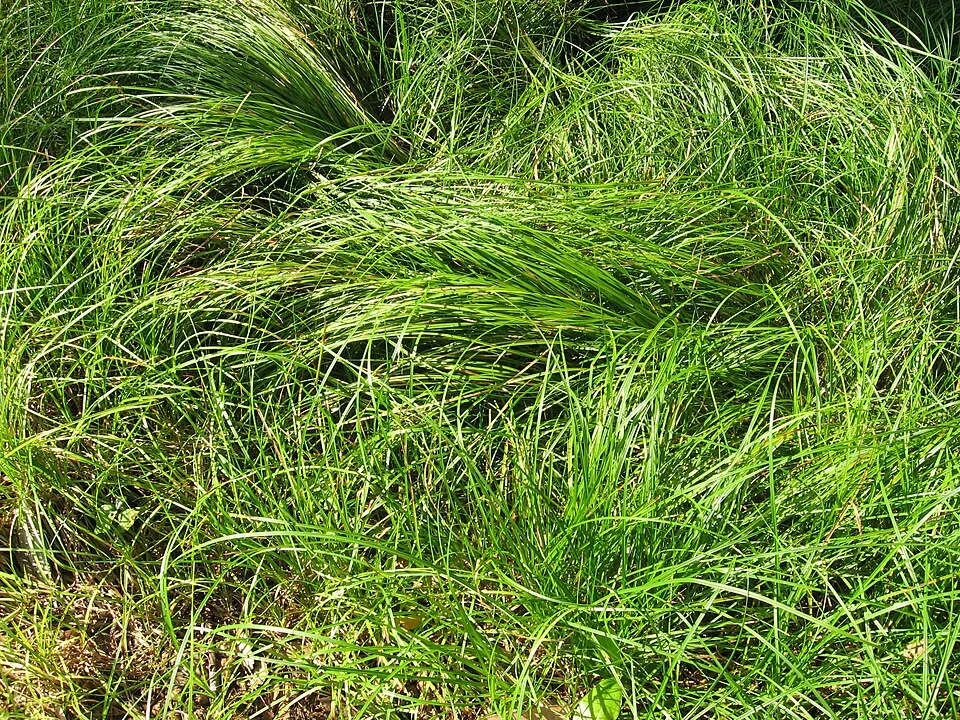
Pennsylvania Sedge (Carex pensylvanica) — dense carpet of fine-textured foliage in dappled woodland shade
Carex pensylvanica forming a soft, flowing carpet — the premier native alternative to lawn grass in dry shade. Photo: Rooted Revival.

Identification

[ field key — habit · leaf · inflorescence · distinguishing features ]

Habit & Growth Form

Colonial via slender, long-creeping rhizomes that produce individual shoots at intervals of 1–4 inches, forming a loose to dense sod-like mat. Individual shoots are not tightly clumped like the caespitose sedges; rather, the plant spreads continuously, each shoot connected horizontally underground. The foliage is very fine- textured, producing a soft, flowing appearance more reminiscent of hair grass (Deschampsia) than of typical broad-leaved sedges. In full shade with adequate moisture, the carpet can become quite dense, effectively outcompeting most broadleaf weeds. Flowering culms are produced very early, often before other species break dormancy.

Foliage

Leaves are exceptionally narrow for a Carex — blades only 1–2 mm wide, almost thread-like, sharply folded or channeled (V-shaped in cross-section), and strongly arching to somewhat lax. The color is bright medium green in spring, maturing to a somewhat darker, slightly blue-green tone in summer. Foliage is semi-evergreen in Tulsa's zone 7a climate — it persists through winter with variable amounts of tan-brown senescence, usually retaining significant green tissue until the following spring, especially in protected sites with good drainage. This is the key aesthetic advantage over warm-season turf grasses, which go fully dormant and brown from November through March.

Inflorescence & Fruit

The inflorescence is compact and held low among the leaves, typically shorter than the foliage. A single slender, often nodding terminal staminate spike sits above 1–2 pistillate spikes that are short, sessile or nearly so, and clustered near the culm tip. The perigynia are small (2.5–3.5 mm), obovoid to globose, densely pubescent (hairy) — a diagnostic feature that distinguishes C. pensylvanica from most other fine-leaved sedges — and taper to a distinct, short beak. Flowering occurs very early, often in April before canopy leaf-out; by late May, the perigynia have matured and dehisced. Pistillate scales are dark reddish-brown to purplish, with a green midrib and hyaline margins, shorter than the perigynia.

Distinguishing Features

The combination of very narrow (1–2 mm) channeled leaves, colonial rhizomatous spread, and pubescent perigynia reliably separates C. pensylvanica from other sedges in the NE Oklahoma flora. It is most likely to be confused with Carex albicans (White-tinged Sedge), which also has fine leaves and grows in dry woodlands, but C. albicans is caespitose (clumped) rather than colonial, with perigynia that have a distinctly whitish, translucent beak and are not pubescent. Carex communis (Fibrous- rooted Sedge), another fine-leaved woodland species, is also caespitose with fibrous rather than creeping rhizomes. In the Cross Timbers, it could conceivably be mistaken for Carex leavenworthii, but that species forms denser, darker tufts with wider leaves and prominently nerved perigynia.

Habitat & Range in NE Oklahoma

Carex pensylvanica is a species of the northeastern and north-central United States and adjacent Canada, with its range extending southward through the Appalachians and into the Ozark highlands. NE Oklahoma sits at the southwestern periphery of its range — the species is documented in the Ozark foothill counties of Adair, Cherokee, and Delaware, and in scattered locations within the Arkansas River valley, but it is not as ubiquitous here as it is in the oak savannas of the upper Midwest. In our region, it is most often found on dry, acidic, well-drained slopes and ridges under open to semi-open oak-hickory canopies, particularly on north- and east-facing aspects where summer heat is moderated.

The ecological niche occupied by C. pensylvanica in NE Oklahoma is the same as elsewhere in its range: the dry, partially shaded understory of mature oak woodlands, especially where post oak and blackjack oak dominate on sandy, well-drained soils derived from sandstone. In the Ozark foothills, it associates with black hickory and eastern hophornbeam. It is notably absent from the heavy clay floodplains and bottomlands where Creek Sedge and Cherokee Sedge dominate.

Ecology & Wildlife Value

[ ground-nesting bird material · early-season cover · satyrid host · oak savanna ecology ]

Ground-Nesting Birds

The fine-textured, persistent foliage of Pennsylvania Sedge provides critical early-season nesting material and cover for ground-nesting birds in oak woodlands. In the upper Midwest, where ecological studies of this species are more extensive, ovenbirds (Seiurus aurocapilla) preferentially nest in woodlands with a dense sedge understory, using the dead foliage from the previous year as nest-lining material. Eastern towhees (Pipilo erythrophthalmus), with their characteristic "drink-your-tea" song, forage heavily in sedge carpets for insects and fallen seeds. In NE Oklahoma, the same associations presumably hold, though specific local research is limited.

Lepidoptera & Insect Associates

Carex pensylvanica is a documented larval host for several satyr butterflies, including the northern pearly-eye (Lethe anthedon), the little wood-satyr (Megisto cymela), and the eyed brown (Satyrodes eurydice). It also hosts the larvae of the dusted skipper (Atrytonopsis hianna) and various other grass-skippers (subfamily Hesperiinae) that use sedges rather than true grasses. The early-flowering culms provide pollen and nectar resources for small solitary bees (chiefly Halictidae and Andrenidae) active in April and early May, at a moment when few other floral resources are available in the woodland understory.

Small Mammals

The seeds are consumed by chipmunks, white-footed mice, and woodland voles. Deer mice (Peromyscus maniculatus) in particular cache sedge seeds in the fall. The dense rhizomatous mat provides runways and cover for shrews and other small insectivores. White-tailed deer browse is minimal — the fine, tough foliage is unpalatable compared to forbs, and browsing pressure on C. pensylvanica is negligible even in areas with high deer density.

Oak Savanna & Fire Ecology

In the fire-maintained oak savannas that once characterized much of the eastern US — and still persist in remnants of the Cross Timbers — C. pensylvanica is a fire-adapted groundcover. It leafs out early, exploits the brief spring window of full sunlight before canopy closure, and can resprout from rhizomes after low-intensity surface fires. Its presence in an oak woodland is an indicator of good ecological condition: it declines under heavy browsing pressure from overabundant deer, excessive soil disturbance, and invasion by non-native groundcovers such as Japanese stiltgrass (Microstegium vimineum) or wintercreeper (Euonymus fortunei).

Horticulture & Care

[ no-mow lawn · dry-shade carpet · plug planting · ecological groundcover ]

Site selection & preparation

Pennsylvania Sedge is not a "plant it anywhere and walk away" species in NE Oklahoma — it demands well-drained soil and significant shade. The ideal site is the dry, partially shaded understory of mature oaks on sandy or loamy soil with a north- or east-facing aspect. In Tulsa's climate, afternoon sun exposure on heavy clay will stress this sedge into summer dormancy or outright death. Pick sites that receive dappled to full shade, with no more than 2–3 hours of direct morning sun. The soil must drain; if water stands after rain, choose Creek Sedge or Cherokee Sedge instead.

Establishment & maintenance

The critical period is the first growing season. Water weekly during dry spells through the first summer. Once the rhizomes have knit together (typically by the end of the second growing season), the planting becomes effectively drought-proof. Thereafter, maintenance consists of:

Limitations & realistic expectations

Pennsylvania Sedge is not a true turfgrass replacement. It does not tolerate foot traffic — a path walked daily will wear bare within weeks. It is a visual lawn substitute, not a recreational surface. It goes partially dormant in prolonged summer heat and drought, turning tan-yellow at the tips by late August in a typical Tulsa summer. It greens up reliably with fall rains and cooler temperatures. It is not suited to full sun in Oklahoma, especially on heavy clay — attempt this only under shade. And it is slower to establish than turfgrass; the transformation from bare soil to continuous sedge carpet requires patience over 2–3 growing seasons.

Companion plants

In a shaded woodland garden where Pennsylvania Sedge forms the ground plane, layer in Christmas fern as evergreen accents, downy serviceberry as a spring-blooming small tree, and wild columbine for early nodding red-and-yellow blooms. Wild ginger and mayapple fit naturally into openings in the sedge carpet. For a transition zone between shady sedge lawn and sunnier garden areas, pair with little bluestem and butterfly milkweed at the sunnier edge.

Landscape uses

Propagation strategy for large areas: The most economical way to establish a Pennsylvania Sedge lawn is by planting plugs at 12-inch spacing and waiting. At roughly $3–5 per plug from native nurseries, a 500 ft² area (roughly 500 plugs at 12-inch centers) costs $1,500–2,500 in plants. This is comparable to or less than the cost of sod, and the long-term savings in water, mowing, fertilizer, and herbicide are substantial. Seed is available from specialty suppliers but germination is erratic and the tiny seedlings are difficult to manage; plug planting is far more reliable.

Cultural Uses & Ethnobotany

Like most fine-textured sedges, Carex pensylvanica has no recorded edible or medicinal use. Its primary ethnobotanical application would have been in weaving and basketry — while the very fine leaves are less suited to basket construction than broader-leaved species like C. cherokeensis, they were used for fine mats, cordage, and household items by Eastern Woodlands peoples. The Ojibwe are recorded as having used sedge leaves for weaving mats and for lining storage pits. Modern- day use of C. pensylvanica is entirely horticultural and ecological: it is the go-to species for native lawn conversion projects throughout eastern North America, championed by organizations such as the Lady Bird Johnson Wildflower Center, Mt. Cuba Center, and the native plant societies of multiple states.

Photo Reference

Dense carpet of Carex pensylvanica forming no-mow lawn under oak trees
// Continuous carpet — dense mat of fine-textured foliage under mature oak
Wikimedia Commons
Wikimedia Commons
Close-up of very fine Carex pensylvanica leaves showing channeled cross-section
// Foliage detail — blades only 1–2 mm wide, channeled, bright green
Wikimedia Commons
Wikimedia Commons
Early spring inflorescence of Carex pensylvanica with reddish-brown spikelets
// Inflorescence — compact reddish-brown spikes emerge early, before canopy leaf-out
Wikimedia Commons
Wikimedia Commons
Slender creeping rhizomes of Carex pensylvanica with emerging shoots
// Rhizome — slender, long-creeping; the mechanism of colonial spread
Wikimedia Commons
Wikimedia Commons
Pubescent perigynia of Carex pensylvanica — a key diagnostic feature
// Perigynia — hairy, small, with distinct beak — diagnostic
Wikimedia Commons
Wikimedia Commons

Sources & Further Reading

  • USDA NRCS PLANTS Database — Carex pensylvanica: plants.usda.gov/plant-profile/CAPE6
  • Lady Bird Johnson Wildflower Center — Native Plant Database: wildflower.org/plants/result.php?id_plant=CAPE6
  • Meyer, M.H. & Pedersen, B. (1999). Low-maintenance grass groundcover evaluation — Carex pensylvanica. University of Minnesota Horticultural Research Center.
  • Mt. Cuba Center (2020). Carex for the Mid-Atlantic Region. Research Report.
  • Ball, P.W. & Reznicek, A.A. (2002). Carex sect. Acrocystis. In: Flora of North America Editorial Committee, Flora of North America North of Mexico, Vol. 23: Cyperaceae. Oxford University Press.
  • Yatskievych, G. (1999). Steyermark's Flora of Missouri, Vol. 1. Missouri Department of Conservation.
  • Tallamy, D.W. (2007). Bringing Nature Home. Timber Press.
  • Packard, S. & Mutel, C.F. (1997). The Tallgrass Restoration Handbook. Island Press.
  • Wikipedia — Carex pensylvanica: en.wikipedia.org/wiki/Carex_pensylvanica

Hero photo: Rooted Revival. Strip photos courtesy of Wikimedia Commons contributors under their respective licenses (linked under each image).