// SPECIES PROFILE · TREE · NATIVE · CLAY-TOLERANT
The Ohio Buckeye is the first tree to leaf out in spring across the moist woodlands and floodplains of eastern Oklahoma — its palmately compound leaves unfurling in the last weeks of March, weeks before most canopy trees break bud. In April and May it produces upright panicles of greenish-yellow tubular flowers that are pollinated primarily by ruby-throated hummingbirds and bumblebee queens, making it one of the earliest nectar sources in the Ozark foothills. Aesculus glabra is a small to medium understory tree, typically 20–40 ft, with a rounded crown, distinctive five-fingered leaves, and spiny husks that split in fall to reveal one or two glossy chestnut-brown "buckeye" nuts. The nut is the namesake of Ohio — the Buckeye State — and though toxic to humans and livestock if eaten raw, it has a long history of folk use. In NE Oklahoma, Ohio Buckeye grows in rich, moist woods and bottomlands, tolerating heavy clay soils better than almost any other native understory tree. It is the close cousin of Red Buckeye (Aesculus pavia), which shares the same genus and the same early-spring pollinator niche but produces vivid red flowers on a shorter, more shrubby frame.

[ field key — leaf · flower · fruit · bark · twig · scent ]
A small to medium deciduous tree, usually 20–40 ft in NE Oklahoma, with a short trunk and a rounded, spreading crown. The bark is a useful field mark: light gray-brown, broken into flat, scaly plates that curl slightly at the edges. On young trunks the bark is smooth and gray, similar to young ash. Branches tend to be stout and ascending. The tree has a characteristic dense, low silhouette when open-grown, providing excellent understory structure in woodland gardens.
Opposite, palmately compound with 5 (rarely 7) leaflets radiating from a central point like the fingers of a hand. Each leaflet is 3–6 in long, elliptic to oblong-lanceolate, with a finely toothed margin and a short stalk. The upper surface is smooth, dark yellow-green; the underside is paler and slightly hairy. The distinctive unpleasant odor of crushed leaves or twigs (sometimes described as rancid peanut butter or skunky) is diagnostic — it gives the tree its alternate name, "fetid buckeye." Fall color is a muted yellow-brown, not showy. Leaves drop early, often by September in drought years, making this one of the first trees to go bare.
Flowers appear in erect, cylindrical panicles 4–7 in long at branch tips in mid-to-late spring (April–May in Tulsa). Individual flowers are greenish-yellow, tubular, about 1 in long, with 4–5 petals of unequal size and stamens that extend well beyond the petals (the diagnostic Aesculus look). The boldest flower at each panicle tip is typically female-fertile; lower flowers are functionally male. Bloom coincides with ruby-throated hummingbird migration and early-season bumblebee queen emergence. The floral display is subtle rather than showy — greenish-yellow against expanding foliage — but up close the individual blossoms are elegant.
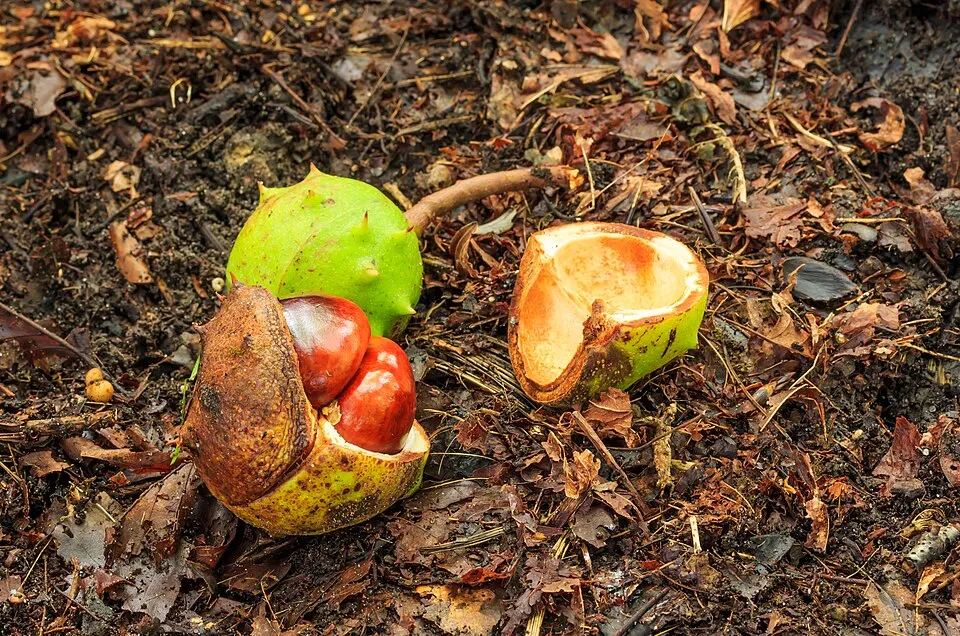
The fruit is a globular, leathery capsule 1–2 in in diameter covered with short, blunt spines (less spiny than the horse chestnut Aesculus hippocastanum). The husk splits into 2–3 sections in September–October to reveal one or two glossy, chestnut-brown nuts with a prominent pale scar (the "buck's eye"). The nut is toxic — containing glycosides and saponins (aesculin) that cause vomiting, paralysis, and in large doses death. Few native animals eat them (squirrels sometimes nibble), though they were historically carried as pocket charms against rheumatism — a folk belief that persists in Ohio to this day.
Aesculus glabra reaches the southwestern corner of its native range in eastern Oklahoma. In the Tulsa region, it is a tree of moist, rich deciduous woods, floodplain terraces, and north-facing lower slopes of the Ozark foothills. It is particularly associated with the deep, alluvial soils of the Grand River and Verdigris River valleys, where it forms part of a diverse understory alongside Spicebush, Pawpaw, American Hornbeam, and Eastern Hophornbeam. It is one of the most clay-tolerant of all native understory trees, persisting in bottomland soils that would suffocate less adaptable species.
Heat is the primary factor limiting this species' success in the Tulsa area. Ohio Buckeye is adapted to cooler, more humid summers than our typical July–August blast furnace. In landscape settings, it performs best with afternoon shade and consistent soil moisture. Trees in full-sun, exposed locations often drop their leaves prematurely in August as a drought-avoidance strategy — unsightly, but rarely fatal.
[ hummingbird pollination · bumblebee queens · limited herbivory · toxic defenses ]
Ohio Buckeye flowers are adapted for hummingbird pollination — the greenish-yellow tubular corolla, copious dilute nectar, and upright panicle architecture are classic ornithophilous traits. In NE Oklahoma, blooming coincides with the northward migration of ruby-throated hummingbirds in April, making this tree a critical early-season refueling stop. Long-tongued bumblebee queens (Bombus spp.), newly emerged from hibernation and founding colonies, also work the flowers heavily. The combination of migration-timing hummingbirds and hungry queen bumblebees makes Ohio Buckeye disproportionately important for early-spring pollinator support despite its modest floral display.
All parts of the plant contain aesculin and related saponins — bitter, toxic compounds that deter most herbivores. Deer browse on the leaves is minimal. Livestock poisoning has been documented (cattle, horses, sheep), and the nuts are dangerous to dogs if ingested. The nuts are rarely consumed by native wildlife; gray squirrels sometimes cache them but usually abandon them. This chemical defense means the tree suffers very little insect damage compared to oaks or maples, and it supports relatively few native Lepidoptera species compared to keystone genera like Quercus or Prunus.
Despite its limited role as a caterpillar host, Ohio Buckeye fills a distinctive temporal niche. It is the earliest native hardwood to leaf out in the Tulsa area, breaking bud 2–3 weeks before most associates. This early canopy provides critical cover for nesting songbirds when other trees are still bare. The early leaf litter also jump-starts the spring decomposer cycle, feeding soil microfauna weeks ahead of the main canopy leaf-out in late April.
Red Buckeye (Aesculus pavia) is the Oklahoma counterpart with red flowers, a more shrubby habit (typically under 15 ft), and a preference for drier, more upland sites. Ohio Buckeye is the larger, more tree-like of the two, with greenish-yellow flowers and a strong affinity for moist bottomlands. Both share the same hummingbird pollination strategy and the same toxic chemistry. In a NE Oklahoma woodland garden, the two species complement each other: Red Buckeye on the drier slopes and edges, Ohio Buckeye in the moister draws and bottomlands.
[ understory planting · moisture · clay tolerance · companion design ]
In the Tulsa climate, Ohio Buckeye performs best as an understory or woodland-edge tree with protection from the hottest afternoon sun. A location on the east or north side of a building or larger tree, receiving morning sun and afternoon shade, is ideal. The soil should be moist, rich, and well-drained, though this species handles heavy clay better than most trees. A bottomland garden, rain garden margin, or creek-side planting is its natural habitat. Avoid dry, exposed south-facing slopes and compacted urban fill.
Ohio Buckeye integrates beautifully into a moist woodland garden. Pair with Pawpaw and Spicebush in the understory layer. In the ground plane, Maidenhair Fern, Ostrich Fern, Solomon's Seal, Wild Ginger, Virginia Bluebells, and Woodland Phlox all thrive in the dappled shade and rich leaf litter beneath a buckeye. For early-spring pollinator synergy, site Ohio Buckeye near Red Buckeye — their combined bloom extends the hummingbird nectar window from April into May.
Do not eat buckeye nuts. All parts of Aesculus glabra contain aesculin, a toxic glycoside-saponin compound that causes nausea, vomiting, diarrhea, paralysis, and in severe cases death. Livestock poisonings are documented, and the nuts are dangerous to dogs. Squirrels appear to consume them occasionally without apparent harm, but the squirrel digestive system processes toxins differently than ours.
Despite their toxicity, buckeye nuts have a rich cultural history. The name "buckeye" refers to the glossy brown seed with a light eye-like scar, resembling the eye of a male deer. Ohio residents ("Buckeyes") have carried the nut as a pocket charm since at least the 1840 presidential campaign of William Henry Harrison, who adopted the buckeye as a campaign symbol. Folk medicine traditions held that carrying a buckeye warded off rheumatism and hemorrhoids. Indigenous peoples of the Eastern Woodlands carefully leached and roasted the nuts to neutralize toxins for medicinal use (externally and internally in small, processed doses), and used the ground nut as a fish poison in streams — the saponins stun fish by disrupting gill function, a practice widespread across many cultures that used toxic plant compounds for fishing.
The wood is light, soft, and not commercially important, though it has been used for paper pulp, crates, and inexpensive furniture. Its real landscape value is ornamental and ecological: an early-leafing understory tree that feeds hummingbirds when few other nectar sources are available.
Hero photo: Rooted Revival. Strip photos courtesy of Wikimedia Commons contributors under their respective licenses (linked under each image).