home/ plants/ woodland-sunflower

// SPECIES PROFILE · PERENNIAL · NATIVE · SPECIALIST BEE HOST · SHADE-TOLERANT · EDIBLE

Woodland Sunflower

Helianthus strumosus

The Woodland Sunflower is the sunflower for shade — a graceful, rhizomatous perennial that brings the golden composite flowers of the genus Helianthus into the dappled light beneath oaks and hickories, where its sun-loving cousins cannot follow. Rising 3–6 ft on smooth stems with opposite leaves that flash a pale, almost silvery-white underside, it blooms from mid-summer into early fall with bright yellow flower heads 2–4 in across. Like all true sunflowers, it supports a guild of Helianthus-specialist native bees that depend on sunflower pollen, and its small but abundant seeds are edible to both humans and birds. In the Cross Timbers and eastern Oklahoma woodlands, this is the sunflower that colonizes sunny gaps and woodland edges under the canopy of post oak and blackjack oak, spreading by rhizomes to form sunny colonies in the shadows. For a food forest or woodland garden, it is one of the few species that provides the unmistakable summer cheer of sunflowers without requiring full, all-day sun.

// QUICK FACTS
Family
Asteraceae (sunflower / daisy family)
Life cycle
Herbaceous perennial
Native range
Eastern and central North America — Quebec to Florida, west to Minnesota and Texas; eastern OK
USDA hardiness
Zones 4–9 (Tulsa = 7a/7b)
Mature size
3–6 ft tall, 2–4+ ft wide; spreads by rhizomes to form colonies
Bloom
July – September (NE OK)
Flower color
Bright yellow rays, golden-yellow disk; heads 2–4 in across
Sun
Full sun to part shade; one of the few Helianthus species that flowers well in partial shade
Soil
Moist, well-drained; tolerates clay, sandy loam, and limestone-derived soils
Water
Medium; tolerates brief dry spells but prefers consistent moisture
Wildlife
Helianthus-specialist bees · checkerspot butterfly host · finch and sparrow seed · edible to humans
Conservation
Secure globally (G5); common and widespread
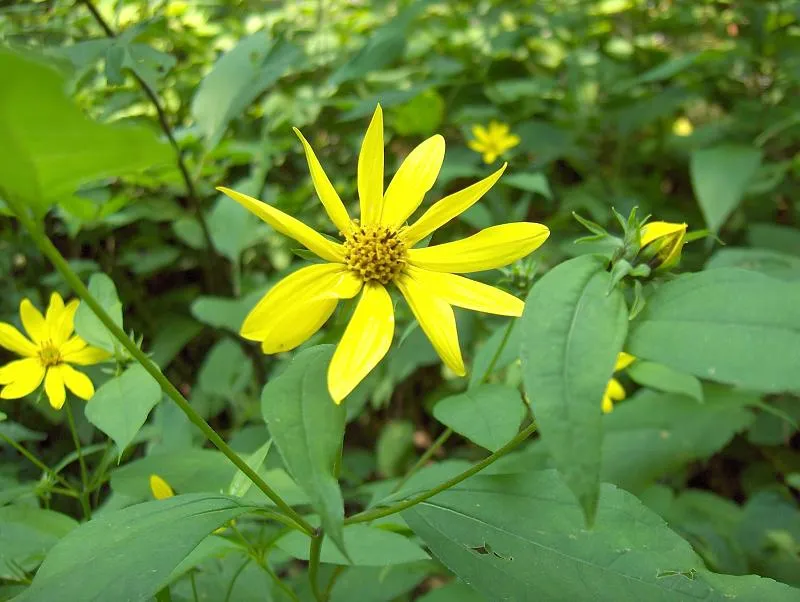
Woodland Sunflower (Helianthus strumosus) with bright yellow composite flowers and pairs of opposite leaves
Helianthus strumosus in mid-summer bloom — the shade-tolerant sunflower of the eastern Oklahoma woodlands. Photo: Rooted Revival.

Identification

[ field key — stem · leaf · flower · rhizome · distinguishing from other Helianthus ]

Habit & Stem

A perennial sunflower 3–6 ft tall with one to several erect stems arising from a creeping, tuber-bearing rhizome system that allows the plant to form expanding colonies over time. Stems are smooth (glabrous) and often glaucous (covered with a waxy, bluish-white bloom that rubs off with a finger), giving the plant a cleaner, less coarse appearance than the common annual sunflower. Stems branch in the upper portion to produce the flowering panicle. The rhizomes are slender, creeping, and produce small tuberous thickenings (similar to Jerusalem artichoke but smaller) that store energy and allow the plant to survive drought and disturbance.

Leaves

Leaves are opposite on the lower and middle stem (unlike the alternate leaves of many Helianthus species, including the common sunflower), becoming alternate near the top. The blades are lanceolate to ovate, 3–8 in long and 1–3 in wide, with entire to shallowly serrated margins and a tapered to rounded base with a short petiole. The upper surface is dark green and moderately rough (scabrous). The diagnostic field character is the underside of the leaf, which is conspicuously whitish or silvery-pale (abaxially glaucous or white-tomentose) — a flash of white when the wind flips the leaves that makes this species identifiable at a distance. This is the root of one of its common names: Pale-Leaved Sunflower.

Flower Heads

The inflorescence is a loose, branched terminal panicle bearing 5–20+ individual flower heads, each 2–4 in across. Each head has 8–15 bright yellow ray florets (the "petals") that are slightly reflexed at the tips and surround a golden-yellow to brownish central disk of fertile disk florets. The phyllaries (bracts) on the back of the head are lanceolate, ciliate-margined (fringed with fine hairs), and loosely arranged, often with spreading tips — a subtle but useful identification feature among Helianthus species. The overall effect is a smaller, looser, more naturalistic sunflower than the massive-headed annual cultivars, closer to the wild archetype of the genus.

Fruit & Edible Seeds

The fruit is a typical sunflower achene, though smaller than the cultivated oilseed types — about 1/8–1/4 in long, flattened, glabrous, and dark brown to black at maturity. The achenes are edible to humans, with a flavor similar to cultivated sunflower seeds but smaller and more labor-intensive to harvest in quantity. Birds, especially American goldfinches and sparrows, consume the seeds directly from the drying heads in fall. The seeds ripen from September through October, and the dried heads persist into winter.

Distinguishing from Other NE Oklahoma Helianthus

The woodland sunflower is distinguished from common sunflower (H. annuus) by its perennial habit, opposite leaves, and smaller flower heads. From Maximilian sunflower (H. maximiliani), it differs by its broader, opposite leaves with white undersides (vs. narrow, arching, alternate leaves) and shorter stature (3–6 ft vs. 5–10 ft). Jerusalem artichoke (H. tuberosus) has thicker, more substantial tubers and generally larger flower heads. The opposite leaves with silvery undersides are the most reliable field mark for H. strumosus in the Oklahoma flora.

Seasonal Cycle in NE Oklahoma

Emerges from rhizomes in April to early May. Grows steadily through May and June. Flower buds form in late June to early July, and the first flowers open in mid-July. Peak bloom runs from late July through August, with flowering continuing through September and tapering in early fall. Foliage is killed by the first hard freeze, usually in late October or November. The dried stems, with their persistent seed heads, remain standing through winter if not cut back. In deep shade, the plant may not flower at all in a given year, putting its energy into rhizome growth instead — a survival strategy that allows it to wait for a canopy opening (a fallen limb, a canopy tree's death) to trigger flowering.

Habitat & Range in NE Oklahoma

Helianthus strumosus is native to eastern and central North America, from Quebec and Maine south to Florida, and west through the Ohio and Mississippi valleys to Minnesota, Nebraska, Kansas, Oklahoma, and Texas. In Oklahoma it occurs throughout the eastern half of the state, with its range extending westward roughly to the eastern edge of the Great Plains. In NE Oklahoma it is found in open woods, woodland edges, thickets, roadsides through wooded country, and sunny openings within the Cross Timbers post-oak / blackjack-oak woodland matrix.

This is one of the characteristic sunflowers of the Cross Timbers ecosystem, where it grows in the dappled light beneath post oak and blackjack oak, often alongside coralberry, fragrant sumac, Virginia creeper, and the grasses little bluestem and indiangrass in the sunny gaps. It also occurs along the wooded draws and creek bottoms throughout eastern Oklahoma, in the Ozark foothill woodlands of the far eastern counties, and in abandoned fields and fence rows that are reverting to woodland. In the Tulsa area, look for it in wooded natural areas like Oxley Nature Center, Turkey Mountain, and any mature oak-hickory woodland with open edges or canopy gaps.

Ecology & Wildlife Value

[ specialist bees · Lepidoptera hosts · birds · woodland edge ecology ]

Helianthus-Specialist Bees

Like all sunflowers, H. strumosus supports a significant guild of oligolectic (specialist) bees that provision their nests almost exclusively with Helianthus pollen. These include Andrena helianthi (the sunflower miner bee), Diadasia enavata (sunflower chimney bee), Melissodes agilis and related long-horned bees, and Svastra obliqua. Generalist visitors include bumblebees (Bombus impatiens, B. pensylvanicus), green sweat bees (Agapostemon), leafcutter bees (Megachile), carpenter bees (Xylocopa virginica), and numerous beetles, flies, and wasps. The woodland sunflower extends the habitat range of these specialist sunflower bees into the partially shaded woodland edge, a microhabitat that common sunflower cannot occupy.

Lepidoptera Hosts

The woodland sunflower serves as a larval host for the same suite of checkerspot butterflies that use common sunflower: the silvery checkerspot (Chlosyne nycteis), gorgone checkerspot (C. gorgone), and bordered patch (C. lacinia). The painted lady (Vanessa cardui) also lays eggs on Helianthus foliage. Several moth species feed on the stalks and seed heads, including the sunflower moth (Homoeosoma electellum) and the sunflower bud moth.

Birds & Mammals

The seeds of H. strumosus are consumed by American goldfinches, house finches, mourning doves, Northern cardinals, Carolina chickadees, tufted titmice, and sparrows. White-tailed deer browse the foliage moderately. The tuberous rhizomes are occasionally dug and consumed by small mammals, including chipmunks, voles, and white-footed mice.

Woodland Edge Ecology

As a woodland edge and canopy-gap specialist, H. strumosus fills an important ecological niche: it capitalizes on light that reaches the forest floor through canopy openings, converting that transient resource into pollen, nectar, and seeds. The rhizomatous root system stabilizes woodland soil on slopes and in draws, and the colonies create microhabitat structure — shade, humidity, cover — for smaller plants and ground-dwelling arthropods. In a woodland garden or food forest, it functions as a mid-layer herbaceous perennial under taller woody species, filling the niche between the canopy and the ground layer.

Horticulture & Care

[ site · shade tolerance · spread control · companion woodland plants ]

Site Selection & Establishment

This is the sunflower for shade — one of the very few Helianthus species that flowers reliably in partial shade. The ideal site mimics its natural habitat: the dappled light at the edge of deciduous woodland, with morning sun and afternoon shade, or a woodland opening where a tree has fallen. It will grow and flower in as little as 4 hours of direct sun per day, though it produces fewer and smaller flowers than plants in full sun. It prefers moist, well-drained, organic-rich soil but tolerates the heavy clay and limestone-derived soils common around Tulsa.

Managing Rhizomatous Spread

Like most perennial sunflowers, H. strumosus spreads by creeping rhizomes and can form colonies that are several feet across within a few years. In a woodland garden or naturalized area, this is a desired behavior. In a small, formal bed, it may require management:

Companion Planting in Woodland Gardens

In a woodland garden or oak savannah planting, combine woodland sunflower with Solomon's seal, mayapple, wild ginger, Christmas fern, and maidenhair fern for a structured woodland floor. Plant beneath post oak, Shumard oak, chinkapin oak, eastern redbud, and downy serviceberry. For a woodland edge pollinator strip, pair with purple coneflower, black-eyed Susan, wild bergamot, and New England aster. In a food forest, plant woodland sunflower as an understory layer beneath fruit and nut trees, where it will produce edible seeds, support pollinators, and suppress weeds with its dense summer foliage.

Edible use in the food forest: The seeds of H. strumosus are smaller than cultivated sunflowers but perfectly edible. In a food forest context, you can harvest heads as they ripen in September–October, dry them, and rub out the seeds for human consumption or leave them on the plant for the goldfinches. The rhizome tubers, while smaller than those of Jerusalem artichoke (H. tuberosus), are also edible when cooked.

Photo Reference

Helianthus strumosus flower head with bright yellow rays and golden disk
// Flower head — 8–15 yellow rays, golden-yellow disk, 2–4 in across
Wikimedia Commons
Wikimedia Commons
Underside of Helianthus strumosus leaf showing striking silvery-white color
// Leaf underside — conspicuously white/silvery — diagnostic field mark
Wikimedia Commons
Wikimedia Commons
Colony of woodland sunflower growing in dappled shade under oak trees
// Colony — spreading through a woodland edge in the Cross Timbers
Wikimedia Commons
Wikimedia Commons
Smooth, glaucous stem of Helianthus strumosus with opposite leaf arrangement
// Stem — smooth, glaucous, with opposite leaves in lower/middle section
Wikimedia Commons
Wikimedia Commons
Sunflower specialist bee (Andrena helianthi) foraging on sunflower
// Andrena helianthi (sunflower miner bee) — an oligolectic Helianthus specialist
Wikimedia Commons
Wikimedia Commons

Sources & Further Reading

  • USDA NRCS PLANTS Database — Helianthus strumosus: plants.usda.gov/plant-profile/HEST
  • Lady Bird Johnson Wildflower Center — Native Plant Database: wildflower.org — HEST
  • Oklahoma Biological Survey — Helianthus strumosus county-level distribution: biosurvey.ou.edu
  • Gleason, H.A. & Cronquist, A. (1991). Manual of Vascular Plants, 2nd ed. New York Botanical Garden.
  • Jarrod Fowler & Sam Droege — Pollen Specialist Bees of the Eastern United States (section on Helianthus specialists).
  • Scott, J.A. (1986). The Butterflies of North America. Stanford University Press — checkerspot host plant records.
  • Wikipedia — Helianthus strumosus: en.wikipedia.org/wiki/Helianthus_strumosus (CC BY-SA 4.0; portions of the description and ecology sections summarize Wikipedia content).

Hero photo: Rooted Revival. Strip photos courtesy of Wikimedia Commons contributors under their respective licenses (linked under each image).