home/ plants/ sensitive-fern

// SPECIES PROFILE · PERENNIAL · NATIVE · FERN · WETLAND

Sensitive Fern

Onoclea sensibilis

The Sensitive Fern is the wetland fern that tells you exactly when the first hard frost has hit. The species name sensibilis was bestowed by Linnaeus in 1753 for the plant's extreme sensitivity to cold — the broad, apple-green sterile fronds collapse into a brown, sodden mess at the first touch of freezing temperatures, often before any other plant in the landscape shows damage. But the Sensitive Fern has a second trick: while the sterile fronds wilt away to nothing by November, the fertile fronds stand upright all winter, their pinnae rolled into dark brown, bead-like structures that look like a string of woody pearls on a stick. These fertile stalks persist through snow and ice, releasing spores in early spring just before the new sterile fronds unfurl. In NE Oklahoma you'll find Onoclea sensibilis in the places that stay wet when everything else dries out — roadside ditches, swampy woods, the margins of farm ponds, and any shaded seep that holds water into July.

// QUICK FACTS
Family
Onocleaceae (sensitive fern family); sometimes placed in Dryopteridaceae
Life cycle
Deciduous perennial fern; sterile fronds die at first frost; fertile fronds persist through winter
Native range
Eastern N. America — Newfoundland to Florida, west to E. Texas, E. Oklahoma, E. Kansas, and Manitoba; also disjunct in E. Asia
USDA hardiness
Zones 3–8 (Tulsa = 7a/7b)
Mature size
Sterile fronds 12–36 in tall; fertile fronds 12–24 in tall; spreads aggressively via rhizome to form colonies
Sporulation
Fertile fronds emerge June–July, green at first, darken to brown; spores released February–April
Sun
Part shade to full shade; tolerates full sun only with consistently wet soil
Soil
Moist to wet; tolerates heavy clay, standing water, and saturated conditions; pH 5.0–7.0
Water
Medium to high; prefers constant moisture; one of the few ferns that handles seasonal flooding
Wildlife
Provides winter structure; dense colonies shelter amphibians and small reptiles; minimal direct food value for vertebrates
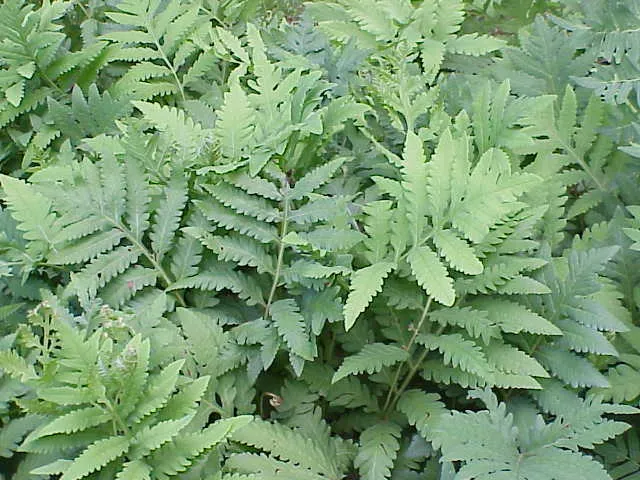
Sensitive Fern (Onoclea sensibilis) showing broad, coarsely lobed sterile fronds in a moist woodland setting
Onoclea sensibilis — the broad, deeply lobed sterile frond and the upright fertile stalks with bead-like pinnae. Photo: Rooted Revival.

Identification

[ field key — sterile frond · fertile frond · rhizome · sori · dimorphism ]

Sterile Fronds

The sterile (vegetative) fronds emerge in early spring as tightly coiled fiddleheads, pale green with a sparse covering of fine hairs, and unfurl into broad, coarse, deeply pinnatifid blades 12–36 in tall and 8–15 in wide. The outline is broadly triangular to ovate; the 8–14 pairs of pinnae are undivided (not compound) but deeply, coarsely lobed — almost scalloped — giving the frond a leathery, crinkled texture that is unlike any other Oklahoma fern. The rachis (central axis) is broadly winged in the upper portion — a helpful field mark when you have the frond in hand. The color is a distinctive light, yellowish- or apple-green that stands out in the darker understory. The stipe (stalk) is long, smooth, and straw- colored, often flushed with purple-brown at the base.

Fertile Fronds & Spores

Separating vegetative and reproductive functions into two completely different fronds is called frond dimorphism, and Onoclea sensibilis is one of the most extreme examples. The fertile fronds arise in mid-summer, usually June and July, as stiff, upright, twice-pinnate stalks that look nothing like the sterile fronds. The pinnules roll tightly inward into hard, bead-like, dark brown spheres that completely enclose the spore-producing structures (sori) within. By autumn these fertile stalks are woody and nearly black; they remain standing all winter and release clouds of green spores in late winter and early spring as the bead-like pinnules split open. The sight of a snow-covered colony of sensitive fern with its fertile stalks poking through the drifts is one of the small, overlooked pleasures of the dormant-season wetland.

Rhizome & Colonial Habit

Sensitive Fern spreads by long, slender, branching rhizomes that run just beneath the soil surface (or right at it in mucky, saturated ground). This gives the plant an aggressively colonial habit — in a suitable site, a single plant can produce a patch several feet across within 3–5 years. The rhizomes are dark brown to black, about ¼ in thick, and readily produce new fronds at intervals. This running habit makes O. sensibilis an excellent groundcover for large, wet, shaded areas where few other plants thrive, but it also means the fern can outcompete more delicate neighbors if not managed. In smaller garden settings, a physical root barrier sunk 8–10 in deep can contain the spread.

Distinction from Similar Species

The combination of broad, coarsely lobed (not compound) sterile fronds and upright, bead-like dark fertile stalks is unique among ferns in the Oklahoma flora — no other species has this pair of traits. If you are looking at sterile fronds only, the broad, wing- margined rachis and the scalloped rather than pinnately compound pinnae distinguish it from the lady fern and wood ferns. The closest potential look-alike is perhaps a young ostrich fern (Matteuccia struthiopteris) before it develops its characteristic vase shape, but ostrich fern pinnae are fully divided and compound, not merely lobed. The fertile fronds are unmistakable — once you've seen the "bead stick," you will never confuse it with anything else.

Habitat & Range in NE Oklahoma

Onoclea sensibilis is widespread in the eastern third of Oklahoma, reaching the western edge of its continuous range roughly along a line from the Kansas border through Tulsa and south toward the Red River. It is a facultative wetland species — strongly associated with wet soils but capable of persisting in merely moist sites — and its presence on the landscape is a reliable indicator of seasonal or permanent soil saturation. In the Tulsa region and eastward, you will find it in:

West of about Sapulpa, the species becomes increasingly restricted to the wettest available microsites and disappears almost entirely west of Oklahoma City except along major riparian corridors. The eastern Oklahoma populations represent the western limit of the species in the central United States. A curious biogeographic note: O. sensibilis also has a native range in East Asia (China, Japan, Korea), making it one of the classic eastern Asian – eastern North American disjunct plant distributions, similar to tulip poplar, sassafras, and mayapple.

Ecology & Wildlife Value

[ wetland structure · amphibian cover · arthropod habitat · frost ecology ]

Amphibian & Reptile Cover

Dense colonies of sensitive fern provide critical cover for amphibians and small reptiles in wetland habitats. The broad, overlapping sterile fronds create a cool, humid microclimate at ground level that persists even on hot summer afternoons — exactly the conditions that amphibians like green frogs, spring peepers, and small skinks require for thermoregulation and predator avoidance. In NE Oklahoma farm ponds and wooded sloughs, look for Blanchard's cricket frogs and southern leopard frogs using sensitive fern colonies as daytime retreat sites. The persistent fertile stalks also provide vertical perching structure for dragonflies and damselflies hunting over standing water.

Invertebrate Associations

Fern-feeding insects are a specialized guild, and sensitive fern hosts at least one specialist herbivore: the sensitive fern borer moth (Papaipema stenocelis), whose larvae bore into the rhizomes and stipes. Several species of sawflies (Hymenoptera: Symphyta) also feed on the foliage, and the rolled fertile pinnae provide overwintering chambers for a variety of small beetles, spiders, and springtails. The dense rhizome mat, interlaced with rotting leaf litter, supports a rich community of isopods (pillbugs and sowbugs), millipedes, and earthworms that drive decomposition and nutrient cycling in the wetland soil.

Birds & Mammals

The direct food value of sensitive fern to birds and mammals is low — the foliage contains thiaminase, an enzyme that breaks down vitamin B1, making it toxic in quantity to horses and potentially to other mammals (though deer browse is generally light). However, the colonies provide foraging habitat for insectivorous birds: Carolina wrens, common yellowthroats, and several warblers hunt the arthropod community that lives in and beneath the fronds. In winter, the standing fertile stalks add structural complexity to an otherwise flat, open wetland landscape, offering hunting perches for Eastern phoebes and other flycatchers that remain in the region during mild winters.

The "Sensitive" Ecology

The rapid frost-sensitivity that gives the plant its name is an ecological strategy, not a weakness. By senescing completely and immediately with the first hard freeze, the plant avoids the frost damage-repair metabolic cost that other perennials incur. The nutrients in the collapsing fronds are rapidly translocated to the rhizome before the tissue fully dies, storing energy for the following spring's emergence. This deciduous strategy, combined with the winter-persistent fertile fronds that release spores during the February thaw (when wind dispersal is maximized in a leafless landscape), makes O. sensibilis superbly adapted to the freeze-thaw cycles of a continental climate. In years with an unusually early freeze (late September or early October in Oklahoma), the fern may lose a significant portion of its photosynthetically active tissue before nutrients have been fully mobilized — which is why colonies that experience early frosts are often smaller and slower to expand the following year.

Horticulture & Care

[ rain garden · wet shade · rhizome management · pond edge · companion planting ]

Site selection & planting

Sensitive Fern is the solution for the problem spot every Tulsa gardener knows: the wet, shady corner where nothing else will grow. If you have a drainage swale, a rain garden basin, the low end of a lot that stays damp, or a shaded area near an air conditioning condensate drain, this is your plant. It tolerates seasonally saturated soil, occasional standing water, heavy clay, and deep shade — conditions that will kill most other perennials in a single season. The only absolute requirement is consistent moisture during the growing season (April–October). In full sun, it can survive only in truly wet soil; the fronds will yellow, crisp, and die back in full sun with merely moist soil.

Containing the spread

In a small garden or a mixed planting, the running rhizomes of sensitive fern can become a management challenge. The fern does not respect planting boundaries and will happily colonize adjacent beds, walkways, and even lawn edges if moisture permits. Strategies for containment:

Companion planting in wet-shade gardens

Sensitive fern pairs beautifully with other moisture-loving native perennials that tolerate shade. Complement its broad, coarse-textured fronds with: cardinal flower (Lobelia cardinalis) for spikes of brilliant red at the wet border, buttonbush (Cephalanthus occidentalis) as a shrub backdrop whose white globular flowers attract a stunning diversity of pollinators, ostrich fern (Matteuccia struthiopteris) for a taller, more upright fern contrast, Green Dragon (Arisaema dracontium) and Jack-in-the-pulpit for unusual aroid texture in the damp understory, and inland sea oats (Chasmanthium latifolium) at the drier edge for a graceful grass accent. For spring color before the fern canopy fills in, underplant with Virginia Bluebells (Mertensia virginica), which emerge and bloom early while the fern's fiddleheads are still on the way.

Edible & Cultural Uses

Sensitive Fern has limited ethnobotanical documentation. The young fiddleheads are sometimes consumed after thorough cooking in parts of the species' range, but this practice carries a significant caution: the plant contains thiaminase, an enzyme that destroys vitamin B1 (thiamine) and can cause deficiency symptoms with heavy or repeated consumption. Horses are particularly susceptible to thiaminase toxicity from grazing large quantities of the fern in pasture settings, and livestock poisonings are documented. In Indigenous ethnobotany, Onoclea sensibilis was used externally by several Woodland peoples: a poultice of the boiled root was applied to skin sores and rashes, and a decoction was occasionally used for rheumatism. The fertile fronds' bead-like pinnae have been used in some folk traditions as a remedy for teething infants to chew, though modern medical consensus would recommend safer alternatives.

Thiaminase risk. Sensitive fern and several other common ferns (bracken fern, ostrich fern) contain thiaminase. Cooking breaks down the enzyme, but the margin of safety is narrow. If you are interested in eating fern fiddleheads, the ostrich fern (Matteuccia struthiopteris) is the established culinary species; the fiddleheads of sensitive fern are not recommended as a forage food.

Photo Reference

Broad, coarsely lobed sterile frond of Onoclea sensibilis against a dark woodland background
// Sterile frond — broad, deeply lobed, apple-green, unlike any other Oklahoma fern
Wikimedia Commons
Wikimedia Commons
Upright fertile fronds of Onoclea sensibilis with dark brown bead-like pinnae in winter
// Fertile fronds — the "bead stick" stalks persist through winter, releasing spores in early spring
Wikimedia Commons
Wikimedia Commons
Dense colonial growth of Onoclea sensibilis in a wetland depression
// Colony — aggressive rhizomatous spread creates a dense groundcover in wet, shaded sites
Wikimedia Commons
Wikimedia Commons
Unfurling fiddlehead of Onoclea sensibilis in early spring
// Fiddlehead — the tightly coiled young sterile frond emerging in April
Wikimedia Commons
Wikimedia Commons

Sources & Further Reading

  • USDA NRCS PLANTS Database — Onoclea sensibilis: plants.usda.gov/plant-profile/ONSE
  • Lady Bird Johnson Wildflower Center — Native Plant Database: wildflower.org — ONSE
  • Flora of North America — Onoclea (Vol. 2): efloras.org
  • Smith, A.R. et al. (2006). A classification for extant ferns. Taxon 55(3):705–731 — placement of Onocleaceae.
  • Barrington, D.S. (1993). Ecological and historical factors in fern biogeography. Journal of Biogeography 20:275–280 — on eastern Asian–eastern North American disjunct patterns.
  • Wikipedia — Onoclea sensibilis: en.wikipedia.org/wiki/Onoclea_sensibilis (CC BY-SA 4.0; portions of the description, ecology and uses sections summarize Wikipedia content).
  • Oklahoma Biological Survey — Atlas of Oklahoma Flora (Pteridophytes): biosurvey.ou.edu

Hero photo: Rooted Revival. Strip photos courtesy of Wikimedia Commons contributors under their respective licenses (linked under each image).