// SPECIES PROFILE · PERENNIAL · NATIVE · DROUGHT-HARDY
Whorled Milkweed is the most drought-tolerant milkweed in eastern North America — a slender, fine-textured perennial whose needle-like leaves are arranged in delicate whorls around the stem, giving it the look of a soft pine seedling rather than a typical broad-leaved milkweed. It is every bit a true Asclepias: the broken stem exudes white latex, and the small, greenish-white flower clusters are reliable monarch butterfly host and nectar plants from mid-summer through fall. Asclepias verticillata thrives on neglect: dry prairies, limestone glades, thin-soiled road cuts, and open rocky woods throughout the Cross Timbers and tallgrass prairie of NE Oklahoma. It will grow where Common Milkweed and Swamp Milkweed wither, making it the go-to monarch host for hot, dry, thin-soil problem spots in the garden. It is also one of the few milkweeds that spreads by rhizomes to form colonies, so give it room or use it where you want a low-maintenance, self-sustaining monarch nursery.

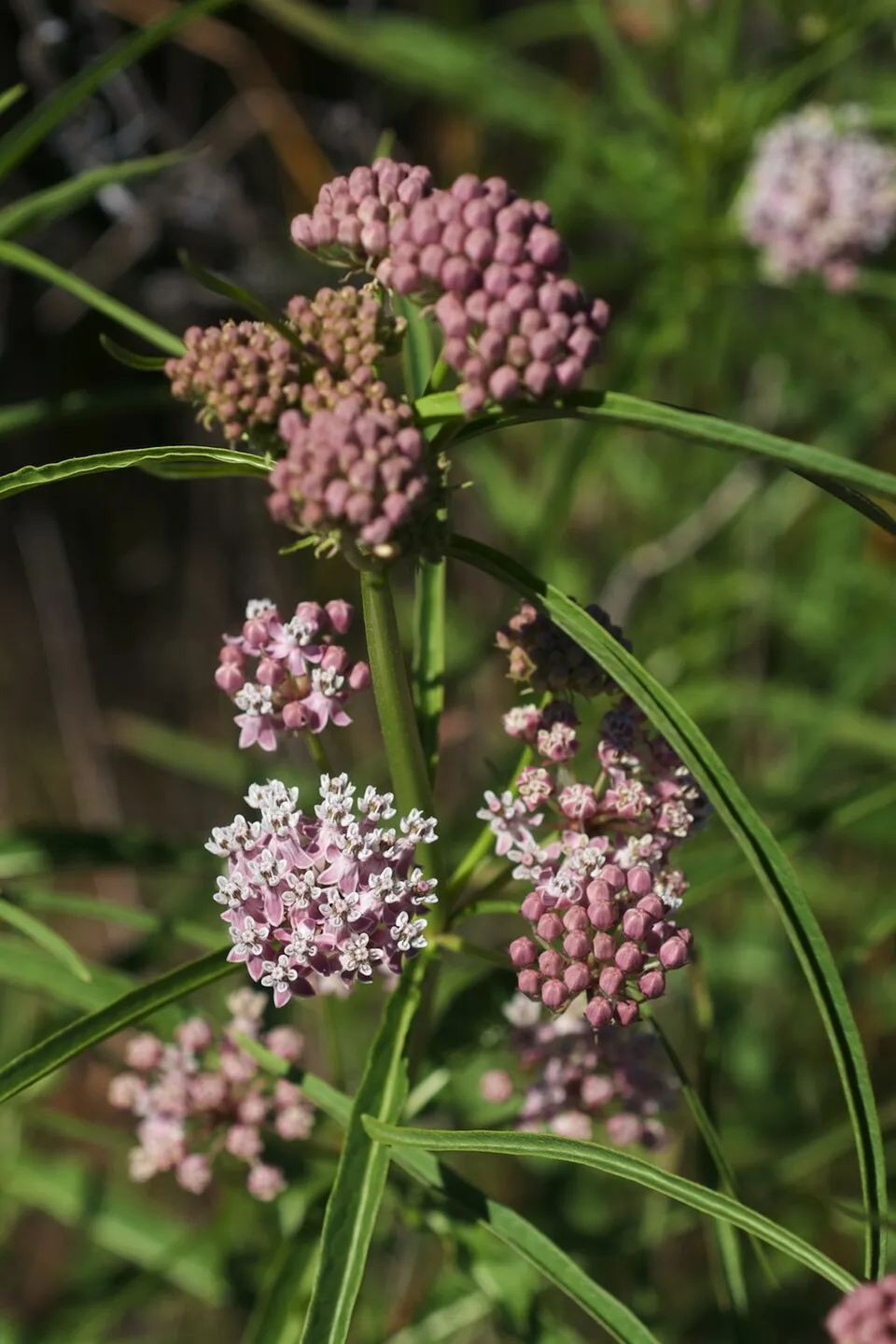
Slender, erect perennial 1–2.5 ft tall, usually unbranched below the flower clusters. The leaves are the diagnostic feature: narrow, linear, needle-like, 1–3 in long, arranged in whorls of 3–6 around the stem at each node. This whorled arrangement gives the plant a soft, feathery, almost coniferous appearance unlike any other Asclepias in our region. Stems and leaves contain white milky latex.
Small, greenish-white to cream flowers in rounded, axillary umbels about 1–2 in across. The individual flowers are tiny and understated, but the clusters are numerous and bloom from June through September. The seed pods (follicles) are slender, smooth, 3–4 in long, splitting to release seeds with silky white coma (fluff) in fall. The seed fluff is classic milkweed — excellent for goldfinch nesting material.
Whorled Milkweed is one of the most widespread milkweeds in North America. In NE Oklahoma, it is common in dry prairies, limestone glades, open rocky woods, and roadsides throughout the Cross Timbers and tallgrass prairie. It is the milkweed of dry, thin, sun-baked soils — sites where other milkweeds cannot persist. It is also frequent in disturbed habitats, old fields, and overgrazed pastures, making it an excellent candidate for low-maintenance restoration plantings.
Like all Asclepias species, Whorled Milkweed is a larval host for the monarch butterfly (Danaus plexippus). Female monarchs readily oviposit on the fine foliage. Because this milkweed remains green and actively growing later into the fall than many other species, it provides critical late-season caterpillar forage during the southward monarch migration in September–October. It also hosts the milkweed tussock moth (Euchaetes egle) and the unexpected cycnia (Cycnia inopinatus).
The small white flowers attract a wide range of pollinators including honey bees, bumblebees, small native bees, hairstreak butterflies, and various wasps and flies. The long bloom season (June–September) makes this a particularly valuable plant for supporting nectar-feeding insects through the hot, dry mid-summer period when many other plants have finished blooming.
Whorled Milkweed needs full sun and well-drained soil. It thrives in the hottest, driest, most difficult spots in the garden — the strip between sidewalk and street, the thin soil over limestone, the neglected corner where nothing else grows. It is the milkweed for dry sites; if your soil stays consistently moist, plant Swamp Milkweed instead.
Excellent in a dry prairie or glade planting with Butterfly Milkweed, Little Bluestem, Purple Coneflower, Stiff Goldenrod, Gray Goldenrod, and Sideoats Grama. For a comprehensive monarch garden in NE Oklahoma, plant this alongside Common Milkweed (for moist sites), Swamp Milkweed (for wet sites), and Green Milkweed (for mesic sites).