home/ plants/ eastern-bluestar

// SPECIES PROFILE · PERENNIAL · NATIVE · CLAY-TOUGH

Eastern Bluestar

Amsonia tabernaemontana

Eastern Bluestar is a clump-forming perennial that delivers three seasons of garden value from a single, largely untended clump: pale blue, star-shaped flowers in late spring, clean willow-like foliage through summer, and brilliant golden-yellow fall color that glows against the tawny grasses of autumn. Amsonia tabernaemontana is, like its milkweed cousins, a member of the Apocynaceae (dogbane family), and the broken stems exude a characteristic milky white sap. In NE Oklahoma, it grows in moist, open woods, stream banks, and bottomlands in the Ozark foothills and eastern part of the state. It tolerates heavy clay, periodic wetness, and the swinging moisture extremes of our region's seasons, making it one of the most reliable and adaptable native perennials for the Tulsa area. The pale blue flowers, which appear at the tips of the willow-leaved stems in April and May, are followed by slender seed pods. By October, the entire plant transforms into a pillar of gold that rivals any shrub for fall impact. This is the plant to put in the ground and forget about — it will quietly deliver year after year.

// QUICK FACTS
Family
Apocynaceae (dogbane / milkweed family)
Life cycle
Herbaceous perennial; clump-forming, long-lived
Native range
Southeastern & south-central US — Virginia to Florida, west to Texas and eastern OK
USDA hardiness
Zones 3–9 (Tulsa = 7a/7b)
Mature size
2–3 ft tall; 2–3 ft spread
Bloom
April–May (NE OK)
Flower
Pale blue, star-shaped, in terminal clusters
Sun
Full sun to part shade; best bloom in full sun
Soil
Moist, well-drained; tolerates heavy clay
Water
Medium; tolerates occasional wet and moderate drought
Fall color
Brilliant golden-yellow
Wildlife
Pollinator nectar · hummingbird visitors · deer resistant
Special feature
Three-season plant: blue flowers / green foliage / gold fall
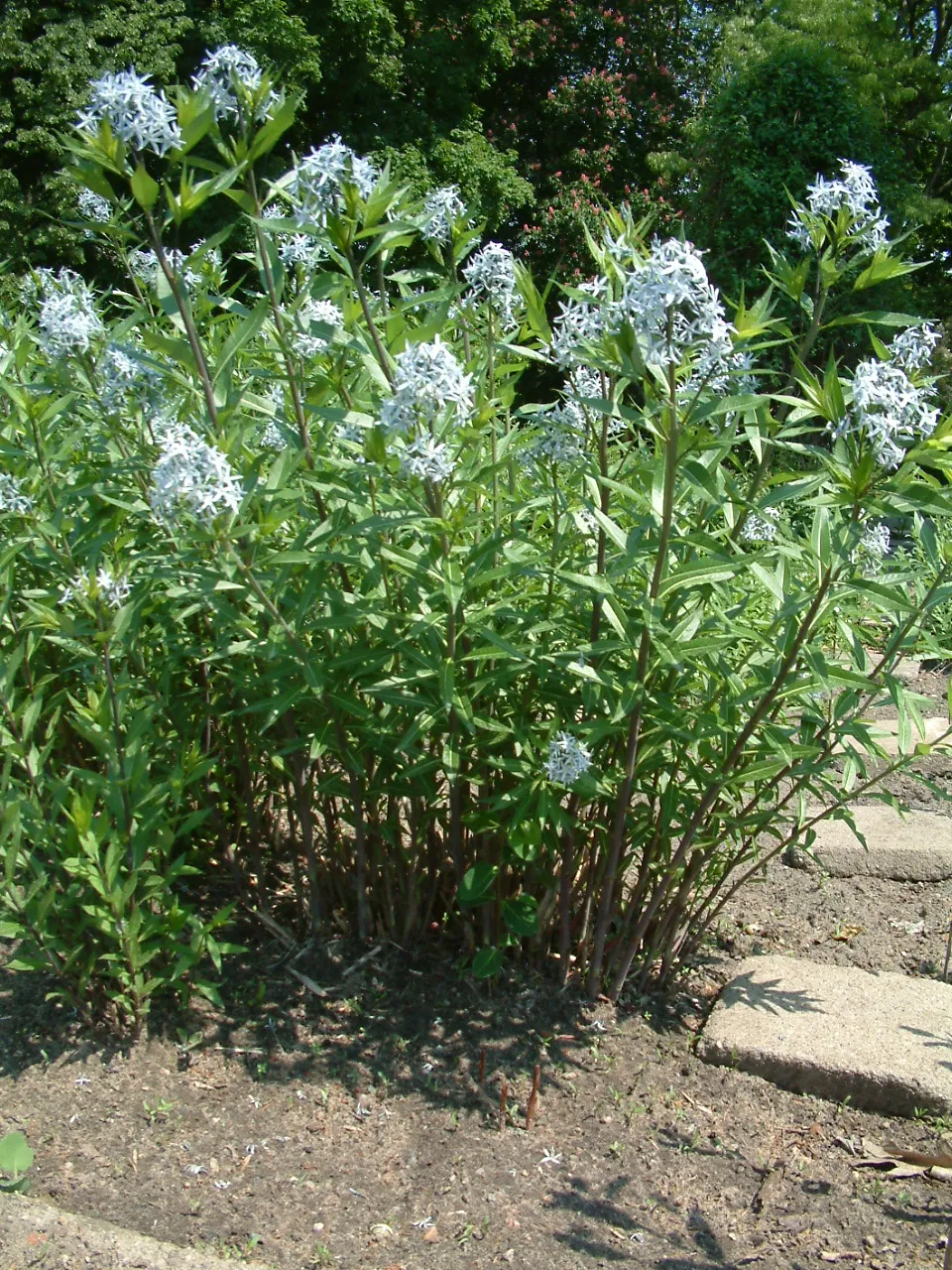
Eastern Bluestar (Amsonia tabernaemontana) with pale blue star-shaped flowers
Amsonia tabernaemontana in spring bloom — pale blue star-shaped flowers on a clump-forming perennial. Photo: Rooted Revival.

Identification

Habit & Leaves

Clump-forming, bushy perennial 2–3 ft tall and wide, with multiple stems arising from a woody crown. The leaves are alternate, narrow, lance-shaped to willow-like, 2–4 in long, dark green and smooth. The dense, fine-textured foliage gives the plant a soft, billowy presence in the garden — it looks a bit like a compact shrub. Stems and leaves contain white milky sap when cut.

Flowers & Fall Color

Pale blue, star-shaped (salverform) flowers, about 3⁄4 in across, with five pointed lobes, borne in loose terminal clusters in April–May. The blue is soft, not intense — the color of a morning sky. After bloom, slender paired seed pods (follicles) 3–4 in long develop and persist. The fall foliage transformation is dramatic: the entire plant turns a brilliant, clear golden-yellow in October–November, often the brightest yellow in the autumn garden.

Habitat & Range in NE Oklahoma

Amsonia tabernaemontana is found in moist, open woods, stream banks, bottomlands, and wet meadows in eastern Oklahoma. It tolerates heavy clay and periodic flooding, making it a versatile plant for the challenging soils of the Tulsa region. It thrives in full sun to part shade, with more compact growth and heavier bloom in sun.

Ecology & Wildlife Value

Pollinators

The star-shaped blue flowers attract long-tongued bees including bumblebees and carpenter bees, as well as ruby-throated hummingbirds. The plant is also a larval host for the holly blue butterfly (Celastrina argiolus) in parts of its range. As a member of the dogbane family, it shares some chemical properties with milkweeds that support specialist insect herbivores.

Deer Resistance

The milky sap contains alkaloids and latex that make the foliage unpalatable to deer and rabbits. Eastern Bluestar is one of the most reliably deer-resistant native perennials available.

Horticulture & Care

Site selection

Eastern Bluestar is broadly adaptable: full sun to part shade, almost any soil including heavy clay, and tolerates occasional wet feet. In full sun, the plant is more compact and floriferous; in shade, it is slightly taller and blooms less heavily. Once established, it is remarkably self-sufficient.

Planting & Maintenance

Companion planting

Beautiful in combination with Purple Coneflower, Wild Columbine, Woodland Phlox, Ohio Spiderwort, Swamp Milkweed, and Little Bluestem. The golden fall foliage pairs spectacularly with the copper winter form of little bluestem.

Photo Reference

Eastern Bluestar pale blue star-shaped flowers
// Flowers — pale blue, star-shaped, terminal clusters, April–May
Wikimedia Commons
Wikimedia Commons
Eastern Bluestar brilliant golden fall foliage
// Fall color — brilliant golden-yellow, October–November
Wikimedia Commons
Wikimedia Commons
Eastern Bluestar clump in garden
// Habit — clump-forming, bushy, willow-like, 2–3 ft
Wikimedia Commons
Wikimedia Commons

Sources & Further Reading