home/ plants/ wild-quinine

// SPECIES PROFILE · PERENNIAL · NATIVE · PRAIRIE RESTORATION

Wild Quinine

Parthenium integrifolium

Wild Quinine is an upright, coarse-textured prairie perennial with a story: its large, rough basal leaves and flat-topped clusters of small, white, button-like flowers sustained a generation of soldiers when cinchona bark (the source of quinine) was unavailable during World War I, and the plant's constituent parthenolide made it a credible substitute. Today, its value in the NE Oklahoma garden is less medicinal and more ecological: Parthenium integrifolium is a long-blooming, deeply rooted prairie native that produces dense heads of small white flowers from early summer through fall, feeding a wide range of native bees, wasps, and beneficial insects for months on end. It is found in dry to mesic prairies and open woodlands throughout the tallgrass prairie and Cross Timbers of NE Oklahoma. The plant is tough, clay-tolerant, and essentially maintenance-free once established. For the prairie restoration or pollinator garden, Wild Quinine provides structure, long bloom, and a quiet white presence among the louder yellows and purples of the summer prairie.

// QUICK FACTS
Family
Asteraceae (sunflower / daisy family)
Life cycle
Herbaceous perennial; long-lived
Native range
Eastern & central US — Maryland to Georgia, west to Minnesota and Oklahoma
USDA hardiness
Zones 4–8 (Tulsa = 7a/7b)
Mature size
2–4 ft tall; 1–2 ft spread
Bloom
June–September (NE OK)
Flower
Flat-topped clusters of small white button-like heads
Sun
Full sun; tolerates light shade
Soil
Dry to mesic, well-drained; tolerates clay
Water
Low to medium; drought-tolerant once established
Wildlife
Native bee plant · beneficial wasps · long bloom season
Medicinal
Historically used as quinine substitute (WWI); parthenolide content
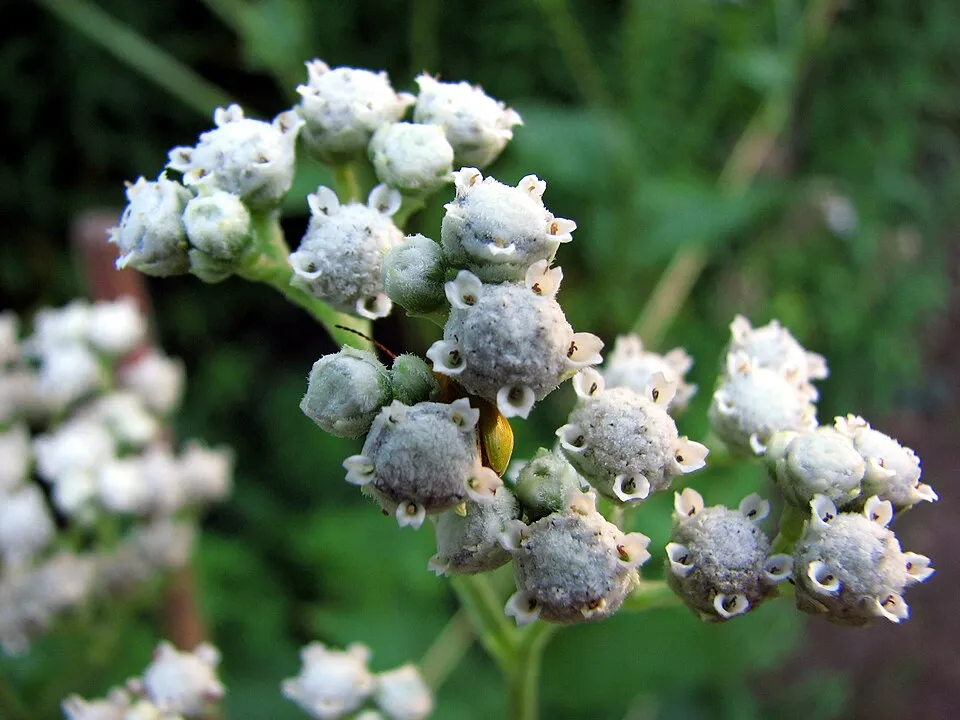
Wild Quinine (Parthenium integrifolium) with flat-topped clusters of white button flowers
Parthenium integrifolium in bloom — white button-like flower clusters on an upright prairie perennial. Photo: Rooted Revival.

Identification

Habit & Leaves

Upright, coarse perennial 2–4 ft tall with a sturdy, unbranched stem. The basal leaves are large, rough-textured, broadly ovate to lance-shaped, 6–12 in long, with toothed margins and long petioles. Stem leaves are progressively smaller and nearly sessile. The overall effect is bold and architectural at the base, giving way to a multi-headed floral display above.

Flowers

Flat-topped clusters (corymbs) of small, white, button-like flower heads, each about 1⁄4 in across. The heads consist of five tiny, white, fertile ray florets surrounding a dense cluster of white disk florets. The overall effect is a flat or slightly domed white cluster 3–6 in across, resembling a cauliflower or yarrow bloom but larger and more textural. Blooms from June through September.

Habitat & Range in NE Oklahoma

Parthenium integrifolium occurs in dry to mesic prairies, open woodlands, and prairie remnants throughout the tallgrass prairie and Cross Timbers of NE Oklahoma. It is tolerant of clay and thin soils and requires full sun for best growth and bloom. In the garden, it is an excellent choice for a prairie restoration, dry meadow, or the back of a perennial border.

Ecology & Wildlife Value

Pollinators

The small white flowers attract a wide diversity of small native bees, syrphid flies, parasitic wasps, and beetles. The flat, accessible inflorescences are particularly popular with short-tongued bees and beneficial predatory wasps. The long bloom season (3–4 months) makes this a valuable "anchor" nectar plant in the summer pollinator garden.

Deer Resistance

The rough, aromatic foliage is moderately deer-resistant — not bulletproof, but less palatable than many other prairie forbs. In areas of heavy deer pressure, it is one of the more reliable natives.

Horticulture & Care

Site selection

Wild Quinine needs full sun and well-drained soil. It tolerates drought, clay, and thin soils, making it an excellent choice for challenging sites. It is deep-rooted and long-lived once established. Avoid wet, poorly drained sites.

Planting & Maintenance

Companion planting

Excellent in a prairie or meadow planting with Purple Coneflower, Rattlesnake Master, Leadplant, Little Bluestem, Big Bluestem, Stiff Goldenrod, and Compass Plant. The white blooms provide a cooling counterpoint to the hot yellows and purples of the summer prairie.

Edible & Cultural Uses

During World War I, when the supply of cinchona bark (the source of quinine, essential for treating malaria) was cut off by the German blockade of the Netherlands, the US government turned to native plant alternatives. Parthenium integrifolium was identified as containing parthenolide and related sesquiterpene lactones with antimalarial and anti-inflammatory properties, and it was harvested in quantity as a wartime substitute. While less effective than true quinine from cinchona, wild quinine preparations were used to treat soldiers.

Native Americans used several Parthenium species medicinally for fever, kidney stones, and as a general tonic. The leaves were also burned as a mosquito repellent. Note: Do not self-medicate with wild quinine; the plant contains pharmacologically active compounds that can cause contact dermatitis and other adverse effects. Its value today is ecological and ornamental, not medicinal.

Photo Reference

Wild Quinine white button flower clusters
// Flowers — flat-topped clusters, white buttons, June–September
Wikimedia Commons
Wikimedia Commons
Wild Quinine large rough basal leaves
// Leaves — large, rough, toothed, bold architectural presence
Wikimedia Commons
Wikimedia Commons
Bee on Wild Quinine flower
// Pollinator — small native bee on white flower cluster
Wikimedia Commons
Wikimedia Commons
Wild Quinine in prairie planting
// Habit — upright, 2–4 ft, sturdy, unbranched stem
Wikimedia Commons
Wikimedia Commons

Sources & Further Reading