home/plants/virgins-bower

// SPECIES PROFILE · VINE · NATIVE · LATE-SUMMER BLOOM

Virgin's Bower

Clematis virginiana

Virgin's Bower is a vigorous, twining native vine that covers itself in masses of small, fragrant, white four-petaled flowers in late summer (August–September), followed by showy, feathery, silver-gray seed heads that persist into winter and give the vine its alternate names: "Old Man's Beard" and "Devil's Darning Needles." Clematis virginiana is the native counterpart to the cultivated clematis of garden catalogs, and it brings the same elegant, billowy presence to a fence, arbor, or trellis, but without the fussiness. In NE Oklahoma, it clambers through moist thickets, streambanks, and fencerows throughout the region. It is not a delicate plant — once established, it can cover a substantial structure in a single growing season, smothering it in white bloom in August and silver seed fluff in November. For the gardener who wants a native flowering vine for a fence or arbor with genuine wildlife value and an unfussy disposition, Virgin's Bower is the answer.

// QUICK FACTS
Family
Ranunculaceae (buttercup family)
Life cycle
Deciduous woody-stemmed vine; perennial
Native range
Eastern & central N. America — all of OK
USDA hardiness
Zones 3–8 (Tulsa = 7a/7b)
Mature size
10–20 ft climbing; spreads indefinitely
Bloom
August–September (NE OK)
Flower
Small white, 4-petaled, fragrant, in dense clusters
Sun
Full sun to part shade; roots prefer shade, tops prefer sun
Soil
Moist, well-drained; adaptable to clay
Water
Medium
Wildlife
Pollinator nectar · seed fluff used by birds for nesting
Special feature
Feathery silver seed heads persist into winter
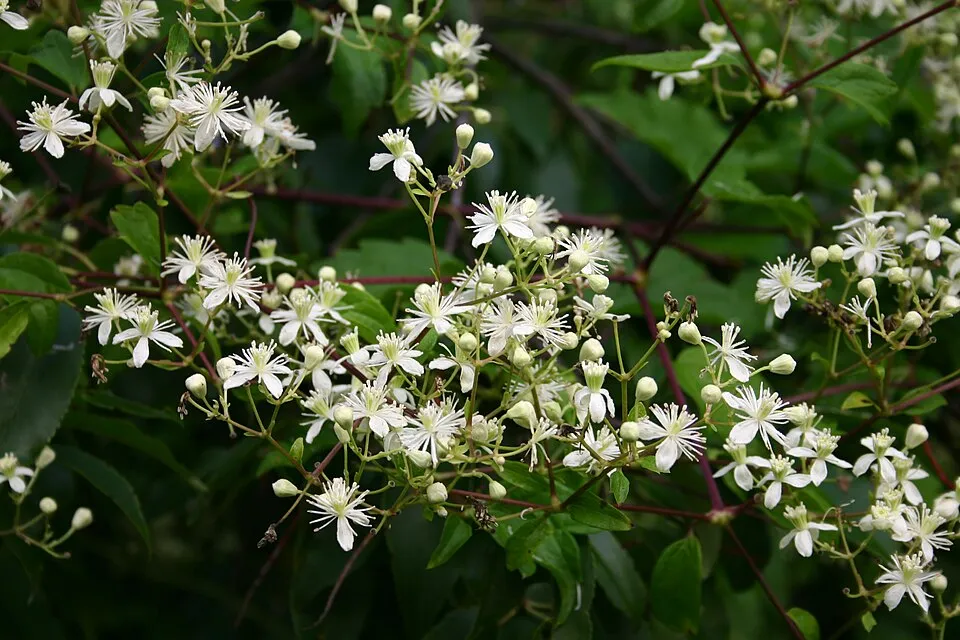
Virgin's Bower (Clematis virginiana) with masses of white flowers and feathery seeds
Clematis virginiana in bloom — masses of small fragrant white flowers, followed by feathery silver seed heads. Photo: Rooted Revival.

Identification

Habit & Stem

Vigorous, twining deciduous vine climbing 10–20 ft by wrapping its leaf stalks (petioles) around supports. Stems are slender, slightly ridged, and brownish with age. Unlike some cultivated clematis, Virgin's Bower dies back partially in winter but regrows vigorously from the base each spring. It can be aggressive in favorable conditions — give it a sturdy structure.

Leaves

Opposite, compound with 3 leaflets (trifoliate). Leaflets are ovate, 2–4 in long, with coarsely toothed or lobed margins. The leaves are medium green and smooth to slightly hairy. The leaf stalks (petioles) act as tendrils, coiling around supports to secure the vine.

Flowers

Small, white, fragrant, 4-petaled flowers about 1 in across, borne in dense, branched clusters (panicles) from the leaf axils. The flowers lack true petals; the showy white structures are petal-like sepals. Bloom appears in August–September, later than most native vines, providing late-season nectar when many other plants have finished flowering.

Seed Heads

After flowering, each female flower produces a cluster of feathery, plume-like achenes (single-seeded fruits with long, silky tails) that persist into winter. These silvery, fluffy clusters give the plant its common names "Old Man's Beard" and "Virgin's Bower." They are conspicuous and ornamental against bare winter branches.

Habitat & Range in NE Oklahoma

Clematis virginiana is common across NE Oklahoma in moist thickets, streambanks, fencerows, woodland edges, and disturbed areas. It climbs over shrubs, small trees, and fences, often forming dense tangles. It prefers moist, well-drained soil but is adaptable to a range of conditions. In the garden, it thrives on arbors, trellises, chain-link fences, and mailboxes.

Ecology & Wildlife Value

Pollinators

The late-summer flowers attract a wide variety of bees, wasps, flies, and small butterflies at a time when many other nectar sources are fading. The fragrance and abundant white bloom make the flowers highly visible to pollinators. It is a particularly valuable resource for late-season bumblebees and honey bees.

Wildlife

The feathery seed fluff is collected by goldfinches and other songbirds for nest lining. The dense tangle of vines provides cover and nesting sites for birds and small mammals. Virgin's Bower is not a significant Lepidoptera host but contributes structural complexity to edge habitats.

Horticulture & Care

Site selection

Virgin's Bower follows the classic clematis rule: "head in the sun, feet in the shade." Give the top of the plant full sun for best flowering, but keep the root zone cool and shaded with mulch or low-growing companion plants. Provide a sturdy support (arbor, fence, trellis, lattice) as this vine is heavy when in full leaf and bloom.

Planting & Maintenance

Companion planting

Excellent on an arbor with Trumpet Honeysuckle and Passionflower for a sequence of native vine blooms. Shade the root zone with Wild Ginger, Woodland Phlox, or a generous layer of wood chip mulch.

Photo Reference

Virgin's Bower white flower clusters
// Flowers — small white fragrant, 4-petaled, August–September
Wikimedia Commons
Wikimedia Commons
Virgin's Bower feathery silver seed heads
// Seed heads — feathery silver plumes, persist into winter
Wikimedia Commons
Wikimedia Commons
Virgin's Bower vine on fence
// Habit — twining vine, 10–20 ft, climbing by petioles
Wikimedia Commons
Wikimedia Commons

Sources & Further Reading