home/ plants/ southern-dewberry

// SPECIES PROFILE · SHRUB · NATIVE · EDIBLE BERRY · WILDLIFE COVER

Southern Dewberry

Rubus trivialis

Southern dewberry is a low, trailing native bramble 6–18 inches tall with prickly, reddish canes that hug the ground rather than arching upright, forming a dense, sprawling mat of thorny foliage. It produces large, sweet, shiny black fruit in late spring — among the earliest bramble fruits of the year in NE Oklahoma — with a flavor that is genuinely excellent and more consistently sweet than many wild blackberries. Rubus trivialis is a sun-loving pioneer of roadsides, field edges, open woods, and disturbed ground throughout the southeastern US and into eastern Oklahoma. Functionally, it is a multifunctional native: a fruit crop at ground level, a protective cover plant for quail and rabbits, an excellent slope stabilizer, and a nearly indestructible plant for difficult, sunny, eroding sites where little else will grow.

// QUICK FACTS
Family
Rosaceae (rose family)
Life cycle
Perennial trailing shrub; canes are biennial (first-year primocanes, second-year floricanes)
Native range
Southeastern and south-central US — Virginia to Florida, west to Texas and Oklahoma, north to Missouri
USDA hardiness
Zones 5–9 (Tulsa = 7a/7b — well within range)
Mature size
6–18 in tall; canes trail 6–15 ft along the ground, rooting at the tips
Bloom
March – May (NE OK); among the earliest Rosaceae blooms
Flower
White to pale pink, 5-petaled, 1–1½ in across; solitary or in small clusters on short axillary shoots
Fruit
Aggregate of drupelets (blackberry-type), ¾–1¼ in long; glossy black when ripe; ripens late April – May in NE Oklahoma
Sun
Full sun to light shade; fruits heavily in sun, survives in woodland edge shade
Soil
Tolerates a very wide range — sand, loam, clay; pH 5.0–7.5; prefers well-drained but accepts period wetness
Water
Medium; drought-tolerant once established but produces better fruit with consistent moisture
Wildlife
Fruit for birds & mammals · ground-level nesting cover for quail and songbirds · pollinator flowers · larval host for numerous moths and butterflies
Conservation
G5 — Secure; common and sometimes weedy throughout its range
Southern Dewberry (Rubus trivialis) — glossy black ripe fruit among prickly trailing reddish canes and compound leaves
Rubus trivialis with ripe fruit — large, glossy black, sweet berries on low trailing canes in late spring. Photo: Rooted Revival.

Identification

[ field key — habit · cane · leaf · flower · fruit · distinguishing features ]

Growth Habit & Canes

Southern dewberry is a low, trailing, semi-evergreen to deciduous bramble that sprawls across the ground rather than forming the erect, arching thickets typical of upright blackberries. The canes are reddish to purple-red, glabrous (smooth) to sparsely hairy, and armed with stout, hooked prickles that are often red at the base. First-year canes (primocanes) trail along the ground, rooting at the tips where they touch moist soil — this tip-rooting habit allows a single plant to expand outward several feet per year, forming a continuous ground-level mat. Second-year canes (floricanes) produce short lateral flowering branches. Unlike the erect black raspberry, dewberry canes never arch up into a self-supporting bush; they stay low, 6–18 inches above the soil, even when flowering.

Leaves

Leaves are alternate, palmately compound with 3–5 leaflets (most commonly 5 on primocanes, 3 on floricanes). Leaflets are ovate to elliptic, 1–3 in long, with sharply serrated or doubly serrated margins and a pointed tip. The upper surface is dark green and smooth to slightly rough; the underside is paler with prickles along the midvein — a useful field character. The foliage is persistent through winter in milder years in Tulsa, turning reddish-purple in cold weather but often remaining green enough for wildlife to browse. The leaflets are noticeably thinner and more papery in texture than the leathery leaves of the sand blackberry (Rubus cuneifolius), another common Oklahoma trailing Rubus.

Flowers

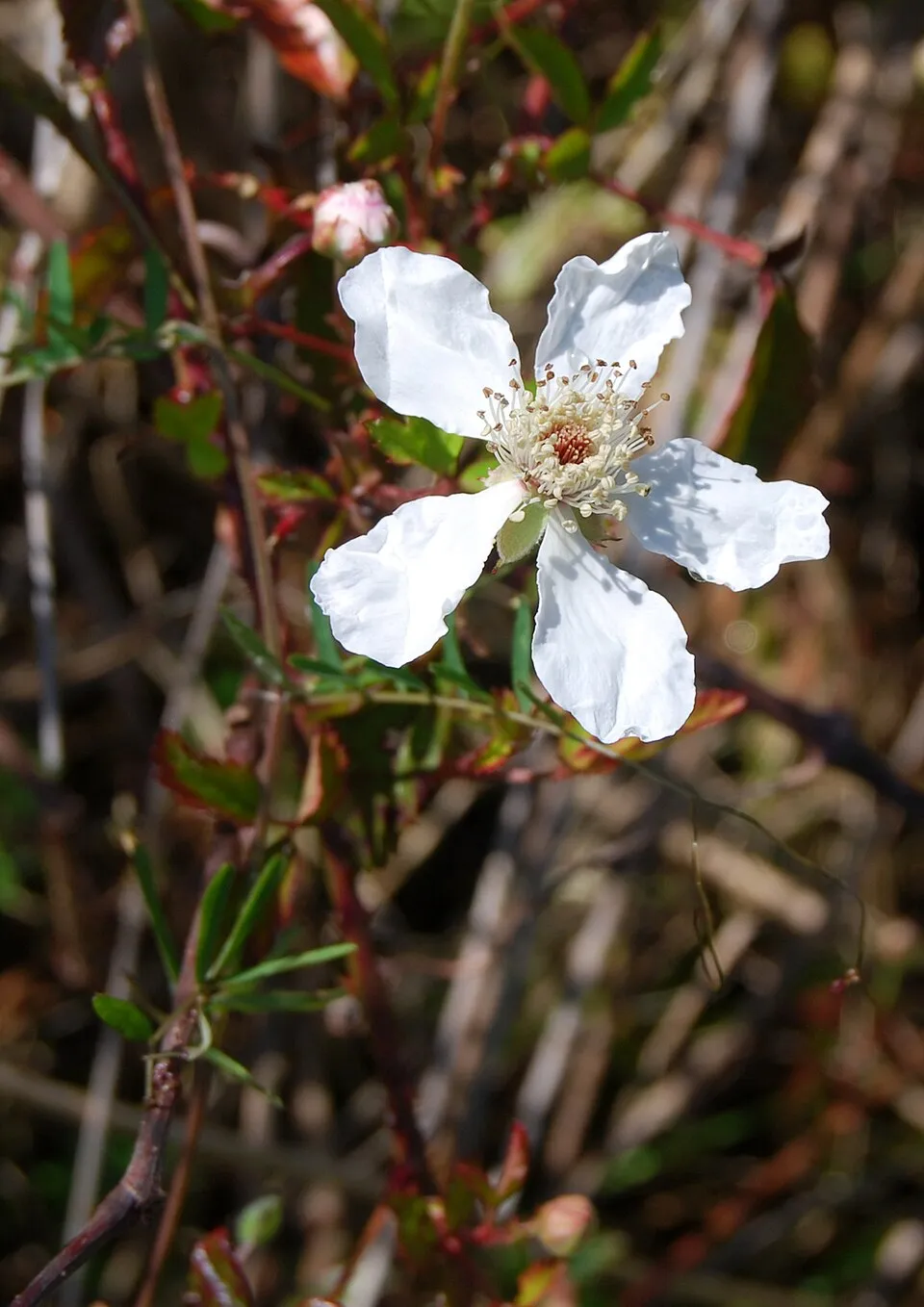
Dewberry flowers appear early — March through May in NE Oklahoma — often overlapping with the very first spring wildflowers. They are white to pale pink, five-petaled, 1–1½ in across, and borne singly or in small clusters of 2–4 on short axillary shoots arising from second-year canes. Each flower has numerous stamens and pistils (the typical Rosaceae pattern). Unlike many upright blackberries that bloom in conspicuous panicles, dewberry flowers are scattered individually along the trailing canes at ground level — they are easy to miss unless you are looking down. The fragrance is delicate and sweet, noticeable when you kneel near the plant.

Fruit & Distinguishing Features

The fruit is an aggregate of drupelets — the classic blackberry-type fruit — ¾–1¼ in long and slightly narrower, glossy black when fully ripe, with a small remnant of the flower (the receptacle) staying attached when you pick it (unlike a raspberry, which leaves the receptacle behind on the cane). The flavor is sweet, rich, and complex — often sweeter than the wild blackberries people are more familiar with, and lacking the musty quality that some Rubus species have. The ripening season in the Tulsa area runs roughly late April through May, making southern dewberry the earliest bramble fruit available — weeks before cultivated blackberries or wild black raspberries ripen.

Habitat & Range in NE Oklahoma

Rubus trivialis has a classic southeastern US distribution, with Oklahoma at the northwestern edge of its range. In NE Oklahoma, it is common and widely distributed in sunny roadsides, fencerows, field edges, railroad embankments, open post oak-blackjack woods, and any disturbed ground that receives at least a half-day of sun. It is one of those plants you see constantly once you recognize it — the low, reddish, prickly mats sprawling along the unmowed margins of county roads in Rogers, Mayes, Wagoner, and Tulsa counties.

The species thrives in the Cross Timbers ecoregion of NE Oklahoma, where its preferred habitat — partially open, partially shaded woodland edges on well-drained sandy or clay loam — is abundant. You will also find it on roadside cuts, pipeline easements, and old pasture margins throughout the region. Unlike some native brambles that require rich woodland soil, southern dewberry is a pioneer species that colonizes poor, compacted, and disturbed ground — the same scrappy sites where eastern redcedar and roughleaf dogwood move in. This tolerance of poor conditions is what makes it so useful for erosion control and tough-site plantings.

Ecology & Wildlife Value

[ early-season fruit · ground-level cover · pollinator support · Lepidoptera hosts ]

Early-Season Fruit: Birds & Mammals

Southern dewberry's late April–May ripening window makes it one of the very first soft fruits available each year in NE Oklahoma — arriving alongside serviceberry and red mulberry and well before summer fruit crops. The berries are eagerly consumed by Northern mockingbirds, brown thrashers, Eastern bluebirds, American robins, wild turkeys, bobwhite quail, gray catbirds, and several sparrow species. Mammals including raccoons, opossums, foxes, striped skunks, and white-tailed deer feed heavily on the ripe fruit. The low height of the fruit (at ground level rather than overhead) makes it particularly accessible to ground-foraging wildlife — quail and turkey poults can feed without flying.

Ground-Level Cover & Nesting

The dense, prickly mat of trailing canes creates exceptional protective cover at ground level. In NE Oklahoma's fragmented landscape, dewberry patches provide critical nesting and escape habitat for Northern bobwhite quail, cottontail rabbits, field sparrows, and various small rodents. The thorny tangle deters cats, coyotes, and other predators, while the open architecture of the low mat allows small birds and mammals to move freely beneath and within it. In a landscape increasingly dominated by close-mowed lawns and bare mulch beds, a dewberry thicket on the sunny edge of a property offers something genuinely scarce: wild, protective cover at the scale of a rabbit or a quail chick.

Pollinators & Insect Ecology

The early-season white flowers are pollinated by a range of early-flying bees, including mining bees (Andrena spp.), small carpenter bees (Ceratina), and honey bees, as well as flies, beetles, and early butterflies. The flowers provide nectar and pollen at a time when floral resources are still scarce in the landscape. As a native Rubus, the foliage hosts a wide variety of Lepidoptera and other insect larvae, contributing to the insect biomass that feeds nestling birds in spring and early summer.

Slope Stabilization

Southern dewberry is an outstanding plant for controlling erosion on sunny slopes and banks. The long trailing canes root at the tips, creating a network of living pins that hold soil in place. This tip-rooting habit, combined with a dense, fibrous root system, makes a mature dewberry mat effectively immune to sheet erosion from rainfall. On the steep road cuts, creek banks, and construction scars common to the Tulsa region's hilly terrain, dewberry can be established from transplants or rooted tip cuttings and will rapidly form a permanent, self-maintaining, self-expanding erosion mat that also happens to feed wildlife and people.

Horticulture & Care

[ site selection · planting · maintenance · harvest · companion planting · erosion control use ]

Site selection & planting

Southern dewberry is one of the easiest native plants to establish in NE Oklahoma — forgiving, fast-growing, and remarkably unfussy about soil. It wants sun and drainage and will handle the rest. The main horticultural consideration is location: dewberry is prickly and ground-hugging, so it should be planted where its low, thorny mat is an asset rather than a nuisance.

Maintenance & management

Harvest

Harvesting dewberries is a kneeling or stooping activity — the fruit is at ground level, and the canes are prickly. Wear long pants, closed shoes, and a long-sleeved shirt. Use a berry rake or a gentle hand to pull ripe fruit (glossy black, soft) from the receptacle. A productive patch yields roughly 1–2 quarts per 10 square feet over a 3–4 week harvest window. The berries are fragile and do not ship well — eat them fresh, freeze them immediately, or process them into jam, syrup, or wine within a day of picking. Birds will find the patch, and you will lose a share of the crop to them; as with all bramble fruit, plant enough for everyone.

Companion planting & food forest integration

Southern dewberry occupies the ground layer / living mulch layer of a food forest, forming a perennial, self-renewing understory beneath taller fruit and nut trees. Pairs well with: red mulberry and American persimmon (dewberry fills the ground layer beneath); Chickasaw plum and American plum in a mixed shrub layer with dewberry at the base; common sunflower and purple coneflower in adjacent sunny openings; and native bunchgrasses like little bluestem or prairie dropseed for a prairie-edge planting where dewberry rambles between the grass clumps. Dewberry will not climb trees or shrubs, so interplanting with taller species is straightforward.

Edible & Cultural Uses

Southern dewberry is, straightforwardly, one of the best-tasting wild fruits in eastern North America. The berries are large, sweet, and juicy, with a flavor that many people prefer to cultivated blackberries — richer, less acidic, with a deep, jammy sweetness. In the rural Ozark and Cross Timbers communities of NE Oklahoma, dewberry picking in May is a regional tradition passed through generations, and old-timers will argue fiercely about which roadside patch produces the best fruit.

The berry that grows itself. Unlike cultivated blackberries, which require trellising, annual pruning, and a dedicated fruit-garden infrastructure, southern dewberry asks only for a sunny, well-drained spot where its prickly sprawl is tolerated. Once established, it is a permanent, zero-maintenance fruit planting that needs nothing from you except a container and a willingness to brave the prickles in late spring. For the low-effort food forest, it is hard to beat.

Photo Reference

Ripe southern dewberry fruit — large, glossy black aggregate berries on trailing canes
// Ripe fruit — glossy black aggregate berries, late April–May
Wikimedia Commons
Wikimedia Commons
Southern dewberry flower — white to pale pink, 5-petaled, among trailing canes
// Flower — white to pale pink, 5 petals, March–May; among the earliest Rosaceae blooms
Wikimedia Commons
Wikimedia Commons
Southern dewberry trailing canes — reddish, prickly stems sprawling at ground level
// Canes — reddish, prickly trailing stems; 6–18 in tall, rooting at tips
Wikimedia Commons
Wikimedia Commons
Dense mat of southern dewberry in its typical roadside/field-edge habitat
// Habitat — dense low mat in sunny roadside, field edge, or open woods
Wikimedia Commons
Wikimedia Commons
Northern bobwhite quail in dewberry cover — ground-level wildlife habitat
// Wildlife cover — Northern bobwhite quail use dewberry mats for nesting and escape cover
Wikimedia Commons
Wikimedia Commons

Sources & Further Reading

  • USDA NRCS PLANTS Database — Rubus trivialis: plants.usda.gov/plant-profile/RUTR
  • Lady Bird Johnson Wildflower Center — Native Plant Database: wildflower.org — RUTR
  • Oklahoma Biological Survey — Rubus trivialis distribution records for eastern Oklahoma.
  • Tallamy, D.W. (2007). Bringing Nature Home. Timber Press — native Rubus as Lepidoptera host genus.
  • Fernald, M.L. (1950). Gray's Manual of Botany. 8th ed. American Book Company — original range descriptions for Rubus species.
  • Wikipedia — Rubus trivialis: en.wikipedia.org/wiki/Rubus_trivialis (CC BY-SA 4.0; portions of the description, ecology and uses sections summarize Wikipedia content).
  • Schooley, R.L. et al. (2010). Ground-level cover and bobwhite quail survival in agricultural landscapes. Journal of Wildlife Management — relevant to the ecological role of low bramble cover.

Hero photo: Rooted Revival. Strip photos courtesy of Wikimedia Commons contributors under their respective licenses (linked under each image).