// SPECIES PROFILE · VINE · NATIVE · WOODLAND EDGE
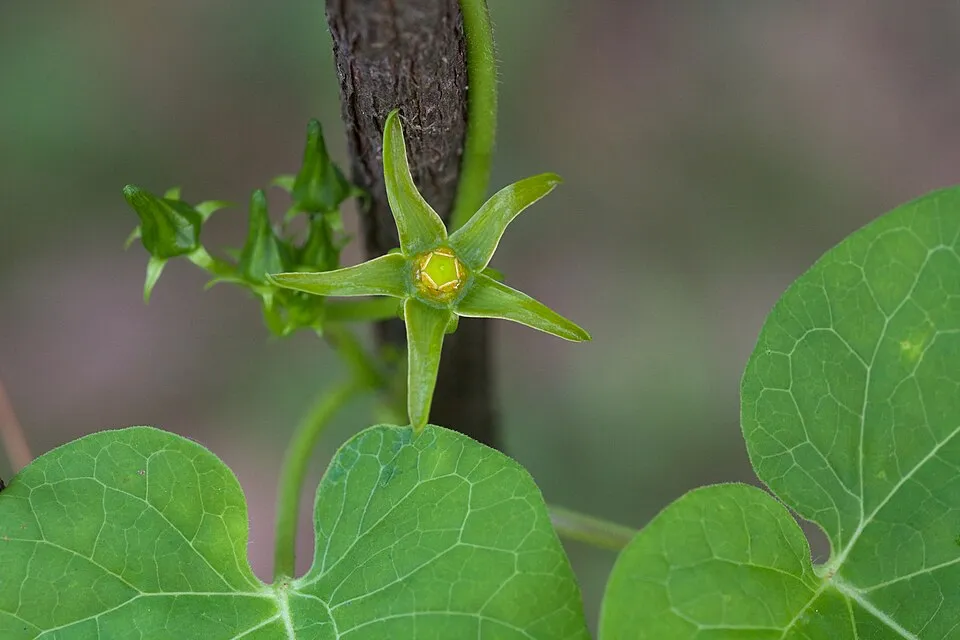
Angular-fruit Milkvine is one of the more unusual and underappreciated native vines in the NE Oklahoma flora — a twining, herbaceous plant in the milkweed subfamily (Asclepiadoideae) with heart-shaped leaves, star-shaped greenish-brown flowers with a peculiar central fleshy disk, and distinctive angular, warty seed pods that split to release tufted seeds. Matelea gonocarpos (formerly M. gonocarpa) is a close relative of milkweeds and shares their milky sap and chemical defenses, making it a larval host for milkweed tussock moths and other specialist insects that have evolved to handle the toxic cardenolides. In NE Oklahoma, it clambers through rich woods, thickets, and bottomlands in the eastern Cross Timbers and Ozark margins. This is not a vine for the formal garden — the flowers are subtle and strange rather than showy — but for the native plant enthusiast or ecological gardener, it is a fascinating and conversation- worthy addition to a woodland edge or shaded arbor.

Slender, twining, herbaceous perennial vine 6–12 ft, dying back to the ground each winter. Stems contain milky white latex when broken. The leaves are opposite, heart-shaped (cordate), 2–5 in long, with entire margins, smooth to slightly hairy surfaces, and long petioles. The foliage is soft and medium green.
The flowers are unlike anything else in the garden: five-petaled, star-shaped, greenish-brown to purplish-brown, about 1–1.5 in across, with a prominent central fleshy disk (corona) that is characteristic of the milkweed subfamily. The color and scent (sometimes described as fetid or mushroom-like) attract flies and beetles as primary pollinators. Blooms appear from May through July at the leaf axils.
The fruit pods are the most distinctive feature: angular, strongly ridged or warty follicles 3–5 in long, covered with soft, finger-like projections, splitting along one side to release tufted seeds with silky coma (like miniature milkweed fluff) that are wind-dispersed. The pods are pale green maturing to brown and persist on the vine into fall.
Matelea gonocarpos is found in rich, moist woods, bottomlands, thickets, and shaded stream banks in the eastern Cross Timbers and Ozark foothills of NE Oklahoma. It requires partial to full shade and consistently moist, well-drained woodland soil. It is uncommon in cultivation but worth seeking out from native plant nurseries.
As a member of the milkweed subfamily, Matelea contains cardiac glycosides (cardenolides) in its milky sap, making it toxic to most herbivores. Specialized insects that have evolved tolerance to these compounds, including the milkweed tussock moth (Euchaetes egle) and potentially monarch butterfly relatives, may use Matelea species as host plants. The plant also hosts milkweed bugs (Oncopeltus fasciatus) and oleander aphids (Aphis nerii), both specialized milkweed herbivores.
The unusual greenish-brown flowers with their central fleshy disk are adapted for fly and beetle pollination (sapromyophily) — the color and sometimes fetid scent mimic carrion or fungi to attract these pollinators. Small flies and nitidulid beetles are the primary visitors.
Milkvine needs partial to full shade and consistently moist, humus-rich, well-drained woodland soil. It is a natural for a shaded arbor, woodland garden, or the dappled shade under mature hardwoods. Provide a small trellis, shrub, or fence for the vine to climb.
Plant in a woodland garden alongside Spicebush, Wild Ginger, Maidenhair Fern, and Woodland Phlox for a layered woodland understory.