home/ plants/ leavenworths-sedge

// SPECIES PROFILE · GRASS · NATIVE · URBAN LANDSCAPE WORKHORSE

Leavenworth's Sedge

Carex leavenworthii

Leavenworth's Sedge is the sedge that thrives where everything else has given up — the dry, compacted, root-bound shade beneath old street trees in Tulsa's historic neighborhoods, the neglected fence rows behind mid-century commercial strips, the heavily shaded and perpetually dry strip between apartment buildings that hasn't seen a gardener in a decade. This is not a sedge of pristine natural areas; it is a sedge of urban disturbance, a species that has followed human settlement across the eastern United States, colonizing the kinds of marginal, degraded habitats that proliferate in the built environment. Carex leavenworthii forms dense, dark green tufts 6–18 inches tall that tolerate heat, drought, poor soil, and deep shade — conditions that would kill most other groundcover plants within a season. If your Tulsa landscape has one of those impossible dry-shade spots under mature trees where nothing grows, this is the sedge for it.

// QUICK FACTS
Family
Cyperaceae (sedge family)
Life cycle
Perennial, cool-season, densely caespitose
Native range
Eastern and central US — New York to Florida, west through the Ohio Valley, Ozarks, and eastern Great Plains; broadly distributed in Oklahoma
USDA hardiness
Zones 4–9 (Tulsa = 7a/7b; well within optimal range)
Mature size
6–18 in tall × 8–12 in wide, forming dense, compact tufts
Bloom
April – May (NE OK)
Flower / fruit
Inconspicuous green spikelets; perigynia 3–4 mm, prominently nerved, with a distinct elongated beak
Sun
Part shade to full shade; tolerates dappled sun; leaves may scorch in direct afternoon sun
Soil
Extremely adaptable — tolerates dry, compacted, nutrient-poor soils; grows in clay, loam, sandy loam, and even degraded urban fill
Water
Dry to medium; exceptionally drought-tolerant once established — one of the most xeric-tolerant sedges available
Wildlife
Satyrid butterfly host · songbird seed · urban pollinator refuge
Conservation status
G5 — Secure globally; common in disturbed habitats across NE Oklahoma
Leavenworth's Sedge (Carex leavenworthii) — dense dark green tufts in dry urban shade under mature trees
Carex leavenworthii thriving in deep, dry shade — the urban landscape workhorse among native sedges. Photo: Rooted Revival.

Identification

[ field key — habit · leaf · inflorescence · distinguishing features ]

Habit & Growth Form

Densely caespitose (clump-forming) with fibrous roots and very short rhizomes, producing compact, dark green, bristly-looking tufts. Individual clumps are 8–12 inches in diameter and maintain a tidy, tight form throughout the growing season — more compact and less arching than most woodland sedges. The species name honors Melines Conklin Leavenworth (1796–1862), a US Army surgeon and botanist who collected extensively in the southeastern United States and contributed early specimens of this and many other species to American herbaria. Individual clumps persist for 3–5 years and are replaced by self-sown seedlings.

Foliage

Leaves are 2–5 mm wide, flat, and dark green, with a somewhat stiff, erect to slightly arching habit. The blades are finer and darker than those of Carex blanda, and the overall tuft has a denser, more compact appearance. Basal sheaths are brown and fibrous. Foliage is fully deciduous in NE Oklahoma, dying back after the first hard freeze and remaining dormant through winter. The compact, dense tufts are notably resistant to lodging (flopping over) even in the deepest shade, a useful characteristic in the landscape where loose, floppy plants appear unkempt.

Inflorescence & Fruit

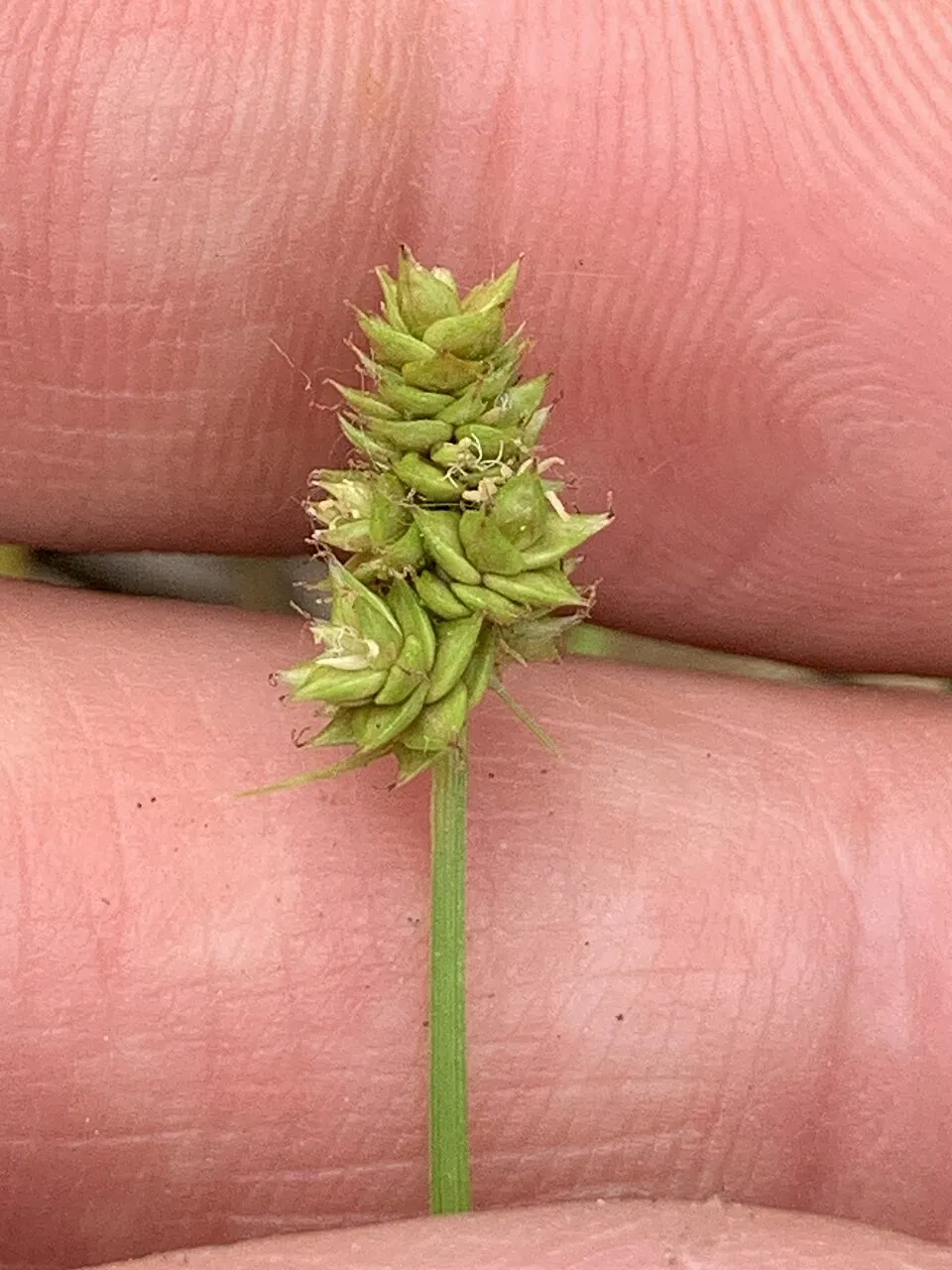
The inflorescence is compact and held within or slightly above the foliage. The terminal spike is staminate (male), slender, and 5–15 mm long. Below are 2–4 pistillate spikes, tightly clustered and sessile or nearly so, 5–10 mm long. The perigynia are 3–4 mm, obovoid, and prominently many-nerved on both faces, tapering to a distinct, elongated beak that is conspicuously toothed at the tip. The beak can be as long as or longer than the body of the perigynium — a diagnostic feature that reliably separates C. leavenworthii from other dry-habitat sedges. Pistillate scales are hyaline with a green midrib, shorter than the perigynia.

Distinguishing Features

In NE Oklahoma, Carex leavenworthii is most often confused with C. blanda (Eastern Woodland Sedge), which occupies similar dry woodland habitats. Key differences: C. leavenworthii forms denser, darker green, more compact tufts; its perigynia are more prominently nerved with a longer beak that is usually toothed; and it shows a stronger affinity for disturbed, urban, and anthropogenic habitats. It may also be confused with C. cephalophora (Oval-headed Sedge), which has an even more compact, head-like inflorescence. The distinction from C. blanda is the most practically important, as the two often grow side by side in the same urban woodlands.

Habitat & Range in NE Oklahoma

Carex leavenworthii occupies a distinctive ecological niche that distinguishes it from every other sedge described in this guide: it is a species of anthropogenic habitats — dry woods, fence rows, old cemeteries, neglected city lots, the compacted soil beneath street trees, and the shaded margins of parking lots and buildings. In NE Oklahoma, it is particularly common in Tulsa's older neighborhoods (Maple Ridge, Swan Lake, Brady Heights, Owen Park) where mature oaks and elms cast deep, dry shade over lawns that were established 50–100 years ago. It also occurs in rural cemeteries, along old fence lines bordering pastures, and in the unmanaged woodland fragments that persist between subdivisions.

Unlike other woodland sedges that require relatively intact forest habitats, C. leavenworthii has benefited from human land use. The creation of open, partially shaded, periodically disturbed habitats — exactly the conditions produced by suburban and urban development — has expanded the available habitat for this species. Its presence in a Tulsa backyard is as natural as the post oak towering overhead; it is simply one of the native species that has adapted to the altered conditions of the built environment rather than retreating from them.

Ecology & Wildlife Value

[ urban refuge · satyrid host · seed foragers · anthropic adaptation ]

Birds & Urban Wildlife

The seeds of C. leavenworthii are consumed by ground-feeding songbirds including northern cardinals, song sparrows, and dark-eyed juncos. In the urban and suburban landscapes where this sedge is most common, it provides valuable forage and cover for birds that have adapted to human-dominated environments. The dense tufts harbor insects and spiders that form the base of the food web for Carolina chickadees, tufted titmice, and Carolina wrens — all common in Tulsa's older neighborhoods.

Lepidoptera Host

Like other Carex species, C. leavenworthii is a larval host for satyr butterflies. The northern pearly-eye (Lethe anthedon) and little wood-satyr (Megisto cymela) are documented users of sedges in urban and suburban woodlands. The Carolina satyr (Hermeuptychia sosybius), a small, inconspicuous brown butterfly of woodland edges and clearings, is increasingly common in Tulsa and likely uses this sedge as a host. Several species of skipper butterflies (Hesperiinae) may also use it.

Small Mammals & Invertebrates

Eastern chipmunks and white-footed mice consume the seeds. During the growing season, the dense foliage provides thermal refuge and overwintering habitat for ground-dwelling arthropods, including spiders, ground beetles, and millipedes. In urban environments where ground-level invertebrate habitat is limited by paving, turfgrass, and compacted soils, native sedge clumps serve as small but significant refugia for the urban arthropod community that supports higher trophic levels.

Urban Ecology & Anthropic Adaptation

Carex leavenworthii is an important example of a native species that has adapted to anthropogenic disturbance rather than being displaced by it. This adaptability makes it an ideal species for urban ecological restoration — creating functional native plant communities in the built environment where soil compaction, shade, and neglect have eliminated most other natives. The concept of "reconciliation ecology" — designing human-dominated landscapes to support biodiversity — depends on species like C. leavenworthii that can thrive under urban conditions without intensive management.

Horticulture & Care

[ impossible dry shade · urban landscape · minimal maintenance · self-sows ]

Site selection

Leavenworth's Sedge is the solution for the worst spots in your landscape: the dry, compacted shade beneath mature street trees, the narrow side yard between buildings that never sees sun, the forgotten strip behind the garage. It is not picky. Any site that receives dappled to full shade and has soil of any texture, fertility level, or degree of compaction will likely support this sedge. It also performs well in containers in shaded courtyards and on covered patios, where its compact form and drought tolerance make it a low-maintenance choice for potted arrangements.

Planting & establishment

Plant container-grown stock in spring (March–April) or fall (September–October). Water weekly during the first growing season to establish roots. After the first year, supplemental irrigation is unnecessary except during extreme drought. This is one of the few sedges that can be planted directly into unamended urban fill soil without compost or soil preparation — though a handful of organic matter in the planting hole will always accelerate establishment.

Maintenance

Cut back dead foliage in late winter. Otherwise, no maintenance is required. The species self-sows freely in the garden, a trait that can be either welcome (free plants filling in bare spots) or requiring management (seedlings appearing in unintended locations). If self-sowing is undesirable, cut off the flowering culms before the perigynia mature in late May. The species is notably free of pests and diseases.

Companion plants for urban dry shade

In the challenging conditions where C. leavenworthii excels, few other native plants survive without significant soil amendment and irrigation. Compatible companions in the better portions of the site (slightly more light or moisture) include Christmas fern, coralberry, and American alumroot. In slightly brighter conditions under open-canopy trees, pair with wild columbine and spiderwort for spring interest.

Landscape uses

Finding it already growing in your yard: Many Tulsa homeowners already have C. leavenworthii growing in their yards without knowing it — it is frequently mistaken for a clump of coarse grass or an unwanted weed and removed. Before you attack that "weed grass" growing in the dry shade under your oak tree, take a closer look. If it forms a dense, dark green tuft with narrow leaves and is thriving where everything else has died, it may well be Leavenworth's Sedge. Protect existing populations, divide them to expand the planting, and consider mowing around rather than through the clumps.

Cultural Uses & Ethnobotany

No specific ethnobotanical uses are recorded for Carex leavenworthii. The species' leaves are relatively narrow and less suitable for basketry than broad-leaved sedges. Its primary cultural significance is as a native plant adapted to urban environments — a living example that ecological function can persist in the built landscape when we choose to recognize and protect the species that have adapted alongside us.

The species was named by Liberty Hyde Bailey (1858–1954), the great American horticulturist and botanist who monographed the North American Carex in the late 19th century. Bailey named dozens of sedge species and laid the taxonomic groundwork for modern Carex classification.

Photo Reference

Carex leavenworthii dense tuft in urban dry shade
// Habit — compact, dense, dark green tufts in urban understory
Wikimedia Commons
Wikimedia Commons
Carex leavenworthii leaf detail showing dark green stiff blades
// Foliage — dark green, stiff, narrower than C. blanda
Wikimedia Commons
Wikimedia Commons
Carex leavenworthii inflorescence with prominently nerved perigynia and long beak
// Inflorescence — compact, with perigynia bearing conspicuously long toothed beak
Wikimedia Commons
Wikimedia Commons
Macro detail of Carex leavenworthii perigynia with elongated beak
// Perigynia — prominently nerved with long toothed beak, diagnostic
Wikimedia Commons
Wikimedia Commons
Carex leavenworthii thriving in heavily shaded urban side yard
// Urban habitat — thriving in deep dry shade between buildings in Tulsa
Wikimedia Commons
Wikimedia Commons

Sources & Further Reading

  • USDA NRCS PLANTS Database — Carex leavenworthii: plants.usda.gov/plant-profile/CALE14
  • Lady Bird Johnson Wildflower Center: wildflower.org/plants/result.php?id_plant=CALE14
  • Weakley, A.S. (2022). Flora of the Southeastern United States. UNC Herbarium.
  • Ball, P.W. & Reznicek, A.A. (2002). Carex sect. Phaestoglochin. In: Flora of North America, Vol. 23. Oxford University Press.
  • Yatskievych, G. (1999). Steyermark's Flora of Missouri, Vol. 1. Missouri Dept. of Conservation.
  • Rosenzweig, M.L. (2003). Win-Win Ecology: How the Earth's Species Can Survive in the Midst of Human Enterprise. Oxford University Press.
  • Tallamy, D.W. (2007). Bringing Nature Home. Timber Press.
  • Wikipedia — Carex leavenworthii: en.wikipedia.org/wiki/Carex_leavenworthii

Hero photo: Rooted Revival. Strip photos via Wikimedia Commons under respective licenses.