home/ plants/ interrupted-fern

// SPECIES PROFILE · PERENNIAL · NATIVE · FERN · LIVING FOSSIL

Interrupted Fern

Osmunda claytoniana

There is a quiet awe that comes from standing before a plant whose ancestors were photosynthesizing in the Triassic, roughly 210 million years ago, when the first dinosaurs were still figuring out how to walk on two legs and flowering plants had not yet evolved. Osmunda claytoniana is that plant. The interrupted fern is a member of the Osmundaceae, one of the oldest surviving fern families on Earth, and the fossil record shows essentially the same plant growing in what is now Antarctica, South America, and Eurasia when the continents were still assembled as Pangaea. In the living flora of northeastern Oklahoma, it is a stately vase-shaped fern with fronds that can reach 4–5 feet tall in a good location, distinguished by the peculiar trait that gives the species its common name: in the middle of some fronds, the regular green pinnae are "interrupted" by a section of fertile, spore-bearing pinnae that shrivel and fall away after releasing their spores in mid-summer, leaving a conspicuous bare gap in the frond. It is a plant that carries the memory of deep time in the architecture of its leaves, and it grows, largely unnoticed, in the moist, acidic woods of the Ozark foothills in Adair and Cherokee counties.

// QUICK FACTS
Family
Osmundaceae (royal fern family)
Life cycle
Deciduous perennial fern; emerges each spring from a stout, woody rhizome
Native range
Eastern N. America — Newfoundland to Georgia, west to Manitoba, E. Oklahoma, and E. Texas; also native to E. Asia (Himalayas, China, Japan)
USDA hardiness
Zones 3–8 (Tulsa = 7a/7b)
Mature size
2–5 ft tall, 2–3 ft wide; forms a dense, vase-shaped clump over many years
Sporulation
Fertile pinnae appear in the middle of the frond late May–June, turning cinnamon-brown, then shrivel and fall away by mid-summer
Sun
Part shade to full shade; tolerates morning sun if soil is moist
Soil
Moist, acidic, humus-rich woods soil; pH 4.5–6.5; does not tolerate alkaline or dry soils
Water
Medium to high; requires consistent moisture; wilts dramatically in drought
Longevity
Extremely long-lived; individual clumps can persist for a century or more
Fossil record
Recognizable Osmunda fossils date to the Late Triassic (~210 mya)
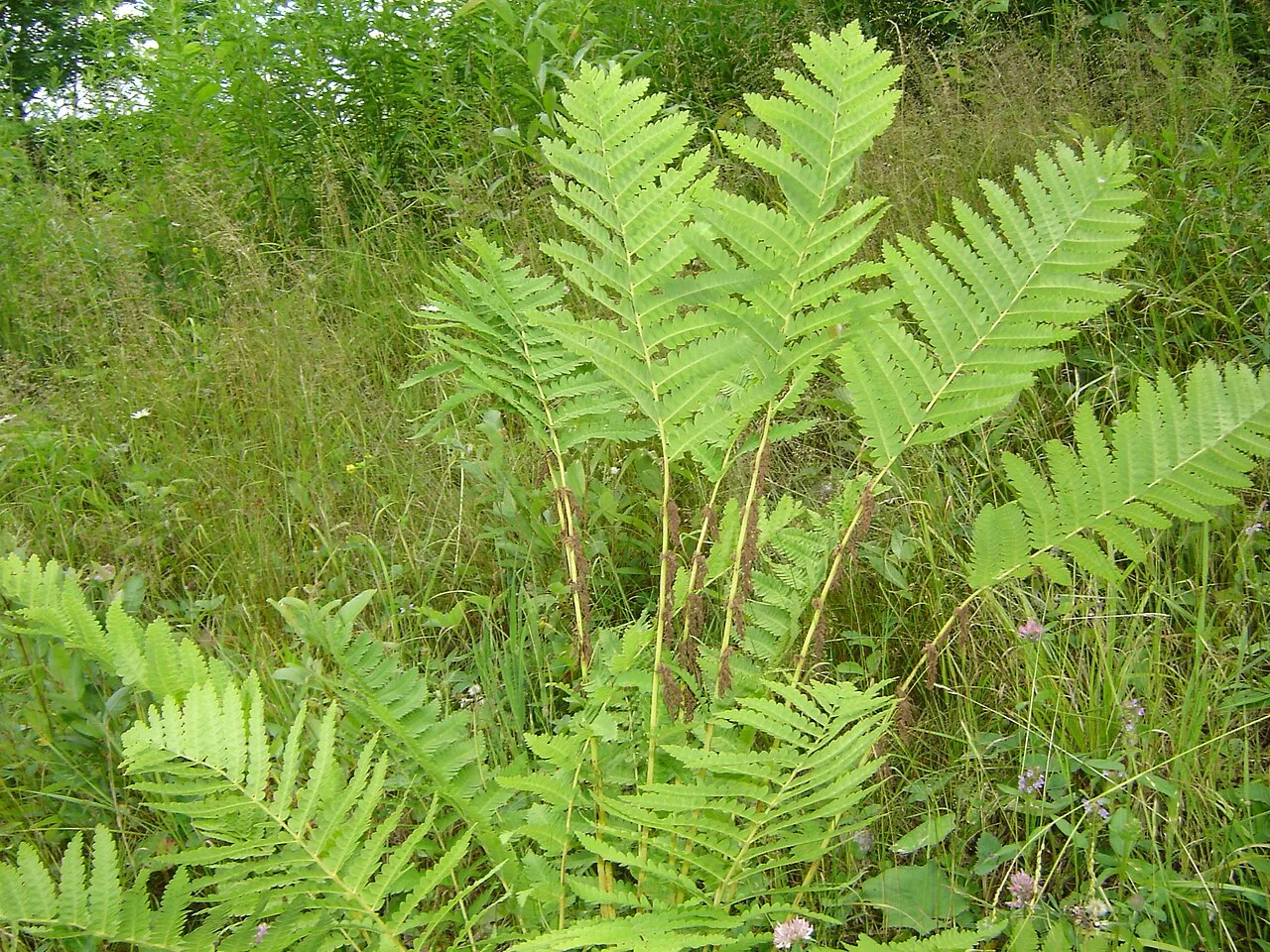
Interrupted Fern (Osmunda claytoniana) showing a tall frond with brown fertile pinnae interrupting the green sterile pinnae in the middle
Osmunda claytoniana — the cinnamon-brown fertile pinnae "interrupt" the green frond in the middle. Photo: Rooted Revival.

Identification

[ field key — frond · fertile interruption · fiddlehead · distinction from cinnamon fern · Osmundaceae features ]

Frond Architecture & Habit

The fronds of Osmunda claytoniana are once-compound (pinnate), with 15–25 pairs of deeply cut (pinnatifid) pinnae that are broadly lance-shaped, 2–4 in long, with entire to slightly toothed margins. Unlike many ferns that produce a loose cluster of individual fronds from a creeping rhizome, interrupted fern grows from a stout, erect, woody rhizome that resembles a small tree stump over decades of growth — functionally a short trunk. The fronds emerge in a tight vase-like rosette from the top of this rhizome, giving the plant the architectural presence of a small shrub. The stipe (frond stalk) is thick, succulent, and green to reddish- brown at the base, noticeably flattened and channeled on the upper side. The overall shape is a fountain arising from a central point, with the oldest fronds arching outward and the youngest standing upright in the center.

The "Interruption" — Fertile Pinnae

This is the one field mark you need. On a portion of the fronds (typically the larger, more robust ones), 2–5 pairs of fertile pinnae develop in the middle third of the frond, replacing the green sterile pinnae that would otherwise occupy those positions. The fertile pinnae are shorter, narrower, and covered entirely with sporangia, turning from green to a rich cinnamon-brown as the spores mature in late May through June. After the spores are released, these pinnae shrivel, turn black, and drop off, leaving a bare gap in the middle of the frond — the "interruption" — with normal green pinnae above and below the gap. The fronds that produce fertile pinnae are the same fronds that carry on photosynthesis above and below the fertile section; the plant does not produce separate sterile and fertile fronds like the sensitive fern or cinnamon fern.

Fiddleheads

The emerging fiddleheads of interrupted fern are among the most handsome in the eastern flora: stout, silvery-woolly, and densely covered with a pale, fleecy pubescence that gives them the look of being dusted with frost. As the crozier unfurls, the woolly hairs persist on the rachis and the base of the pinnae, gradually thinning through the season but usually still visible on the lower stem into summer. This pubescence sets Osmunda fiddleheads apart from the smooth, glabrous croziers of the lady fern, wood ferns, and most other common Oklahoma woodland ferns. The fiddleheads are also larger and thicker than those of almost any other fern in the region except the related cinnamon fern (Osmundastrum cinnamomeum).

Distinction from Cinnamon Fern

Cinnamon fern (Osmundastrum cinnamomeum) is the most common look-alike in NE Oklahoma, and the two species frequently grow side by side in the same moist woods. The key differences: Fertile structures — Cinnamon fern produces separate, entirely fertile fronds that are shorter, narrower, and completely covered in cinnamon-colored sporangia (no green tissue at all), while interrupted fern's fertile pinnae are embedded in otherwise green fronds. Frond shape — Cinnamon fern pinnae are typically fully divided to the midrib (pinnatifid) with a tuft of hairs at the base of each pinna on the underside; interrupted fern pinnae are less deeply cut. Wooliness — Both species' fiddleheads are woolly, but cinnamon fern's wool is often rufous (rusty-brown) while interrupted fern's is paler, more silvery- white. Habitat overlap — Both occur in wet woods, but cinnamon fern is more strictly a wetland species, often growing with its feet in standing water, while interrupted fern tolerates slightly drier, better- drained slopes.

Habitat & Range in NE Oklahoma

Osmunda claytoniana is at the southwestern limit of its range in eastern Oklahoma, where it is restricted to the coolest, most mesic microhabitats of the Ozark foothills and the eastern edge of the Boston Mountains. It is primarily a species of moist, acidic, north-facing wooded slopes and sandstone-shale ravines in Adair, Cherokee, Sequoyah, and far eastern Delaware and Mayes counties. The underlying geology matters: interrupted fern is strongly associated with acidic substrates derived from sandstone and cherty residuum, the weathered remnants of the Boone and St. Joe limestone formations that produce acid- leaching soils in the Ozark dome. You will not find it on the calcareous prairie soils of western Tulsa County or on the limestone-rich clay of the Osage Hills.

Look for it on the cool, moist, lower slopes and ravines of the Cookson Hills and the J.T. Nickel Family Nature and Wildlife Preserve, where rich deciduous canopy of oaks, hickories, and sugar maple maintains the shaded, humid conditions the fern requires. Good populations also exist in the upper reaches of the Illinois River and Baron Fork watersheds, particularly in those drainages where the stream gradient is steep enough to create perennial seepage on the adjacent slopes. The species is uncommon even in suitable habitat within Oklahoma — you are more likely to encounter the related cinnamon fern, which has a broader ecological tolerance in the state — and it is a species of conservation concern at the southwestern edge of its range. Protecting mature Ozark woodland fragments from clearing and overbrowsing by deer is critical to maintaining the Oklahoma populations.

Ecology & Wildlife Value

[ Triassic lineage · specialist insects · mammal browse · soil acidification · ancient reproductive biology ]

Living Fossil Context

The Osmundaceae are the most ancient surviving lineage of leptosporangiate ferns (the group that includes nearly all living ferns), with fossil evidence extending continuously from the Late Permian (~260 mya) through the present day. Osmunda claytoniana itself is recognizable in the fossil record from the mid-Triassic onward, with virtually identical fertile pinnae preserved in the Triassic Molteno Formation of South Africa and the Jurassic of Yorkshire, England. The species exhibits morphological stasis — the remarkable phenomenon of a biological form remaining essentially unchanged across tens of millions of years because it is already well-adapted to a stable ecological niche. What this means in a NE Oklahoma context: when you find an interrupted fern in an Adair County ravine, you are looking at a plant that is structurally indistinguishable from the ferns that formed the understory of Triassic forests along with cycads, ginkgos, and early conifers.

Invertebrate Associations

Osmundaceous ferns host a specialized guild of associated insects. The Osmunda borer moth (Papaipema speciosissima) is a stem-boring noctuid whose larvae tunnel into the thick stipes and rhizomes of Osmunda species. Several sawflies (Symphyta) feed on the foliage. The dense, fibrous rhizome mass provides habitat for a rich community of millipedes, isopods, springtails, and soil mites — the detritivore community that drives decomposition in acidic forest soils. The thick, slowly decomposing frond litter contributes to the development of a distinctive acidic organic horizon that shapes the soil chemistry of the site and facilitates the growth of ericaceous shrubs and other acid-loving species in the same microhabitat.

Birds & Mammals

The food value of interrupted fern to vertebrates is minimal. White-tailed deer browse the young fiddleheads in early spring, and heavy deer pressure can suppress colony expansion in small populations — an issue in the Ozark foothills, where deer density is high. The stout, woody rhizomes are occasionally dug and consumed by feral hogs in the eastern Oklahoma woods, causing significant damage to individual plants. The dense, moist clumps provide cover for small woodland salamanders (particularly the many-ribbed and slimy salamanders, Plethodon spp.) that move through the litter between the rhizome crown and the surrounding soil. During the spring migration, ovenbirds and other ground-foraging warblers hunt arthropods among the emerging fronds.

Reproductive Ecology

The interrupted fern's reproductive strategy is distinctly ancient. The sporangia are large and thick-walled (a primitive character; more derived ferns have smaller, thin-walled sporangia), arranged in clusters (sori) that cover the underside of the fertile pinnae. Each sporangium produces hundreds of green, short-lived spores that require moist, bare mineral soil to germinate and establish a gametophyte. The gametophyte stage is a small, heart-shaped, photosynthetic thallus that lives on the surface of wet soil — a life-history phase that ties the species to sites with persistent surface moisture and exposed soil, such as the vertical faces of stream cuts, the upturned root masses of fallen trees, and the saturated moss mats at seepage heads. In the heavily littered forest floor of a stable Oklahoma woodland, successful spore germination and gametophyte establishment are rare events, which may partly explain the species' slow colonization rate and its restriction to geologically stable, long-undisturbed sites.

The philosophical gardener: When you plant an interrupted fern, you are installing an organism whose body plan was finalized before the Atlantic Ocean existed, before the Rocky Mountains rose, and roughly 80 million years before Tyrannosaurus rex. There are not many garden plants that genuinely bridge the Mesozoic and the Anthropocene. The interrupted fern does that, with no fuss and no demands beyond moist, acidic soil and dappled shade. It is one of the few plants you can look at and think, with scientific justification: this is what a forest floor looked like when the dinosaurs were new.

Horticulture & Care

[ soil pH · moisture · establishment · companion planting · patience ]

Site selection & planting

The interrupted fern is not a plant for every garden, and in the Tulsa region it demands careful site selection. The non-negotiable requirements are acidic soil (pH 4.5–6.5), consistent moisture, and dappled to full shade. The soil must be deep, loose, and high in organic matter — the fern's thick, woody rhizome needs room to expand downward and outward over decades. Heavy, compacted red clay must be deeply amended: work in at least 6 in of composted pine bark, leaf mold, and acid peat moss to a depth of 18 in before planting. A site on a north-facing slope or at the base of a shaded retaining wall is ideal; a flat, low-lying area that holds moisture after rain is also suitable if the drainage is not so poor that the crown sits in stagnant water during winter.

Establishment patience

Interrupted fern is slow to establish and slow to reach its full stature. A newly planted specimen may produce only 2–3 fronds its first year, and those fronds may be only 12–18 in tall — do not be discouraged. The plant is building a rhizome system that will support a much larger crown in 3–5 years. A mature, well-sited interrupted fern with a rhizome crown the size of a dinner plate and 15–20 fronds 4–5 ft tall is a decade-plus investment. This is a fern you plant for the garden you will have in 2035, not the garden you want next summer. The reward is a genuinely spectacular, dinosaur-era specimen that becomes a conversation piece and a personal landmark in the landscape.

Companion planting

Interrupted fern pairs superbly with other acid-loving, moisture-tolerant woodland plants. Natural companions in the Ozark foothills that translate well to the garden include: wild ginger (Asarum canadense) as a low, evergreen ground layer beneath the tall fronds, true Solomon's seal (Polygonatum biflorum) and False Solomon's Seal (Maianthemum racemosum) for arching foliage at mid-height, maidenhair fern (Adiantum pedatum) for delicate textural contrast with the coarse interrupted fern fronds, Christmas fern (Polystichum acrostichoides) for winter evergreen structure when the interrupted fern is dormant, and spicebush (Lindera benzoin) as a shrub-layer companion that shares the fern's preference for moist, acidic woods. Plant the fern on the north side of an eastern redbud (Cercis canadensis) or downy serviceberry (Amelanchier arborea) to provide the high, dappled canopy that the fern naturally grows beneath.

Edible & Cultural Uses

The emerging fiddleheads of Osmunda claytoniana have been harvested as a spring wild food in parts of the species' range, particularly in Appalachia and the Ozarks. The thick, succulent croziers are collected when 6–10 in tall and still tightly coiled, with the woolly covering removed by rubbing and washing. They are then boiled in at least two changes of water to remove bitterness and the trace amounts of thiaminase common to many ferns. The flavor is described as similar to asparagus with a slight nuttiness, and the texture is tender-crisp when properly cooked. They can be served with butter and salt as a vegetable side or pickled. However, the fiddleheads of the ostrich fern (Matteuccia struthiopteris) are the more widely recognized and safer edible fern, and foragers unfamiliar with fern identification should start with that species rather than risking confusion among Osmunda species.

In Cherokee ethnobotany, the root of Osmunda species was used in a fiber form — the dense, black, wiry root mass surrounding the rhizome (the "osmunda fiber") was traditionally employed as a potting medium for orchids and epiphytes in 19th-century horticulture, a use that led to extensive commercial harvesting of wild Osmunda populations across the Southeast and Appalachians through the early 20th century until synthetic substitutes became available. The genus name Osmunda may derive from the Anglo-Saxon title "Osmund," a name for the god Thor, or possibly from the Latin os mundare ("to clean the mouth"), a reference to the use of osmunda fiber as a tooth-cleansing material in some folk traditions.

Photo Reference

Fertile pinnae of Osmunda claytoniana in the middle of a green frond, turning cinnamon-brown
// Fertile pinnae — the diagnostic "interruption" mid-frond, sporangia turning brown in June
Wikimedia Commons
Wikimedia Commons
Woolly, silvery fiddlehead of Osmunda claytoniana emerging in early spring
// Fiddlehead — the stout, silvery-woolly crozier emerging in April
Wikimedia Commons
Wikimedia Commons
Mature vase-shaped clump of Osmunda claytoniana in a moist woodland setting
// Habit — the vase-shaped clump of a mature specimen, fronds 3–5 ft tall
Wikimedia Commons
Wikimedia Commons
Close-up of the sporangia clusters on the underside of a fertile pinna of Osmunda claytoniana
// Sporangia detail — thick-walled, primitive sporangia covering the fertile pinna
Wikimedia Commons
Wikimedia Commons

Sources & Further Reading

  • USDA NRCS PLANTS Database — Osmunda claytoniana: plants.usda.gov/plant-profile/OSCL2
  • Lady Bird Johnson Wildflower Center — Native Plant Database: wildflower.org — OSCL2
  • Flora of North America — Osmundaceae (Vol. 2): efloras.org
  • Smith, A.R. et al. (2006). A classification for extant ferns. Taxon 55(3):705–731.
  • Phipps, C.J. et al. (1998). Osmunda (Osmundaceae) from the Triassic of Antarctica: An example of evolutionary stasis. American Journal of Botany 85(6):888–895 — the definitive paper on morphological stasis in the genus.
  • Moran, R.C. (2004). A Natural History of Ferns. Timber Press — excellent accessible treatment of fern biology and the Osmundaceae.
  • Wikipedia — Osmunda claytoniana: en.wikipedia.org/wiki/Osmunda_claytoniana (CC BY-SA 4.0; portions of the description, ecology and uses sections summarize Wikipedia content).
  • Oklahoma Biological Survey — Atlas of Oklahoma Flora: biosurvey.ou.edu

Hero photo: Rooted Revival. Strip photos courtesy of Wikimedia Commons contributors under their respective licenses (linked under each image).