// SPECIES PROFILE · SHRUB · NATIVE · OZARK NATIVE
American Bladdernut is an understated but unmistakable shrub of the eastern woodland understory, named for its large, inflated, papery seed pods that hang from the branches like pale green lanterns in summer and persist as brown, rattling husks through winter. The three-parted leaves, nodding clusters of white bell-shaped spring flowers, and distinctive bladder- like fruit make this an easy shrub to identify and a genuinely unusual addition to a native plant garden. Staphylea trifolia is a plant of moist, rich woods and stream banks, ranging from Quebec to Florida and westward into the Ozark foothills of eastern Oklahoma, where it grows as an upright, sometimes suckering shrub or small tree reaching 8–15 ft. It is not a bold, showy plant — the flowers are delicate rather than dramatic, the fruit curious rather than colorful — but it rewards close inspection and fills a niche in the understory that nothing else quite occupies. For the woodland gardener looking for a subtle, native shrub with genuine four-season interest, bladdernut is a choice worth making.

[ field key — leaf · flower · fruit · bark · habit ]
An upright, often suckering deciduous shrub or small tree with a rounded crown, typically 8–15 ft tall. The bark is smooth and greenish to gray-brown with distinctive white streaks or stripes on young branches (similar to striped maple). Older stems become gray-brown with shallow fissures. The species spreads by suckering to form loose colonies over time, but it is not aggressively colonial.
Opposite, trifoliate (three-parted — the species name trifolia means "three leaves"), reminiscent of a three-leaf clover. Each leaflet is elliptic to ovate, 2–4 in long, with a finely toothed margin and a short stalk. The upper surface is dark green and smooth; the underside is paler. Fall color is a pale yellow, not showy. The trifoliate leaves are a reliable identification character; few other shrubs in our region have opposite, compound leaves with exactly three leaflets.
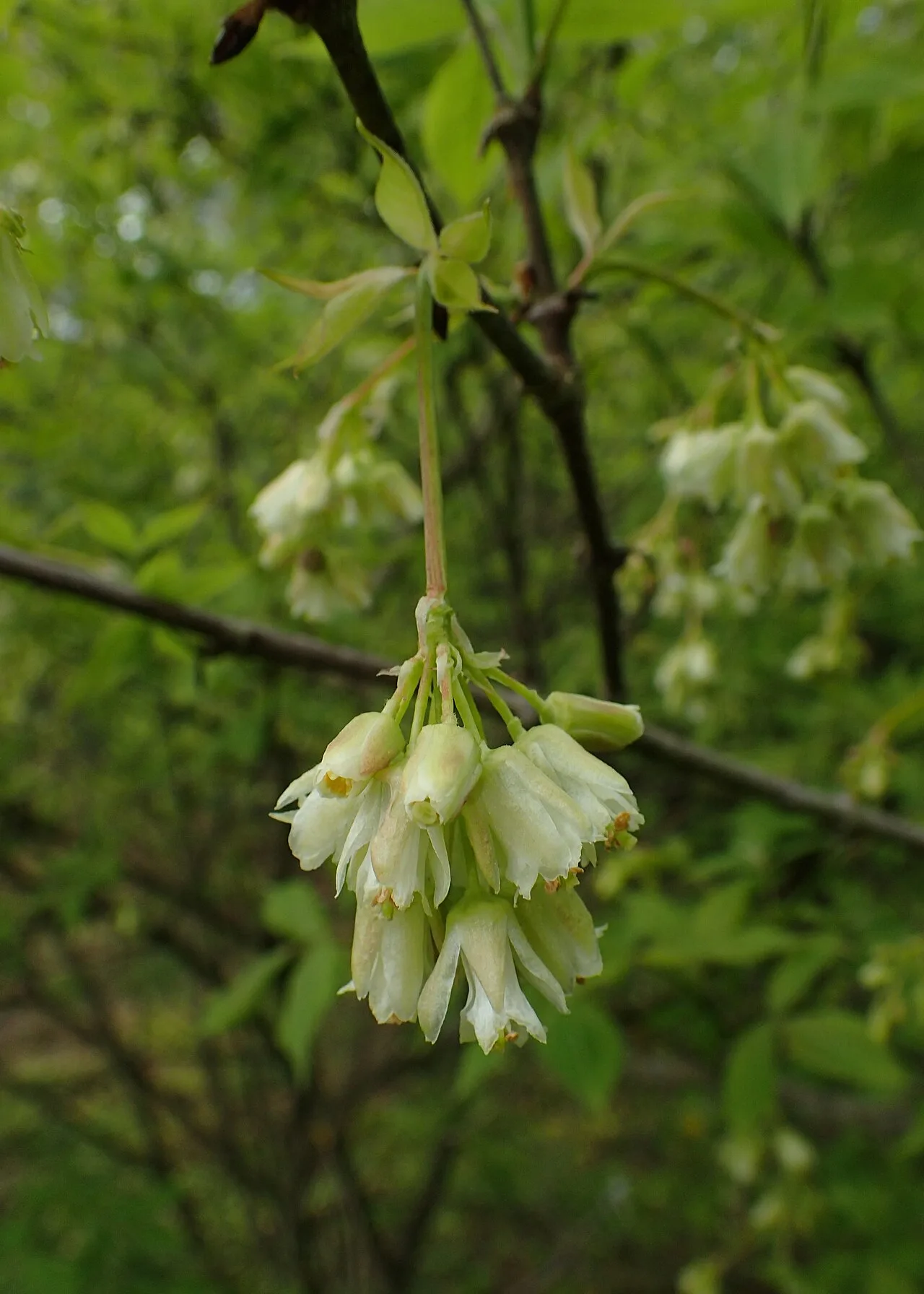
Flowers appear in pendulous, nodding clusters (panicles) 2–3 in long at the branch tips in spring (April–May). Individual flowers are white to greenish-white, bell-shaped, about 1⁄3 in long, with five petals, prominent stamens, and a mild, pleasant fragrance. The blooms are pollinated by bumblebees and small native bees. The floral display is understated compared to showier shrubs, but the nodding, bell-like clusters reward the gardener who looks closely.
The fruit is the signature feature: large, inflated, papery, three-lobed capsules 1–2 in long that hang from the branches like tiny lanterns. When young they are pale green; as they dry through late summer and fall they turn tan to light brown and become papery and translucent. The pods persist on the shrub through winter, rattling in the wind as the loose seeds tumble inside. Each lobe contains one or two hard, shiny brown seeds. The empty pods are popular for dried flower arrangements. The bladder-like capsule is unique among native shrubs in our region — no other plant produces anything quite like it.
Staphylea trifolia reaches the western edge of its range in eastern Oklahoma, occurring in the Ozark foothills along shaded stream banks, moist woodland edges, and rich, north-facing slopes. It is a plant of consistently moist, well-drained, rich woodland soils, often found in the understory of oak–hickory forests alongside Spicebush, Eastern Hophornbeam, and Red Buckeye. In NE Oklahoma, it is local and uncommon — a plant you find in the deeper, wetter draws and stream headwaters where mesic forest conditions persist.
The bell-shaped white flowers attract bumblebees and small solitary bees in spring. While not a pollinator powerhouse on the scale of willows or redbuds, bladdernut contributes to the diversity of the early-season nectar calendar in the woodland understory.
The hard seeds are occasionally eaten by small mammals and ground-feeding birds, though they are not a major wildlife food source. The dense, multi- stemmed growth provides good cover for nesting songbirds and small mammals in the understory. The shrub's principal ecological value is as structural diversity in the woodland understory layer.
Bladdernut needs partial to full shade and consistently moist, rich soil. In the Tulsa climate, afternoon shade is essential; a north-facing woodland edge or shaded stream bank is ideal. Soil should be well-drained but moisture-retentive, with plenty of organic matter.
Pair with Spicebush, Red Buckeye, Wild Ginger, Maidenhair Fern, Woodland Phlox, and Solomon's Seal in a moist woodland garden setting.
Hero photo: Rooted Revival. Strip photos courtesy of Wikimedia Commons contributors under their respective licenses (linked under each image).