// SPECIES PROFILE · PERENNIAL · NATIVE · SPRING EPHEMERAL
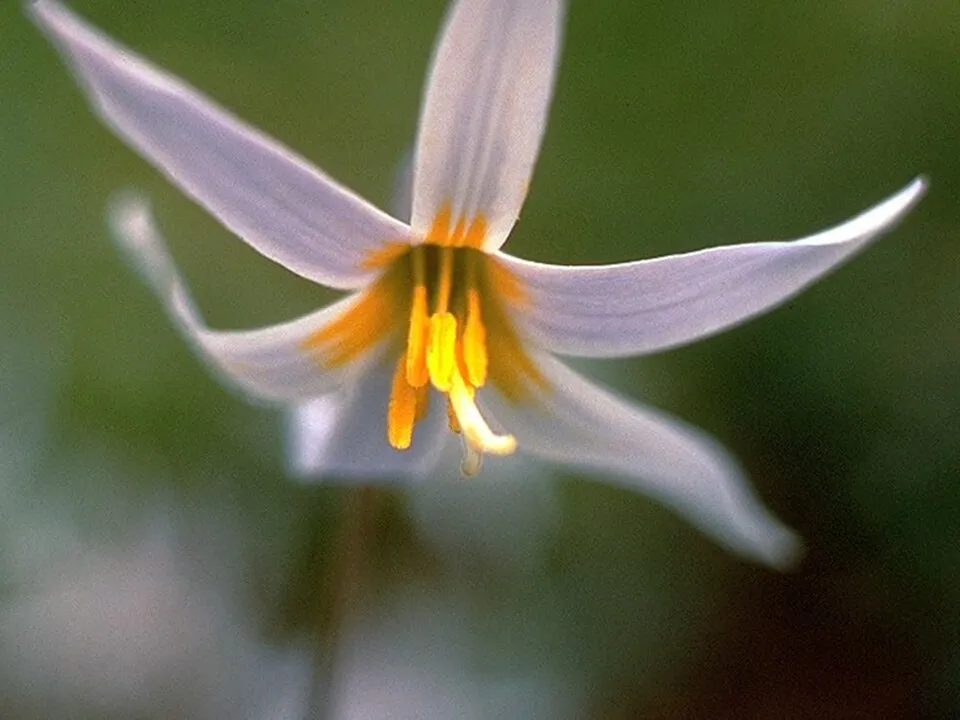
In the still, cool days of March, when the forest floor is mostly brown leaves and bare soil and the canopy is a tangle of gray branches against a pale sky, the White Trout Lily is one of the first signs that winter has truly loosened its grip. Erythronium albidum is a delicate spring ephemeral of the eastern deciduous forest, named for its basal leaves — a pair of smooth, elliptical, brown-and-green mottled blades that look, from a few feet away, exactly like the back of a brook trout resting on the leaf litter. From between the leaves rises a slender, leafless stalk bearing a single nodding white flower with six recurved petals (tepals) that arcs downward like a tiny bell. The flower opens on sunny mornings and closes at night and on overcast days, tracking the brief window of warm spring light that reaches the forest floor before the canopy trees leaf out. In NE Oklahoma, E. albidum is at the southwestern edge of its range, following the Ozark uplift into the rich, north-facing slopes and shaded coves of Adair, Cherokee, and Delaware counties, where it forms colonies that can carpet an acre of woodland floor. The sight of hundreds of white blossoms hovering above a field of trout-mottled leaves on an April morning is one of the quiet, transcendent experiences of the Ozark spring — the kind of thing you plan a walk around, and then remember for years.

[ field key · leaves · flower · corm · distinction from E. americanum ]
The trout lily produces one or two basal leaves (two on flowering plants, one on juvenile or non-flowering plants) that emerge directly from the corm at soil level. Each leaf is elliptical to lanceolate, 3–8 in long and 1–2 in wide, with a smooth (not toothed) margin and a fleshy, slightly succulent texture. The upper surface is mottled in shades of brown, bronze, and olive-green, creating a pattern that is uncannily similar to the markings on a brook trout (Salvelinus fontinalis) — an example of what may be visual camouflage against the dappled light and leaf litter of the forest floor. The lower surface is uniformly pale green. The leaves are glaucous (with a waxy bloom) in some populations, giving them a slightly blue-gray cast. Unlike many spring ephemerals whose foliage yellows and dies quickly after flowering, trout lily leaves persist for several weeks after blooming, continuing to photosynthesize well into May before senescing.
A single, slender, leafless scape (flower stalk) rises 4–8 in from between the leaves, arching at the tip so that the flower hangs nodding downward. The flower has six tepals (three petals + three petal-like sepals, indistinguishable in appearance) that are white, often tinged with pale lavender or pink on the outside (the backs of the tepals), and strongly recurved — each tepal sweeps upward and backward like the petals of a Turk's-cap lily. The flower is typically ¾–1½ in across. At the base of the tepals, inside the throat of the flower, there is a small ring of yellow or gold, and the six prominent stamens have bright yellow anthers (a useful field mark: the yellow anther is a key distinction from the closely related E. americanum, which has red-brown to purplish anthers). The flower closes at night and reopens in morning sun, a behavior called nyctinasty, which may protect the pollen and nectar from cool nighttime temperatures and non- pollinating visitors.
The trout lily grows from a deep, slender, teardrop-shaped corm that sits 3–6 in below the soil surface. The corm is covered in a thin, papery brown tunic and is white, crisp, and starchy inside. Unlike bulbs (onions, daffodils) that have concentric layers, corms are solid storage organs that are replaced each year: the old corm shrinks as the new one forms above or beside it. This annual replacement means the corm migrates very slowly through the soil profile over the years, and the plant's absolute dependence on the stored energy in the corm means that any removal of foliage before it naturally senesces (June) will weaken or kill the plant. The corm produces slender, white rhizome- like stolons that can extend several inches laterally and produce offsets (daughter corms) — the mechanism by which colonies expand vegetatively. This offset production explains the plant's ability to form large, dense colonies over decades.
Two Erythronium species occur in the region, and they are easily confused. E. albidum (White Trout Lily) and E. americanum (Yellow Trout Lily) overlap substantially in range and habitat. The key differences: Flower color — White (E. albidum) has white tepals often tinged lavender on the back; Yellow (E. americanum) has bright yellow tepals, often spotted with red at the base. Anthers — White: yellow; Yellow: red-brown to purplish-chocolate. Stigma — White: three short, recurved lobes; Yellow: three longer, spreading lobes. Leaf — White: often somewhat narrower, more uniformly mottled; Yellow: often broader, more irregularly mottled, and sometimes with a more bluish-green cast. Range in OK — White Trout Lily reaches into NE Oklahoma more reliably and is the species most commonly encountered in the Ozark foothills; Yellow Trout Lily is more eastern and is rare-to-absent in Oklahoma, though it may occur at the far eastern edge of the state in the Arkansas border region.
Erythronium albidum reaches the southwestern limit of its continuous range in eastern Oklahoma, where it is a characteristic member of the spring-flowering community of rich, moist, mature deciduous forests in the Ozark foothills. The strongest populations are in:
In the Tulsa area, the White Trout Lily is not a common wild plant — the climate is warmer and drier than the species prefers, and the calcareous clay soils of the Cross Timbers are not its ideal substrate. However, the species is perfectly cultivable in the prepared woodland garden, where the gardener can replicate the cool, moist, well-drained conditions it requires. The plant's range in Oklahoma is effectively defined by the Cookson Hills and the western flank of the Ozark dome; west of about Tahlequah, wild populations become increasingly scarce and restricted to the deepest, coolest microhabitats.
[ early-spring bees · ant dispersal · colony dynamics · spring ephemeral ecology ]
The White Trout Lily blooms at a time (late March through April in NE Oklahoma) when the pollinator community is just beginning to stir from winter. The primary visitors are early-emerging solitary bees, particularly mining bees (Andrenidae) and sweat bees (Halictidae), which emerge from their underground nests as soil temperatures rise and seek out the earliest available pollen and nectar sources. Overwintered queen bumblebees (Bombus impatiens, B. pensylvanicus), searching for food to sustain their colony-founding energy expenditures, are also important visitors. The nodding orientation of the flower may serve to protect the pollen from rain (common in early spring) while still allowing access to flying insects. The yellow anthers produce copious pollen, which is the primary reward; nectar is produced in smaller quantities at the base of the tepals. The floral biology of Erythronium places it in the pollen flower guild — plants that offer pollen, rather than nectar, as the primary pollinator attractant.
Like virtually all spring ephemerals of the eastern deciduous forest, trout lily seeds are dispersed by ants (myrmecochory). Each seed bears a prominent white, oily elaiosome that is eagerly collected by ants, particularly Aphaenogaster species. Ants carry seeds up to several meters, consume the elaiosome, and discard the intact seed in nutrient-rich nest middens. The seeds require cold-moist stratification (a winter in the ground) to break dormancy and germinate the following spring. The resulting seedling produces a single tiny, thread-like leaf and requires 4–7 years to reach flowering size. This long juvenile period, combined with short- distance ant dispersal, explains why trout lily colonies expand slowly and are vulnerable to disturbance. The colonies we see today may have been established decades or even a century ago, and the loss of a mature colony to development, logging, or overbrowsing may take many decades to recover, if recovery is possible at all.
The foliage and corms of trout lilies are browsed by white-tailed deer, and in areas with high deer density, the plants may be kept persistently cropped, preventing flowering and gradually depleting the corm reserves until the plant dies. Wild turkey forage in trout lily colonies in early spring, digging for corms and eating the emerging leaves. Eastern chipmunks and white-footed mice also consume corms, particularly during the winter when other food sources are scarce. The seeds, with their lipid-rich elaiosomes, are an important early-spring food source for ants, and the discarded seeds also feed a community of seed-harvesting insects and fungi in the litter layer.
A trout lily colony is not a uniform population of flowering plants. In a well-established colony, only a minority of plants (typically 5–15%) produce a flower in any given year. The rest are juveniles (single-leaf, non-flowering plants) or vegetative adults (plants that produced flowers in a previous year but are now in a "resting" year while they rebuild corm reserves). This age-structured demography is typical of long-lived perennials and means that the flowering display in a given year represents only the visible minority of the underground population. A gardener planting a few corms should expect to see only leaves for the first several years, with flowering beginning in year 3–5 and reaching full display levels only when the colony has accumulated a substantial number of mature corms. The density of single-leaf juveniles in a colony can be staggering — hundreds to thousands of tiny plants per square meter — and these "background plants" are critical to the long-term persistence of the colony.
[ corm planting · shade garden · colony establishment · companion design ]
Select a site that receives bright, unfiltered sun in March and April but is shaded by deciduous trees from May onward. The north side of a large tree, the east side of a building, or a bed beneath high-canopy oaks or maples on the south side of the lot (where the low-angle spring sun reaches under the branches) are all suitable. The soil must be deep, loose, rich in organic matter, and well- drained — trout lily corms rot in heavy clay or in soils that stay saturated during dormancy. Amend with 3–4 in of leaf mold, composted hardwood bark, and coarse sand worked into the top 12 in. pH should be 5.5–7.0. The site should not receive summer irrigation — the corms must stay dry during dormancy.
The White Trout Lily's early bloom, modest stature, and full dormancy by June make it an ideal companion for other spring ephemerals and for summer-emergent species that fill the visual void after the trout lilies go dormant. Plant with other ephemerals that bloom on the same March–April schedule: bloodroot (Sanguinaria canadensis) for the earliest white flowers, mayapple (Podophyllum peltatum) for distinctive umbrella foliage that emerges as the trout lilies are going dormant, Dutchman's Breeches (Dicentra cucullaria) for finely cut foliage and white pantaloon flowers, and Toadshade (Trillium sessile) for maroon flowers and mottled leaves. To fill the summer season, interplant with Christmas fern (Polystichum acrostichoides), which stays evergreen and provides structure, or true Solomon's seal (Polygonatum biflorum), which emerges in late April (just as the trout lilies begin to fade) and arches gracefully over the now-empty ground.
The leaves of Erythronium albidum were gathered as a cooked spring green by several Indigenous groups across the species' range, including the Cherokee and the Iroquois. The young leaves, collected before flowering, can be boiled in one or two changes of water and eaten as a mild-flavored potherb; the texture is slightly mucilaginous, similar to cooked spinach. The corms, which are small but starchy and crisp, were eaten raw or cooked by some groups, though the labor of digging and cleaning enough corms for a meal makes this a food of patient foragers. The Cherokee name for the plant has been translated as "fish scale leaf," a reference to the mottled pattern. The plant was also used medicinally: a poultice of the crushed corm was applied to boils and skin sores, and a weak tea of the leaves was taken as a mild emetic.
The species is now primarily valued for its ornamental qualities, and like all spring ephemerals, it should never be wild-harvested for any purpose. The common name "Dogtooth Violet" (applied to both E. albidum and E. americanum) refers to the shape of the corm, which resembles a dog's canine tooth. The name "Trout Lily" is a more recent coinage that speaks directly to the visual experience of seeing the mottled leaves against the brown forest floor.
Hero photo: Rooted Revival. Strip photos courtesy of Wikimedia Commons contributors under their respective licenses (linked under each image).