// SPECIES PROFILE · SHRUB · NATIVE · BEE MAGNET
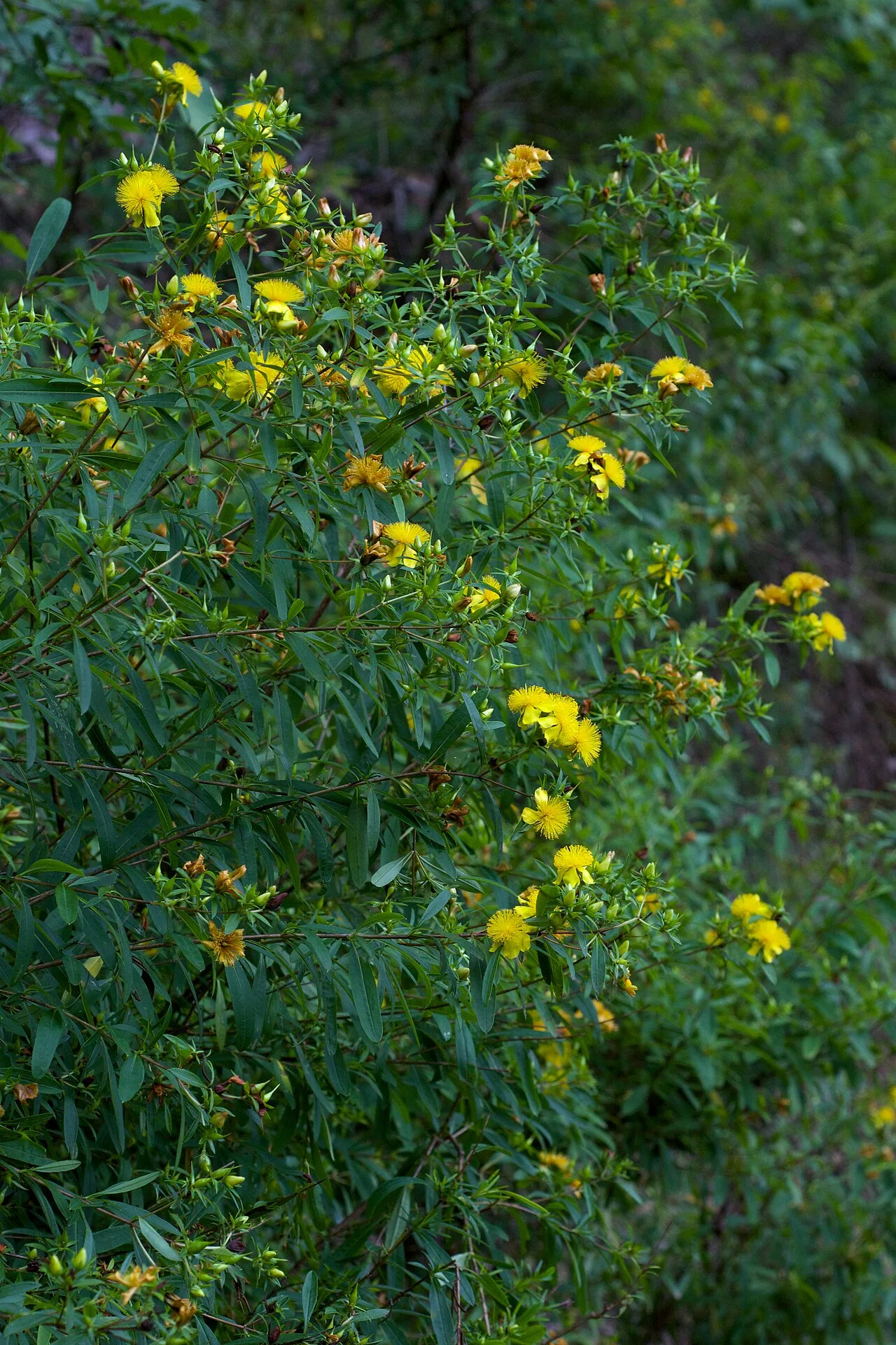
Shrubby St. John's Wort is a compact, well-behaved native shrub that produces masses of brilliant golden-yellow, five-petaled flowers with a burst of prominent stamens from mid-summer well into fall — one of the longest bloom seasons of any native shrub. The flowers are among the most attractive in the eastern flora for native bees, particularly small to medium-sized solitary bees that collect the abundant pollen. Hypericum prolificum is unusually compact for a native shrub (2–4 ft), with narrow, dark green leaves and a dense, rounded habit that fits into small garden spaces where larger shrubs would overwhelm. In NE Oklahoma, it grows in rocky, open woods, glade margins, and stream banks in the Ozark foothills and Cross Timbers, where it endures drought, thin soil, and full sun with equanimity. For the gardener who wants a small, low-maintenance, long-blooming native shrub that bees will work from July through September, there are few better choices.

A compact, densely branched, rounded shrub 2–4 ft tall, with numerous slender, erect to arching stems. Stems are two-edged (flattened on two sides) when young, becoming rounded and peeling in thin strips on older wood. The bark on mature stems is reddish-brown and exfoliating. The shrub maintains a tidy, mounded form without pruning.
Opposite, simple, narrowly oblong to linear, 1–2 in long, dark blue-green above, paler below, with a smooth margin and no petiole (sessile). The leaves are dotted with translucent glands visible when held to the light — a classic Hypericum trait. Fall color is a muted yellow.
Brilliant golden-yellow, five-petaled, 1–1.5 in across, with a dense central cluster of numerous prominent stamens that give the flower a powder-puff appearance. Flowers are produced in small clusters at branch tips from July through September, often continuing sporadically into October. The long bloom season — 8–12 weeks — is exceptional among native shrubs.
Cone-shaped, dark brown seed capsules that persist into winter, splitting at the top to release numerous tiny seeds. The dried capsules and seed heads add subtle winter texture. Seeds self-sow modestly but are not aggressive.
Hypericum prolificum is native across much of eastern North America, including eastern Oklahoma. In our region, it occurs in rocky open woods, glade margins, stream banks, and old field edges in the Ozark foothills and Cross Timbers. It thrives in dry, thin soils and full sun but also tolerates partial shade and moister sites with good drainage. It is one of the most adaptable native shrubs in the eastern flora.
The flowers are an outstanding resource for native bees, ranking among the best summer-blooming shrubs for pollinator support. The open, accessible flowers with abundant pollen attract a diverse guild of small to medium-sized bees, including sweat bees (Agapostemon, Lasioglossum), mining bees (Andrena), leafcutter bees (Megachile), and bumblebees. The long bloom season (July–September) bridges the gap between early summer and fall nectar sources.
Seeds are occasionally eaten by small songbirds. The dense, compact habit provides ground-level cover for small wildlife. Deer browse is relatively light — the foliage contains hypericin and related compounds that make it moderately unpalatable to mammalian herbivores.
Shrubby St. John's Wort is one of the easiest native shrubs to grow. It accepts full sun to part shade (blooms best in full sun) and almost any well-drained soil, including heavy clay and thin rocky soils. It tolerates drought once established. Plant in spring or fall from container-grown stock. Space 2–3 ft apart for a low hedge or mass planting.
Excellent in a mixed shrub border or pollinator garden with Butterfly Milkweed, Purple Coneflower, Little Bluestem, Stiff Goldenrod, and New Jersey Tea. The golden bloom complements purple coneflowers and blue asters beautifully.