// SPECIES PROFILE · PERENNIAL · NATIVE · FERN
If you are looking for the fern that does the most with the least — the one that forgives a dry week, tolerates more sun than the textbooks say, and still produces a lush, three-foot cascade of delicately dissected fronds that transforms the north side of a Tulsa house into something approaching an Ozark cove — the Lady Fern is your plant. Athyrium filix-femina is the elegant, lacy workhorse of the shade garden, a wide-ranging native fern that grows from Alaska to Florida and from the Pacific Northwest to western Europe — one of the most geographically widespread fern species in the Northern Hemisphere. In NE Oklahoma it occupies the moist, shaded transition zones between dry upland woods and wet riparian corridors, appearing along creek banks, in the dappled shade of north-facing bluffs, and at the seepage heads where groundwater emerges on wooded slopes. Its fronds are the most finely divided — almost feathery — of any large fern in the Oklahoma flora, and that texture, combined with its remarkable adaptability, makes it the single best choice for a fern that bridges the gap between a fully irrigated "fern garden" and the reality of ordinary, somewhat dry, somewhat shady Tulsa backyard conditions.

[ field key — frond dissection · stipe · sori · habit · variability ]
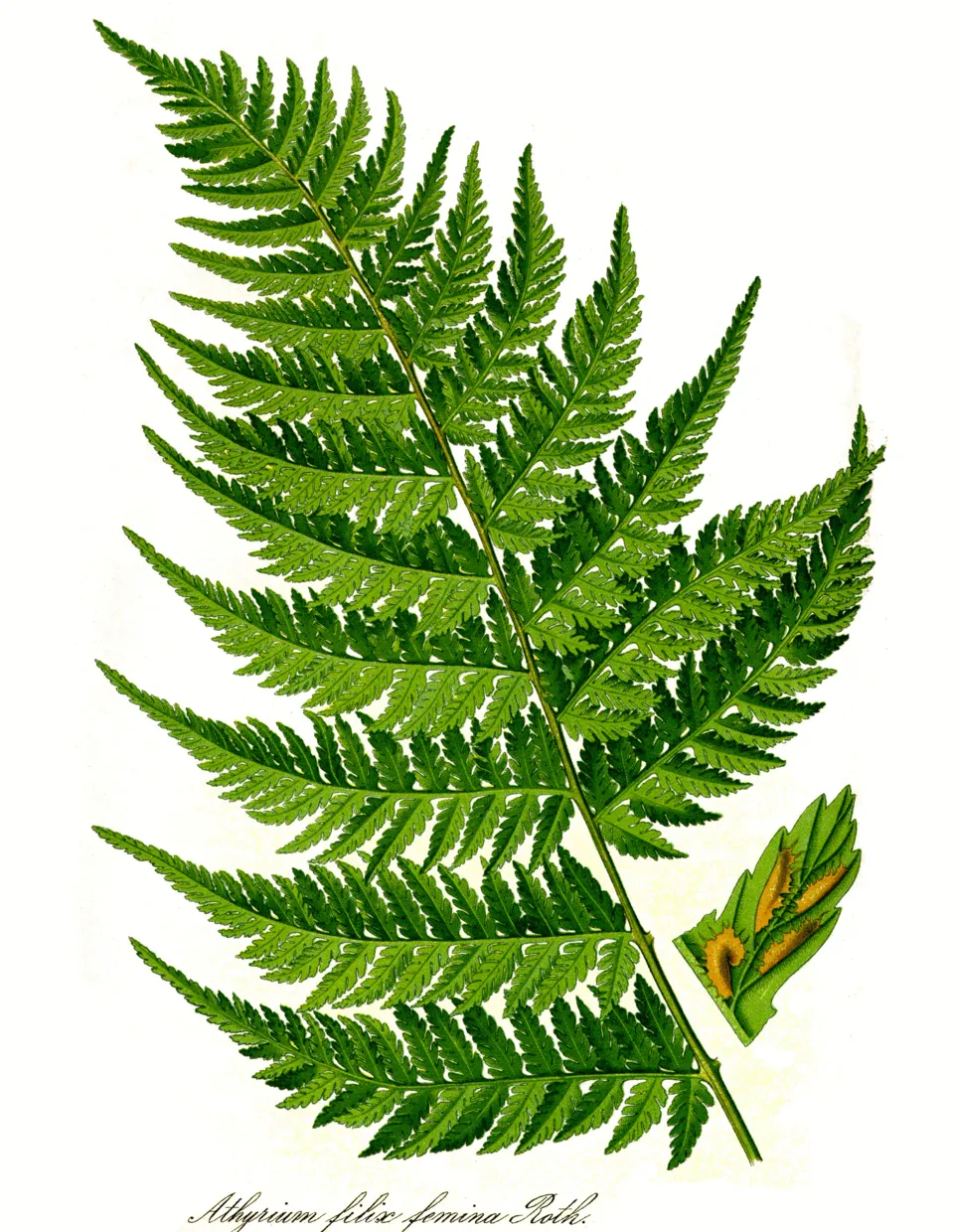
The frond is twice to thrice-pinnate (2–3 times compound), giving it the finest, laciest texture of any common large fern in the Oklahoma flora. The blade is broadest in the middle, tapering to both ends (elliptic-lanceolate in outline), typically 18–36 in long and 6–14 in wide. Individual pinnae are narrow, pointed, and themselves divided into small, toothed pinnules that are typically oblong with rounded, slightly notched tips. The degree of dissection varies considerably across the species' enormous range and among the dozens of named cultivars, from relatively simple (twice-pinnate) to the extreme filigree of 'Frizelliae' and 'Lady in Red.' The fronds emerge from a short, stout, ascending rhizome (not a creeping rhizome like sensitive fern), forming a tidy, non-invasive clump.
The stipe is relatively short (4–12 in), slender, and typically straw-colored or greenish with scattered dark brown to blackish scales, especially near the base. In many Oklahoma populations, the stipe and rachis (central axis) are flushed with a subtle reddish-burgundy color, and this trait has been selected in the named cultivar 'Lady in Red,' which has striking wine-red stipes that provide a beautiful color accent in the shade garden. The stipe is notably brittle — the species name filix-femina translates loosely to "female fern," a Medieval Latin moniker contrasting the plant's delicate, brittle-stemmed character with the supposedly more robust "male fern" (Dryopteris filix-mas), although the modern taxonomic relationship between the two genera is distant.
The spore-producing sori are arranged on the underside of fertile pinnae in a pattern that is the single best identification character for the genus Athyrium: each sorus is elongate, curved, and shaped like a small comma or fishhook (J-shaped), covered by a delicate, flap-like indusium that is attached along one side and opens along the other. This is distinct from the round sori of the wood ferns (Dryopteris) and the linear sori of the spleenworts (Asplenium). The sori are arranged in rows along the veins on the underside of the pinnules, and they turn from green to brown to nearly black as the spores mature. Spore release occurs from mid-summer to early fall, and a large frond can produce millions of spores.
The lady fern's finely cut, three-times-divided fronds distinguish it from most other Oklahoma woodland ferns, which are typically once-pinnate (Christmas fern, sensitive fern) or at most twice-pinnate (wood ferns). The most likely point of confusion is with the intermediate wood fern (Dryopteris intermedia) and the marginal wood fern (D. marginalis), both of which have twice-pinnate fronds that can appear superficially similar. Key distinctions: Sori shape — J-shaped / comma-shaped and elongate in Athyrium, round and covered by a kidney-shaped indusium in Dryopteris. Stipe scales — papery, brown, and relatively few in Athyrium; dense, dark, and persistent in Dryopteris. Clump form — Athyrium is more delicate, with fronds arching outward from a central point (fountain- like); Dryopteris is typically more robust and upright.
Athyrium filix-femina is a cosmopolitan species with a distribution that follows the northern temperate zone around the globe. In NE Oklahoma it is a common and widespread fern, occurring in a broader range of habitats than most of the state's other woodland ferns. You will find it in:
In the immediate Tulsa region, lady fern is common along the creek systems that drain into the Arkansas and Verdigris rivers — Bird Creek, Mingo Creek, Haikey Creek, and their tributaries all support populations. The species is more drought-tolerant than most ferns (relatively speaking — it still requires shade and at least moderate soil moisture), which explains its broader ecological amplitude compared to moisture-obligate species like cinnamon fern. In the Ozark foothills to the east, it grades into populations of the closely related southern lady fern (Athyrium asplenioides), a taxon that some botanists treat as a separate species and others consider a variety of A. filix-femina.
[ cover · insect hosts · soil stabilization · deer browse ]
A well-established clump of lady fern creates a dense, low canopy of finely dissected foliage that provides cover and microclimate buffering for small ground-dwelling animals. In NE Oklahoma creekside habitats, the fern clumps are used by ground skinks (Scincella lateralis), five-lined skinks, and various small snakes for thermoregulation and predator avoidance. The area beneath mature fronds stays several degrees cooler and significantly more humid than the surrounding woodland floor — a critical refuge for moisture-sensitive arthropods and amphibians during the hot, dry stretches of July and August. The deep, fibrous root mass around the rhizome also provides hibernacula (overwintering sites) for various insects and spiders.
Several species of fern-feeding sawfly larvae (Tenthredinidae) specialize on Athyrium foliage, and the fronds are also consumed by larvae of at least two fern moths in the genus Papaipema (Noctuidae). Stenella filicum, a leaf-spot fungus that produces small brown lesions on the frond surface, is a common associate in the humid microclimate of the fern clump. More importantly from a gardener's perspective, the diverse arthropod community that lives in and beneath the fronds supports a rich guild of insectivorous birds: Carolina wrens, hooded warblers (in the deeper Ozark woods), and Kentucky warblers all forage preferentially in the fern layer.
The emerging fiddleheads in April are browsed by white-tailed deer, and in areas with high deer density (much of NE Oklahoma), the fern can be kept cropped to a few inches if not protected. Ruffed grouse (in the Ozark foothills where small populations persist in Oklahoma) eat the young fiddleheads, and wild turkey poults forage for insects among the fronds. Unlike many woodland plants whose fruit or seed provides direct food value, the lady fern's contribution to vertebrate wildlife is primarily through the invertebrate food web it supports and the physical habitat structure it provides. This is a plant that generates ecological value by creating the conditions for other organisms to thrive, rather than by being eaten directly.
Along the eroding banks of NE Oklahoma creeks (and there are many — flashy flows and clay-rich soils combine to make bank erosion a chronic issue), the fibrous, mat-forming root system of lady fern is an important component of riparian soil stabilization. A colony of lady fern growing along a creek bank creates a dense network of fine roots that binds the soil and reduces the erosive impact of both flowing water and rainfall impact on exposed soil. This service is synergistic with the deeper, woody roots of riparian trees and shrubs: the fern holds the surface layer while the trees anchor the deeper bank profile. In garden-scale rain-garden plantings, lady fern performs the same function at the micro-drainage level.
[ shade garden staple · planting · division · cultivar selection · companion design ]
Lady fern is the most forgiving fern for the average Tulsa shade garden. While it appreciates moist, rich woods soil, it tolerates a wider range of conditions — drier soil, more sun, heavier clay — than any other native fern of comparable size and ornamental appeal. Choose a site with dappled shade to full shade; a location that receives morning sun and afternoon shade (east side of a building or large tree) is ideal. Hot afternoon sun (west exposure) will scorch the fronds unless the soil is consistently saturated. The soil should be amended with 2–3 in of compost or leaf mold worked into the top 8–10 in, but the fern does not require the deep, intensely prepared bed that more demanding species (interrupted fern, maidenhair fern) need.
| Cultivar | Type / use | Distinguishing feature | Notes for Tulsa |
|---|---|---|---|
| 'Lady in Red' | Specimen / accent | Striking wine-red stipes contrasting with bright green foliage | Excellent color accent in the shade garden; the red color is strongest in plants receiving dappled sun. |
| 'Frizelliae' (Tatting Fern) | Collector's curiosity | Pinnae reduced to tiny round beads along the rachis — looks like tatting lace | Delicate and slow-growing; protect from slugs and drying winds. |
| 'Victoriae' (Queen Victoria's Fern) | Specimen / Victorian garden | Pinnae cross into X-shaped patterns along the frond | A Victorian-era selection; quite striking but can be finicky in Tulsa heat. |
| 'Dre's Dagger' | Specimen / accent | Narrow, erect fronds with forked, crested tips | Unusual upright form; good for vertical accent in the fern garden. |
| Straight species (wild type) | Naturalistic / massing / ecological | Arching, lacy green fronds 2–4 ft tall | Best for wildlife value and naturalistic plantings; most reliable in Tulsa conditions. |
Lady fern's fine texture and medium height make it an ideal bridge plant in the woodland garden — it sits visually between the low groundcovers and the taller shrubs and understory trees, and its lacy fronds provide textural relief against the broad leaves of most woodland perennials. Excellent companions include: wild ginger (Asarum canadense) for a glossy, evergreen ground layer beneath the cascading fronds, wild columbine (Aquilegia canadensis) for a splash of red-orange in the April sun before the fern fully leafs out, true Solomon's seal (Polygonatum biflorum) for arching foliage with pendulous flowers at a contrasting height, coralberry (Symphoricarpos orbiculatus) as a low shrub backdrop, and Christmas fern (Polystichum acrostichoides) for winter interest when the lady fern is dormant. Under taller canopy trees like American hornbeam and eastern redbud, a drift of lady fern interplanted with mayapple and bloodroot creates a classic eastern deciduous forest ground layer.
The young fiddleheads of lady fern are edible when thoroughly cooked and have been harvested as a spring wild food across the species' enormous range, from the Pacific Northwest (where it was a traditional food of Coast Salish and other Indigenous peoples) to Appalachia and the Ozarks. The fiddleheads are collected when 4–8 in tall, with the papery brown scales rubbed off under running water. They are then boiled for at least 10–15 minutes (some foragers recommend two changes of water) and served with butter, salt, and a splash of vinegar. The flavor is mild, slightly nutty, and less assertive than that of the ostrich fern fiddlehead. As with all fern fiddleheads, never eat them raw — they contain thiaminase and potentially other thermolabile compounds that are deactivated by cooking.
The lady fern has been cultivated as an ornamental in European gardens since at least the 17th century, and by the Victorian era the species was one of the most popular ferns in the "pteridomania" (fern craze) that swept Britain and North America between 1840 and 1900. Dozens of named cultivars were selected during this period, and the plant remains a staple of shade gardening worldwide. In Japanese and Chinese traditional medicine, preparations of Athyrium species have been used as anthelmintics (to expel intestinal worms), though this use is not ethnobotanically documented for North American Indigenous peoples.
Hero photo: Rooted Revival. Strip photos courtesy of Wikimedia Commons contributors under their respective licenses (linked under each image).