// SPECIES PROFILE · PERENNIAL · NATIVE · SPRING EPHEMERAL
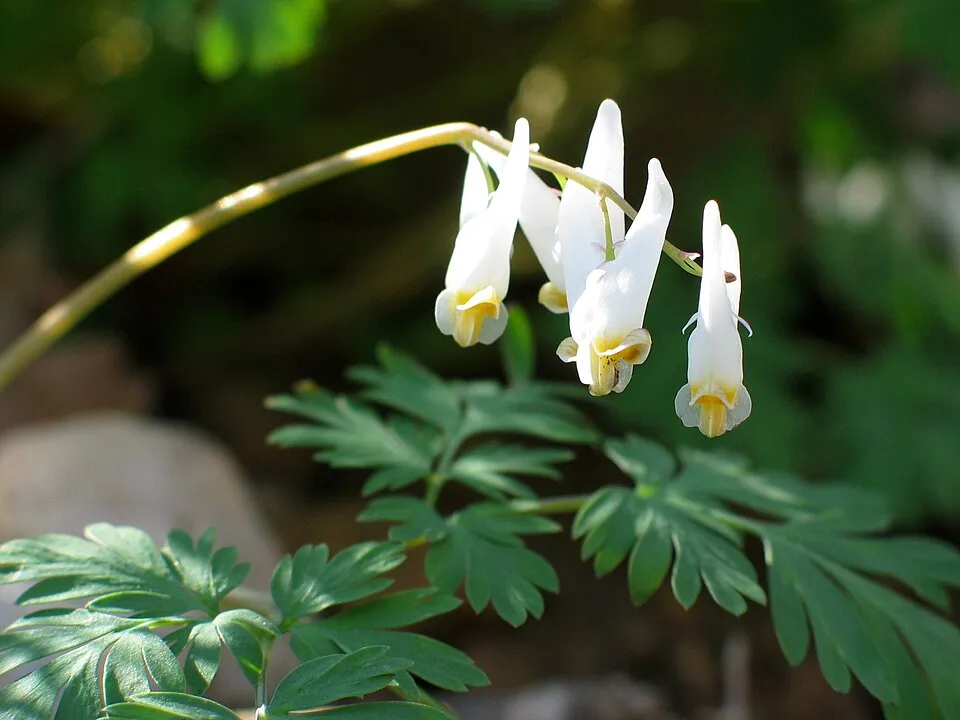
Among the spring ephemerals of the eastern deciduous forest, Dutchman's Breeches is the one that makes people laugh when they first bend down for a close look. The common name is not folksy poetry — it is a literal description. Each flower is white with a yellow "waistband" at the tip, shaped exactly like a tiny pair of 18th-century Dutchman's pantaloons hung upside down to dry on a clothesline. The flowers are arranged in a nodding row along an arching stem above a delicate mound of finely dissected, fern-like blue-green foliage, and on a warm April day in the Ozark foothills of NE Oklahoma, they are visited by the season's first queen bumblebees — large, heavy, buzzing insects that are among the only native pollinators strong enough to force open the flower's complex hinged petals and reach the nectar inside. Dicentra cucullaria is a member of the Papaveraceae (poppy family), a relative of the garden bleeding-heart (Lamprocapnos spectabilis), and it shares that plant's distinctive floral architecture, but it is a true native of the eastern North American woodland, reaching the southwestern edge of its range in the rich, north-facing slopes and alluvial woods of the Ozark- influenced drainages of eastern Oklahoma.

[ field key · leaves · flower · root · distinction from squirrel corn ]
The foliage of Dutchman's Breeches is one of the most delicate and beautiful in the spring woodland flora. Each plant produces a basal cluster of leaves on long, slender petioles, and each leaf is finely dissected into narrow, linear segments — so finely cut that the overall effect is feathery, almost fern-like, but softer and more blue-green in color. The leaves are glaucous, with a pale, waxy bloom that gives them a slightly smoky appearance. The compound leaf is typically twice to thrice compound (2–3 times divided), and the ultimate segments are narrow (1–3 mm wide), soft, and smooth. The foliage emerges in March, fully expands by early April, and begins to yellow shortly after flowering is complete, generally senescing by late May or early June in the Tulsa region. The foliage contains isoquinoline alkaloids (related to those in opium poppy and bloodroot) that make it toxic to most herbivores, a defense that allows the delicate leaves to persist un-browsed through their short season.
The inflorescence is a one-sided raceme (flower cluster) of 4–10 flowers borne on an arching, leafless stalk (scape) that rises above the foliage. Each flower is white, sometimes faintly pink-tinged, and shaped like a tiny pair of upside-down pantaloons — the two outer petals form the "legs" of the pants, with inflated, spur-like pouches at the base and flared, yellow tips that create the "waistband" effect. The inner petals are small, narrow, and fused, projecting slightly from the opening and protecting the stamens and stigma inside. The flower is bilaterally symmetrical and hangs nodding from the arching stem. The yellow tip is not just ornamental: it is the nectar guide that directs bumblebees to the opening at the base of the flower, where they must pry the hinged inner petals apart with their legs and mouthparts to access the nectar. The flower structure is a classic example of a bee-pollination lock-and-key mechanism.
Dutchman's Breeches grows from a cluster of small, pinkish, grain-like tubers (actually corm-like storage organs) that sit just below the soil surface. These tubers are scaly, irregularly shaped, and clustered together like a handful of corn kernels — a characteristic that gives the closely related species Dicentra canadensis its common name "Squirrel Corn." The tubers store carbohydrates and alkaloids and allow the plant to survive the long summer and winter dormancy. The plant also produces small, globose bulblets in the leaf axils of some populations, which drop to the ground and produce new plants. These bulblets are dispersed very short distances (they simply fall at the base of the parent plant), which contributes to the plant's tendency to form tight, discrete colonies. The tubers are occasionally dug and consumed by rodents, and the alkaloid content may serve as a deterrent to heavier predation.
Squirrel Corn (Dicentra canadensis) is the most similar species in the region and blooms at the same time in the same habitat. Key differences: Flowers — Dutchman's Breeches: white with yellow tips at the "waist" of the pantaloons, the spurs (legs) diverge widely and are relatively short; Squirrel Corn: white to pale pink with a more heart-shaped profile, the spurs are more rounded and less divergent, and the flower lacks the distinct yellow tip. Fragrance — Dutchman's Breeches: generally fragrance-free or faintly sweet; Squirrel Corn: smells distinctly of hyacinth or lilac — a very useful field character. Tubers — Dutchman's Breeches: pinkish, grain-like, clustered; Squirrel Corn: bright yellow, rounded, like kernels of yellow corn. Range in OK — Dutchman's Breeches is the more common of the two in NE Oklahoma; Squirrel Corn is rarer and reaches its southwestern limit in the same Ozark-influenced drainages.
Dicentra cucullaria is at the southwestern edge of its range in eastern Oklahoma, where it occurs in rich, moist, north-facing wooded slopes, deep ravines, and alluvial bottomland woods in the Ozark-influenced drainages of Adair, Cherokee, Delaware, and far eastern Mayes and Sequoyah counties. The species shows a preference for calcareous (lime-rich) soils, and many of the best populations in Oklahoma are associated with the limestone substrates of the Ozark Plateau. The Illinois River valley, the Baron Fork watershed, and the upper reaches of the Flint Creek drainage all support good populations, typically in the company of other spring ephemerals including bloodroot, mayapple, and trilliums.
The species' preference for slightly calcareous soils makes it an excellent candidate for cultivation in Tulsa-area gardens where the native clay is near-neutral to alkaline — a characteristic that sets it apart from many woodland plants that demand acidic conditions. In the wild, look for it on the steep, north-facing slopes above perennial streams, where groundwater seepage keeps the soil cool and moist through the spring growing season. The foliage and flowers are gone by the time the summer heat arrives, but in April, the plant can form extraordinary displays on the best sites, with hundreds of flowering stems creating a haze of white above the blue-green foliage.
[ bumblebee pollination · ant dispersal · alkaloid defense · spring ephemeral ecology ]
The flower of Dutchman's Breeches is a marvel of co-evolution with bumblebees. The nectar is stored deep within the inflated spurs at the base of the outer petals, accessible only through a narrow opening guarded by the hinged inner petals. To reach the nectar, a visiting bee must land on the flower, grip the outer petals with its legs, and use its weight and strength to force the inner petals apart, extending its long tongue into the spur. In doing so, the bee's head and thorax contact the stigma and anthers, effecting pollination. The force required excludes most smaller bees, flies, and beetles, and in practice the primary pollinators are newly emerged queen bumblebees (especially Bombus impatiens and B. pensylvanicus), which are among the only insects active in early April that have both the strength and the tongue length to operate the mechanism. Honey bees, which are not native to North America, occasionally "nectar-rob" by chewing a hole through the spur from the outside, bypassing the pollination mechanism entirely.
Like bloodroot, trillium, and trout lily, Dutchman's Breeches relies on ants for seed dispersal. Each seed bears a prominent white, fleshy elaiosome that attracts ants, which carry the seeds to their nests, consume the elaiosome, and discard the viable seed in the colony midden. The ant genus Aphaenogaster is the primary disperser in Oklahoma woodlands. This dispersal mechanism explains the plant's tendency to form dense, discrete colonies rather than a continuous groundcover — each colony represents the accumulated seed rain around a long-established ant nest. The seeds require cold- moist stratification to germinate, and the resulting seedlings take 2–4 years to reach flowering size.
Dutchman's Breeches produces a suite of isoquinoline alkaloids that render the foliage toxic to most vertebrate and invertebrate herbivores. The compounds are related to those in the opium poppy, and the plant has been documented to cause staggering, convulsions, and respiratory distress in livestock that consume it (hence the folk name "Little Blue Staggers" — "blue" referring to the foliage, "staggers" to the symptoms of poisoning). This chemical defense allows the plant to persist with minimal browsing damage, even in areas with high deer density, and it is one reason why Dutchman's Breeches can form large, healthy colonies in woodlands where other spring wildflowers have been browsed to the ground. White-tailed deer generally avoid the plant, and the few insect herbivores that feed on it (some flea beetles, Chrysomelidae) are specialists that have evolved tolerance to the alkaloids.
Dutchman's Breeches is the definition of a spring ephemeral: it emerges, leafs out, flowers, sets seed, and senesces entirely in 8–10 weeks, completing its entire above-ground life cycle before the canopy trees fully leaf out in May. The tubers store enough carbohydrate and alkaloid reserves to fuel the rapid spring growth spurt, and the plant's retreat underground by early summer allows it to survive the hot, dry Tulsa summer in a metabolically inactive state. This strategy means the plant requires no summer water and is actually harmed by summer irrigation, which can rot the dormant tubers. The ephemeral life history also makes Dutchman's Breeches a plant that does not compete well with summer-active vegetation — in the garden, it must be sited where it will not be shaded out by later- emerging perennials or smothered by groundcovers that fill in after the ephemeral has gone dormant.
[ ephemeral timing · tuber planting · soil preference · companion design ]
Choose a location that provides full sun in March and April (before canopy leaf-out) and dappled to full shade from May onward. The south side of a large deciduous tree, the east side of a building, or a bed on the north side of a tall fence or hedge all work. The soil should be rich, moist, well-drained, and near-neutral to slightly alkaline — Dutchman's Breeches has a tolerance for calcareous soils that sets it apart from many woodland plants. The heavy Tulsa clay can be acceptable if amended with leaf mold and compost to improve drainage; the plant is less demanding of acidic conditions than species like interrupted fern or heartleaf.
Dutchman's Breeches pairs beautifully with the full ensemble of spring ephemerals that share its habitat and timing. Excellent companions include: bloodroot (Sanguinaria canadensis) for the earliest white flowers, overlapping in late March, mayapple (Podophyllum peltatum) for the umbrella-like foliage that emerges alongside the Dutchman's Breeches foliage, Toadshade (Trillium sessile) for maroon flowers and mottled leaves at a similar height, Cut-leaved Toothwort (Cardamine concatenata) for white-to-pink flowers and finely cut leaves, and the White Trout Lily (Erythronium albidum) for trout-mottled ground foliage beneath the Dutchman's Breeches flower stalks. For summer interest after the ephemerals go dormant, underplant with Christmas fern (Polystichum acrostichoides) or interplant with wild ginger (Asarum canadense), which emerges in late spring and covers the ground with its glossy leaves through summer and winter. Dutchman's Breeches also associates naturally with understory trees like eastern redbud (Cercis canadensis) and spicebush (Lindera benzoin).
Dicentra cucullaria was used medicinally by several Indigenous groups of eastern North America. The Cherokee, Iroquois, and Menominee, among others, employed preparations of the root as a treatment for skin conditions, as a diuretic, and as a blood purifier. A poultice of the crushed tubers was applied to sores and skin inflammations. The plant was also reportedly used internally (in very small, carefully managed doses) for menstrual pain and as a general tonic, though the narrow margin between therapeutic and toxic doses made this a medicine requiring expert preparation.
Hero photo: Rooted Revival. Strip photos courtesy of Wikimedia Commons contributors under their respective licenses (linked under each image).