// SPECIES PROFILE · PERENNIAL · NATIVE · SPRING EPHEMERAL · EDIBLE
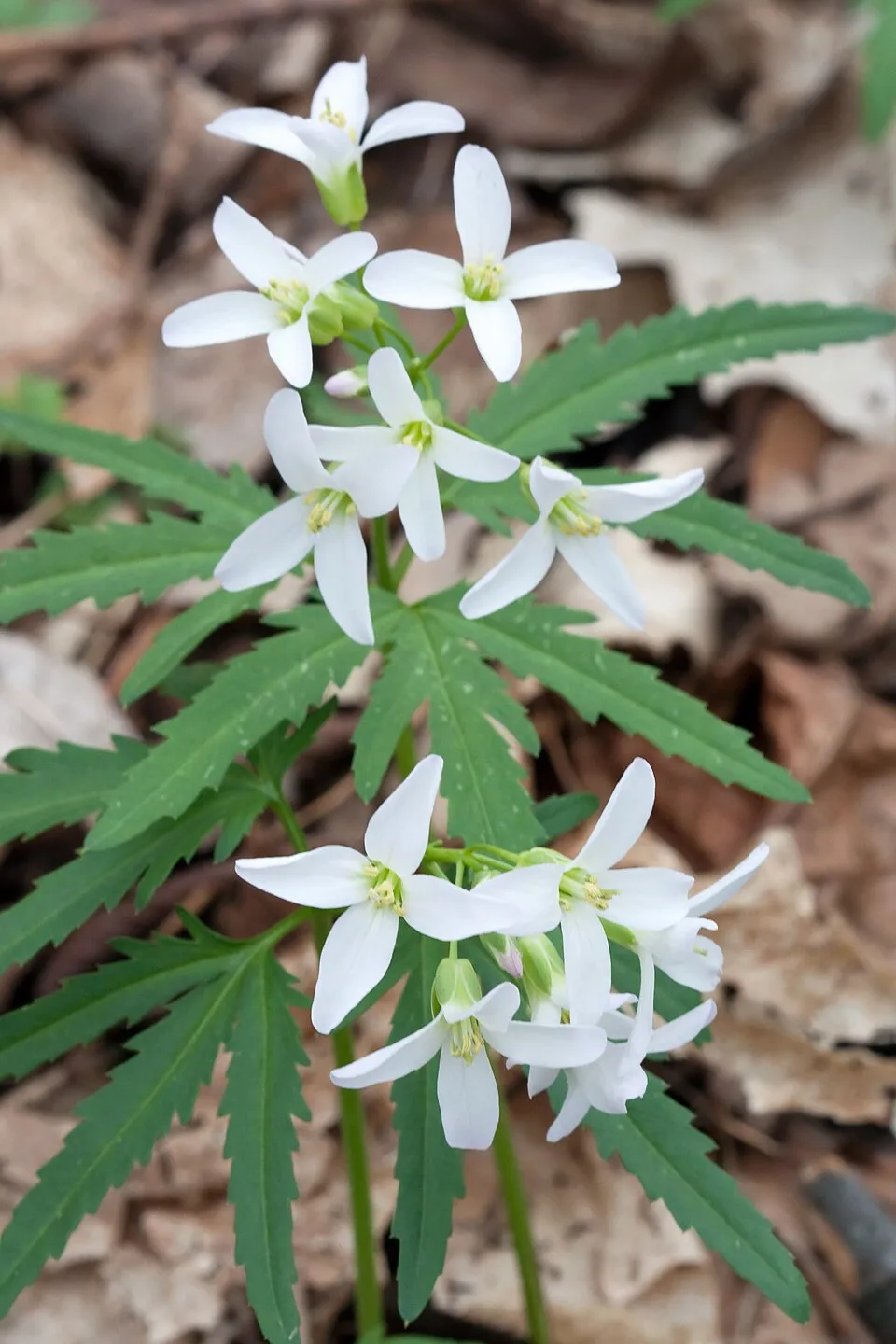
In the race to bloom before the canopy closes, Cut-leaved Toothwort is consistently among the first to the starting line. Cardamine concatenata is a delicate spring ephemeral of the eastern deciduous forest, a member of the Brassicaceae (mustard family) — a taxonomic placement that becomes obvious the moment you taste the root, which delivers a sharp, peppery, radish-like heat that is one of the most surprising sensory experiences of the spring woodland. The plant emerges in March with a stem bearing a whorl of three deeply cut, palmately divided leaves, above which rises a loose terminal cluster of four-petaled flowers that open white or very pale pink, sometimes with a hint of lavender. The flowers are typical of the mustard family — four petals arranged in a cross (the old family name, Cruciferae, means "cross-bearing") — and they are among the earliest woodland wildflowers to bloom in NE Oklahoma, often opening before the bloodroot and just as the serviceberry buds are beginning to swell. By May the plant has set seed, the leaves have yellowed, and the entire above-ground structure has retreated to a segmented, tooth- like rhizome just beneath the soil surface, waiting out the summer heat and the winter cold for another early-spring sprint.

[ field key · leaves · flowers · rhizome · fruit · Brassicaceae characteristics ]
The foliage of Cut-leaved Toothwort is the plant's most reliable vegetative field mark. A single, smooth, erect stem rises from the rhizome and bears a whorl of three leaves at the top, just below the inflorescence. Each leaf is palmately divided into 3–5 narrow, lanceolate segments, with the segments themselves coarsely toothed or shallowly lobed — hence "cut-leaved." The leaf margin teeth are sharp and irregular, and on close inspection they do look a bit like a row of tiny teeth, which connects to the plant's name (see Cultural Uses). The leaves are thin, soft, and a fresh medium green, with a slightly waxy texture. The petioles are slender and the leaves spread outward from the whorl like the fingers of a hand. The foliage persists through April and begins to yellow in May. There are no basal leaves (unlike many other spring ephemerals) — all the leaves are on the flowering stem.
The inflorescence is a loose, terminal raceme of 10–20 four-petaled flowers that opens sequentially from the bottom upward. Each flower is ½–¾ in across, with four white to very pale pink (occasionally pale lavender) petals arranged in the characteristic mustard- family cross shape. The petals are broadly obovate (egg-shaped with the widest part at the tip) and usually have fine, darker pink or lavender veins that are visible on close inspection. The flower has six stamens (four long and two short — the classic Brassicaceae "tetradynamous" arrangement) with yellow anthers, and a single green pistil in the center. The buds are often tinged pink or lavender before opening, and the overall effect on a sunny March day is a delicate, frothy cluster of white hovering above the dark brown leaf litter of the forest floor. The flowers are unscented but produce a modest amount of nectar, and they close at night and on cold, overcast days.
The underground structure is a segmented, knobby rhizome that resembles a string of small, irregular tubers or a row of misshapen teeth — the feature that gives the plant its common name. Each segment is white, crisp, and fleshy, with a texture similar to a water chestnut and a flavor that is sharply peppery, like horseradish or a particularly pungent radish. The "teeth" are actually the swollen bases of previous years' stems, and each year the plant produces a new segment that connects to the old ones, slowly extending the rhizome through the soil. This segmented structure also provides the means for vegetative reproduction: sections of the rhizome can break apart (particularly when disturbed by burrowing animals or stream bank erosion), and each segment can produce a new plant. The rhizome sits only 1–3 in below the soil surface and is vulnerable to disturbance.
After flowering, the pistil elongates into a narrow, cylindrical, slightly flattened silique (the characteristic mustard-family fruit) about 1–1½ in long. As the seeds mature, the two halves of the silique dry and curl back explosively, flinging the seeds several feet from the parent plant — a dispersal mechanism called ballistic dehiscence or "explosive seed dispersal." The seeds are small, round, and brown, and they do not have elaiosomes (unlike most woodland ephemerals that rely on ant dispersal). Instead, the seeds germinate directly in the soil after a period of warm, then cold, stratification (they require a summer of warmth followed by a winter of cold to break dormancy). This ballistic dispersal mechanism explains the plant's tendency to form scattered, irregular colonies rather than the dense, discrete patches typical of ant-dispersed species.
Cardamine concatenata is widespread across eastern Oklahoma and is one of the more common and easily observed spring ephemerals in the region. Unlike many of the woodland species that are restricted to the Ozark foothills or the Arkansas River bottomlands, Toothwort is an ecological generalist within moist deciduous woods and can be found in:
In the Tulsa area, Cut-leaved Toothwort is common in the woods along Bird Creek, Mingo Creek, and other tributary drainages, and it is frequently the first spring wildflower that beginning naturalists notice and identify. Its relatively broad ecological tolerance, early bloom, and distinctive leaves make it an excellent ambassador species for the spring woodland flora.
[ early-spring pollinators · mustard-family insects · explosive seed dispersal · deer browse ]
Toothwort blooms at a time when the pollinator community is sparse, and it relies primarily on early-emerging solitary bees (Andrenidae, Halictidae), bee flies (Bombyliidae), and hover flies (Syrphidae) for pollination. The open, accessible flower structure (characteristic of the Brassicaceae) does not restrict pollinators to a particular size or tongue-length class, and a wide variety of small insects visit the flowers. Queen bumblebees, which have the strength and tongue length to access more specialized flowers (like Dutchman's Breeches), will also visit Toothwort flowers for the relatively accessible nectar and pollen. The flowers are self-incompatible in many populations (requiring cross-pollination between different genetic individuals), which promotes genetic diversity within colonies.
As a member of the Brassicaceae, Toothwort serves as a larval host plant for several butterfly species that specialize on crucifers. The most notable is the West Virginia white (Pieris virginiensis), a butterfly whose larvae feed primarily on toothwort species and that is an indicator of healthy, undisturbed eastern deciduous forest. This butterfly does not feed on the invasive garlic mustard (Alliaria petiolata), a non-native crucifer that has overrun many eastern woodlands, and the West Virginia white's decline is partly attributed to the displacement of native toothwort host plants by garlic mustard. The more common falcate orangetip (Anthocharis midea) also uses toothworts as a host plant in parts of its range, though it will also feed on other native crucifers. In Oklahoma, the West Virginia white is not known to occur (the state is at the edge of its range), but the ecological relationship between native crucifers and specialist Lepidoptera is one that gardeners should be aware of when managing invasive mustard-family plants.
The ballistic dehiscence of Toothwort's siliques is one of the most entertaining seed dispersal mechanisms in the woodland flora. When the silique is fully mature and dry, the slightest touch — a raindrop, a passing animal, a gust of wind — causes the two valves of the pod to snap violently from the base upward, curling into a tight spiral and flinging the seeds 3–6 feet from the parent. If you find Toothwort with mature siliques in late April or early May, gently brush your finger against a pod: the sudden explosion, audible as a soft "snap," is one of the small pleasures of woodland botany, and it demonstrates the mechanical basis of a dispersal mechanism that has served the Brassicaceae for millions of years.
White-tailed deer browse Toothwort moderately to heavily, and in areas with high deer density, the plants may be kept cropped and prevented from flowering. The foliage lacks the alkaloid defenses of Dutchman's Breeches or bloodroot, and its early emergence makes it one of the first green, tender foods available on the forest floor. In addition to deer, eastern cottontail rabbits and woodchucks (groundhogs) browse the foliage, and the shallow rhizomes are occasionally dug and eaten by chipmunks and voles. The glucosinolates (mustard oils) that give the plant its peppery flavor provide some chemical defense against generalist insect herbivores, but they are not a deterrent to mammalian browsers.
[ woodland garden · rhizome planting · self-seeding · companion design ]
Toothwort is one of the easiest spring ephemerals to establish in the garden, and it is more forgiving of less-than-ideal conditions than trilliums, trout lilies, or Twinleaf. It wants the standard ephemeral formula: spring sun before canopy closure, followed by dappled to full shade through summer, in moist, well-drained, humus-rich soil. Unlike some calciphilic species (Twinleaf), Toothwort tolerates a range of pH conditions (5.5–7.0) and is not demanding about soil chemistry. The plant's natural tendency to self-seed via explosive dehiscence means that, once established, a Toothwort colony will gradually expand on its own without the gardener's intervention.
If you want your Toothwort colony to expand naturally, do not clean up the bed after the plants go dormant. The maturing siliques need to dry and dehisce naturally, and the seeds need to land on bare or lightly littered soil to germinate. Raking or removing the leaf litter from the bed in June (when the seeds are dispersing) will remove the seed crop. Instead, leave the bed alone through the summer and fall, allowing the seeds to settle into the soil and begin their warm-then-cold stratification cycle. By the following March, you will see the tiny, simple, rounded cotyledon leaves of new seedlings appearing among the returning adult plants. It takes 2–3 years for a seedling to reach flowering size, but the wait is brief by woodland ephemeral standards.
Cut-leaved Toothwort's modest height, early bloom, and full dormancy by May make it an ideal member of the spring ephemeral guild in the woodland garden. It pairs beautifully with other March–April ephemerals: bloodroot (Sanguinaria canadensis) for the earliest white flowers, which bloom at exactly the same time, mayapple (Podophyllum peltatum) for the umbrella-like foliage that emerges alongside the Toothwort, Dutchman's Breeches (Dicentra cucullaria) for the white pantaloon flowers and finely cut foliage, White Trout Lily (Erythronium albidum) for trout- mottled ground-level leaves, and Virginia Bluebells (Mertensia virginica) for the brilliant blue that follows the Toothwort bloom by a week or two. For summer cover: Christmas fern (Polystichum acrostichoides), true Solomon's seal (Polygonatum biflorum), and wild ginger (Asarum canadense) all emerge after the Toothwort has gone dormant and provide continuous ground coverage through the growing season.
Cut-leaved Toothwort is one of the few eastern woodland wildflowers with a well-documented culinary tradition. The segmented rhizome, harvested in early spring or late fall when the plant is dormant, has a sharp, clean, peppery heat comparable to horseradish or a particularly aggressive radish. It was eaten raw or cooked by numerous Indigenous groups across the species' range, including the Cherokee, Iroquois, Algonquian peoples, and others. The fresh rhizome was sliced thin and eaten as a condiment with meat, mixed into salads, or boiled as a root vegetable (cooking mellows the heat somewhat). The Iroquois reportedly used the crushed root as a poultice for headaches, and the Cherokee used it as a stimulant and a digestive aid and as a seasoning for other wild foods. The "toothwort" name comes from the tooth-like shape of the rhizome segments, which were thought in the Doctrine of Signatures (the Medieval and Renaissance belief that a plant's physical form indicates its medicinal use) to signify a treatment for toothache. In folk medicine, the root was indeed chewed for tooth pain, though the peppery heat may have been more of a distracting counter-irritant than a true analgesic.
For the modern forager, Toothwort is an accessible and sustainable wild food — the species is common across its range, unlike the rare and slow-growing trilliums and Twinleaf. Sustainable harvest means taking only a small section of rhizome from a well-established colony (break off a single "tooth" and leave the rest), never digging entire plants, and never harvesting from small, isolated populations. The rhizome has the best flavor in early spring (before flowering) or late fall (after the first freeze), when the plant's energy is concentrated in the underground storage tissue. The foliage is also edible as a peppery salad green or cooked potherb, though it should be collected sparingly (the plant needs its leaves to photosynthesize and rebuild the rhizome). As with all wild foraging, positive identification is essential: Toothwort's leaves can be confused with those of certain toxic plants in the buttercup family if the forager is not attentive to the mustard- family flower structure (four petals in a cross).
Hero photo: Rooted Revival. Strip photos courtesy of Wikimedia Commons contributors under their respective licenses (linked under each image).