home/plants/canada-wild-rye

// SPECIES PROFILE · GRASS · NATIVE · PRAIRIE RESTORATION

Canada Wild Rye

Elymus canadensis

Canada Wild Rye is the fastest-establishing native grass in the eastern prairie flora — a clump-forming cool-season bunchgrass that can germinate, grow 3–5 ft tall, and produce its distinctive nodding, bristly seed heads with long, curved awns all within a single growing season from seed. Elymus canadensis is the workhorse of prairie restoration: it is used as a nurse crop that stabilizes bare soil, suppresses weeds, and provides cover for slower-establishing warm-season grasses (Big Bluestem, Indiangrass, Little Bluestem) that need 2–3 years to mature. In NE Oklahoma, it is found in prairies, open woods, sandy river terraces, and disturbed areas throughout the region. Its nodding seed heads are among the most ornamental of the native grasses — thick, greenish-bristly spikes with long, curving awns that catch the afternoon light and provide abundant seed for songbirds and small mammals.

// QUICK FACTS
Family
Poaceae (grass family)
Life cycle
Cool-season perennial bunchgrass; relatively short-lived (3–5 yr)
Native range
Most of N. America — all of OK, across US and Canada
USDA hardiness
Zones 3–8 (Tulsa = 7a/7b)
Mature size
3–5 ft tall; 2–3 ft spread
Bloom/Seed head
June–August (NE OK)
Seed head
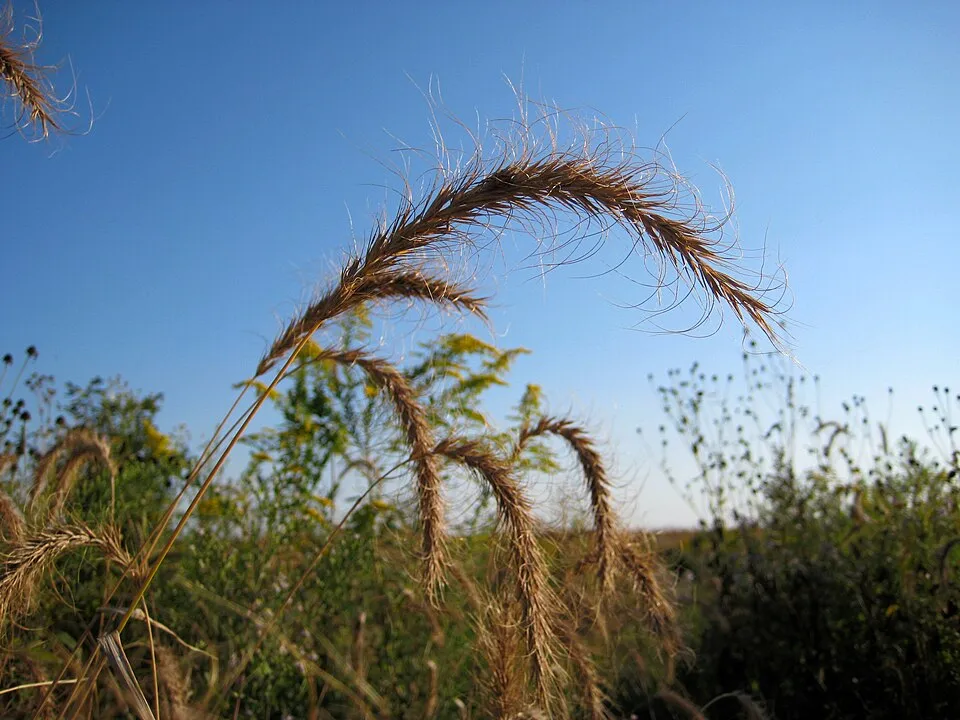
Nodding, bristly, greenish spike 4–10 in long, with long curved awns
Sun
Full sun; tolerates light shade
Soil
Adaptable; prefers sandy to loamy, well-drained; tolerates clay
Water
Medium; drought-tolerant once established
Wildlife
Seed for songbirds & small mammals · cover for wildlife
Special feature
Fastest native grass to establish from seed; pioneer/nurse crop
Canada Wild Rye (Elymus canadensis) with nodding bristly seed heads
Elymus canadensis in seed — distinctive nodding, bristly spikes with long curved awns. Photo: Rooted Revival.

Identification

Habit & Leaves

Clump-forming, cool-season bunchgrass 3–5 ft tall, with erect to arching stems. The leaves are flat, broad for a grass (up to 3⁄4 in wide), 6–12 in long, blue-green to gray-green, with rough margins. The leaf sheaths are open and often purplish at the base. The plant greens up early in spring (March), grows actively through the cool months, and sets seed by mid-summer.

Seed Heads

The inflorescence is the signature feature: a thick, nodding, bristly spike 4–10 in long, composed of paired spikelets at each node. Each spikelet is tipped with a long, stiff, curved awn up to 1.5 in long, giving the entire head a shaggy, bearded appearance. The spikes nod or droop gracefully from the arching stems. The awns catch light beautifully in late summer and persist into fall, gradually shattering to release seed.

Habitat & Range in NE Oklahoma

Elymus canadensis is widespread across NE Oklahoma in prairies, open woodlands, sandy river terraces, roadsides, and disturbed areas. It thrives in a wide range of soils, including sandy loams along the Arkansas River and heavier clay soils of the Cross Timbers. It is one of the most drought-tolerant cool-season grasses.

Ecology & Wildlife Value

Seed Forage

The large, protein-rich seeds are eagerly consumed by songbirds (sparrows, juncos, finches) and small mammals (mice, voles). The dense clumps provide cover for ground-nesting birds and small wildlife. Canada Wild Rye is also a larval host for several skipper butterflies (Hesperiidae) and various grass-feeding moths.

Restoration Ecology

The most important ecological role of Canada Wild Rye is as a pioneer and nurse crop in prairie restorations. It germinates and grows rapidly on bare soil, stabilizing the site against erosion, suppressing annual weeds, and creating a sheltered microclimate for slower-establishing warm-season grasses. As the warm-season grasses mature (3–5 years), Canada Wild Rye naturally declines, ceding dominance. This "live fast, die young" strategy makes it an essential tool for prairie reconstruction.

Horticulture & Care

Site selection

Canada Wild Rye needs full sun and well-drained soil. It accepts almost any soil type, from sand to clay, and is excellent for erosion control on slopes, in rain gardens, and in restoration plantings.

Planting & Maintenance

Companion planting

In prairie restorations, sow with Big Bluestem, Indiangrass, Little Bluestem, Sideoats Grama, Switchgrass, and flowering forbs like Purple Coneflower and Maximilian Sunflower.

Photo Reference

Canada Wild Rye nodding bristly seed head
// Seed head — nodding, bristly spike, 4–10 in, long curved awns
Wikimedia Commons
Wikimedia Commons
Canada Wild Rye clump in prairie
// Habit — clump-forming bunchgrass, 3–5 ft, nodding seed heads
Wikimedia Commons
Wikimedia Commons
Canada Wild Rye broad flat leaves
// Leaves — broad, flat, blue-green, rough margins
Wikimedia Commons
Wikimedia Commons

Sources & Further Reading