// SPECIES PROFILE · TREE · NATIVE (OZARK/OZARK-MARGIN) · NITROGEN-FIXER
Black Locust is the tree that built America's fence posts, ship hulls, and homesteads — a fast-growing, nitrogen-fixing legume with deeply furrowed bark, compound leaves, and drooping racemes of intensely fragrant, white pea-like flowers that perfume the late spring air in NE Oklahoma for about ten days each May. The flowers are edible (dipped in batter and fried as fritters, they taste faintly of sweet peas), and the bloom period coincides with a major nectar flow for honeybees, producing a light, mild honey prized by beekeepers throughout the Ozarks and Appalachians. The wood is legendary: exceptionally rot-resistant, stronger than white oak in bending and compression, and durable in ground contact for decades without treatment. Robinia pseudoacacia is native to the Ozark and Appalachian highlands, with a remnant native population in the Ozark foothills of far eastern Oklahoma; it has since been widely planted and naturalized across North America, Europe, and Asia.

[ field key — habit · leaf · flower · fruit · bark · thorns ]
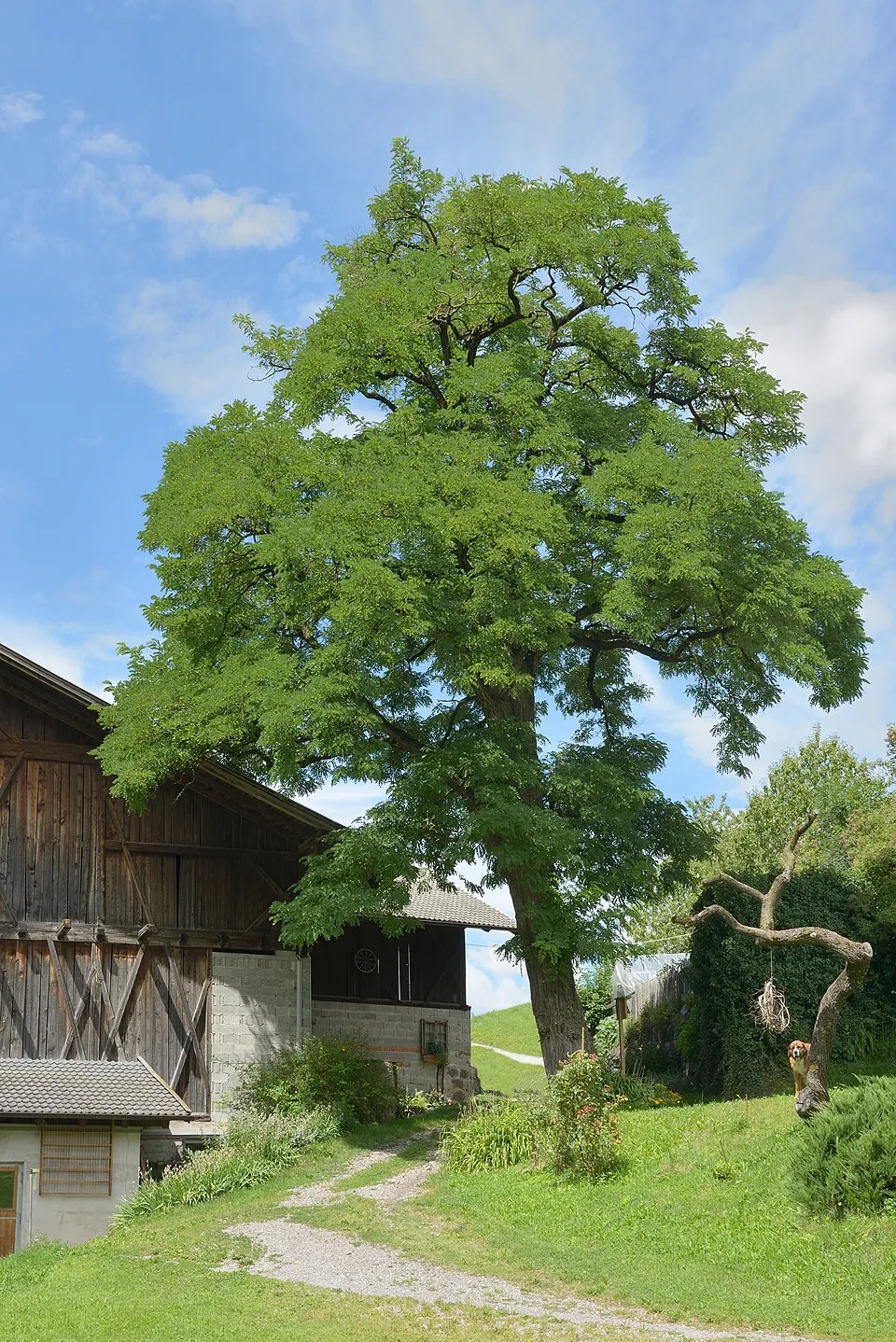
Fast-growing deciduous tree with an open, irregular crown of twisted, often leaning branches. Young trees are upright and narrow; mature trees develop a broad, rounded-to-flat-topped silhouette. The bark is thick, deeply furrowed, and dark gray-brown with a coarse, ropey texture that becomes more pronounced with age. The wood is bright yellow to olive-green just beneath the bark — a helpful field character. Black Locust is aggressively suckering from lateral roots, forming clonal groves of densely packed stems that exclude nearly all other vegetation. A mature ring of locust clones can cover half an acre, all genetically identical individuals connected by a shared root system.
A pair of stout, sharp stipular thorns (modified stipules) guards each leaf scar on young twigs and branches. These thorns are flattened at the base, sharp as needles, and 1–2 in long. On mature trunks the thorns are largely absent, but on young stems, suckers, and low branches they are abundant and formidable — enough to discourage browsing by deer and any gardener attempting to work beneath the tree without gloves. The thornless cultivar 'Inermis' (also sold as 'Frisia', the golden-foliage form, and 'Purple Robe', the pink-flowered form) is available and preferred for landscape plantings. Do not confuse Black Locust's paired stipular thorns with the large, branched thorns of honey locust (Gleditsia triacanthos), which arise from the trunk and branches themselves.
Alternate, pinnately compound, 8–14 in long with 7–19 oval to elliptical leaflets, each 1–2 in long with entire margins and a small bristle tip. Leaflets are medium green above, paler bluish-green beneath, and fold together (droop) at night and during drought stress. Leaves emerge late in spring (typically mid-to-late April in Tulsa, after the flowers have already opened or are starting) and turn a brief, unremarkable yellow-green in fall before dropping early — often by mid-October. The compound leaf structure and overall appearance can be confused with honey locust, but Black Locust leaflets are broader, duller green, and lack the honey locust's translucent yellow-green coloration.
Flowers are borne in drooping racemes 4–8 in long, each holding 20–40 fragrant white pea flowers about ¾–1 in long. The individual flowers have the classic legume structure: a broad upright banner, two lateral wings, and two fused keel petals, with a yellow blotch on the banner. The fragrance is intensely sweet and pervasive — reminiscent of orange blossoms or jasmine. Fruits are flat, narrow, dark brown pods 2–4 in long containing 4–8 hard, kidney-shaped, dark brown seeds. Pods persist on the tree through winter, rattling in the wind. Caution: the bark, leaves, and especially the seeds contain the toxic lectin robin and related compounds (robinin, phasin) and are poisonous to humans and livestock if ingested. The flowers are the exception — they are edible when cooked.
Robinia pseudoacacia has a fragmented native range centered on the Ozark and Ouachita highlands of Arkansas, Missouri, and far eastern Oklahoma, with a separate native population in the southern Appalachians from West Virginia to Georgia. The tree's status in NE Oklahoma is best described as near-native: a remnant native population persists in the Ozark foothills of Adair, Cherokee, and Delaware counties in far eastern Oklahoma, but the trees found throughout Tulsa, Rogers, Wagoner, and Osage counties are almost certainly naturalized escapes from historical plantings rather than strictly native occurrences. That distinction is worth noting for ecological purists, but in practical terms Black Locust has been a component of the Oklahoma landscape since at least the mid-19th century.
The tree is aggressively pioneering in habit: it colonizes roadside cuts, abandoned fields, fence rows, cleared woodlots, and any disturbed, open ground. In the Tulsa region, you'll see it most commonly along highways and rural roadsides, in the margins of old cemeteries and homesteads (where it was deliberately planted), and in the scrubby wooded edges of suburban greenbelts. It associates with a wide range of woody plants but frequently dominates the sites it colonizes due to nitrogen-fixing, prolific suckering, and rapid height growth. Because of its aggressive tendencies, it should be planted judiciously and managed actively in NE Oklahoma landscapes — it is not a "plant it and forget it" tree.
[ nitrogen fixation · pollinators · lepidoptera · wildlife · caution ]
Black Locust is a prolific nitrogen-fixer, forming root nodules with rhizobial bacteria and contributing substantial quantities of fixed nitrogen to the soil — considerably more per tree per year than most other temperate nitrogen-fixing trees. This nitrogen subsidy fertilizes the surrounding soil, which is why the ground beneath a mature locust grove is often dominated by nitrophilic (nitrogen-loving) understory plants like pokeweed, stinging nettle, and chickweed rather than the species typical of the surrounding forest. In a managed silvopasture or alley-cropping system, locust's nitrogen contribution can significantly reduce the need for supplemental fertilization of adjacent crops.
The fragrant flower racemes are a major nectar source for honeybees during the brief mid-spring bloom window. Black locust honey is light-colored, mild-flavored, and highly valued in the Ozarks and Appalachians. Beyond honeybees, the flowers are visited by bumblebees (Bombus spp.), large carpenter bees (Xylocopa virginica), solitary bees in several genera, and hummingbirds, which occasionally visit for nectar. The dense bloom display, though brief, represents a significant pulse of food for pollinator populations at a time (mid-spring) when many other nectar sources are between bloom cycles.
Black Locust serves as a larval host for the silver-spotted skipper (Epargyreus clarus), whose caterpillars tie leaflets together with silk. It also hosts the funereal duskywing (Erynnis funeralis) and is recorded as a host for several geometer and owlet moths. The tree's prolific foliage production supports a significant biomass of herbivorous insects, which in turn feed insectivorous birds.
White-tailed deer browse the foliage and twigs, though the thorns provide some protection on young trees. Squirrels (fox and gray) consume the seeds, as do northern bobwhite quail and wild turkey where they occur near locust stands. The trees provide cavity nesting sites for woodpeckers, screech owls, and wood ducks as they age and develop heart rot. The dense, sucker-formed thickets offer excellent winter cover for songbirds. However, the toxicity of bark, leaves, and seeds limits the overall wildlife value relative to oaks and other mast-producing hardwoods.
[ site selection · planting · management · cultivars · permaculture ]
Black Locust is a tough, fast tree that will grow on sites where little else will: compacted clay subsoil, strip-mined land, gravelly road cuts, and dry, infertile slopes. That said, it is not a tree for a small suburban lot — the aggressive root suckering, formidable thorns on young stems, and self-seeding habit mean it belongs in a managed woodlot, shelterbelt, silvopasture, or large permaculture planting where its spread can be controlled. Full sun is essential; the tree is shade-intolerant and will die out if overtopped by taller species.
Black Locust requires active management to prevent it from becoming a nuisance. Suckers must be regularly removed from areas where the tree is not wanted — mowing or cutting simply stimulates more suckering from the root system. Persistent cutting (every 2–4 weeks during the growing season for 2–3 years) will eventually exhaust the root reserves of unwanted stems. For hedgerow or coppice management, cut stems on a 5–7 year rotation for fence posts, fuel wood, or biomass. Coppiced stems regrow vigorously from the stump and produce straight, thorny poles ideal for rustic fencing.
| Cultivar | Features | Notes for NE Oklahoma |
|---|---|---|
| 'Frisia' | Golden-yellow foliage all season; less vigorous than species | Striking specimen tree; needs full sun for best color; fewer thorns. |
| 'Purple Robe' | Rose-pink to purple flowers; slightly smaller tree | Showy bloom color; popular landscape selection; still suckers. |
| 'Inermis' | Thornless form; otherwise identical to species | Preferred for gardens and areas with foot traffic; still suckers. |
| 'Umbraculifera' | Dense, rounded, lollipop-shaped crown; rarely flowers | Odd but useful for formal settings where bloom is not desired. |
| 'Appalachia' | Selected for straight trunk and timber quality | Silvopasture/fence-post production; slightly less suckering. |
Black Locust is a premier nitrogen-fixing overstory tree for temperate agroforestry systems. In a silvopasture, widely spaced trees (30–40 ft apart) provide dappled shade for livestock while fertilizing the pasture beneath. In an alley-cropping system, rows of locust coppiced on a short rotation provide nitrogen-rich mulch for vegetable alleys. The rot-resistant wood makes non-treated fence posts, raised bed timbers, and mushroom logs (shiitake performs well on locust). For honey production, a small grove of locust trees provides a reliable spring nectar flow. Companion plantings in a food forest understory might include American hazelnut, gooseberry, comfrey, and shade-tolerant herbs. Avoid interplanting with crops sensitive to nitrogen competition or allelopathy.
The fragrant white flowers are the edible exception to an otherwise toxic tree. Harvest racemes when fully open and fragrant (mid-to-late May in Tulsa), rinse gently, and use immediately. The classic preparation is locust flower fritters: dip whole racemes or individual flowers in a light batter (flour, egg, milk, a pinch of salt) and fry in hot oil or butter until golden and crisp. The cooked flowers have a mild, sweet, faintly pea-like flavor. They can also be stirred into pancake batter, added to salads (sparingly, raw), or infused into syrups and cordials. Collect only from trees that have not been sprayed with pesticides, and always cook the flowers thoroughly — raw flowers may cause mild digestive upset in some people.
Black Locust wood is one of the most rot-resistant timbers native to North America, surpassing even eastern redcedar and white oak in ground-contact durability. The heartwood's high concentration of flavonoids (primarily robinetin and dihydrorobinetin) makes it naturally resistant to fungal decay and insect attack. Historical and current uses include:
Black Locust was one of the first North American trees exported to Europe, arriving in France in 1601 and England by 1636. It was planted extensively across Europe as a timber tree, erosion-control species, and ornamental, and has naturalized widely. European beekeepers value locust honey (known in France as miel d'acacia) as a premium product. In North America, the tree's native range has been obscured by centuries of cultivation and naturalization; the question "is it native here?" often requires county-level floristic records to answer definitively.
Hero photo: Rooted Revival. Strip photos courtesy of Wikimedia Commons contributors under their respective licenses (linked under each image).